
Where AI in marketing delivers real results and where it only produces content to fix. A practical split of tasks between tools and specialists, no hype.

AI in marketing works on two fronts today: inside the ad platforms, which optimize campaigns automatically, and on the customer's side, where people ask ChatGPT and other assistants for recommendations before they buy. Below we explain what that actually means for a business, where it is worth increasing budget, and where you should fix measurement first. If you want to be visible in AI answers, see our AI SEO agency page.
Where AI in marketing delivers real results and where it only produces content to fix. A practical split of tasks between tools and specialists, no hype.
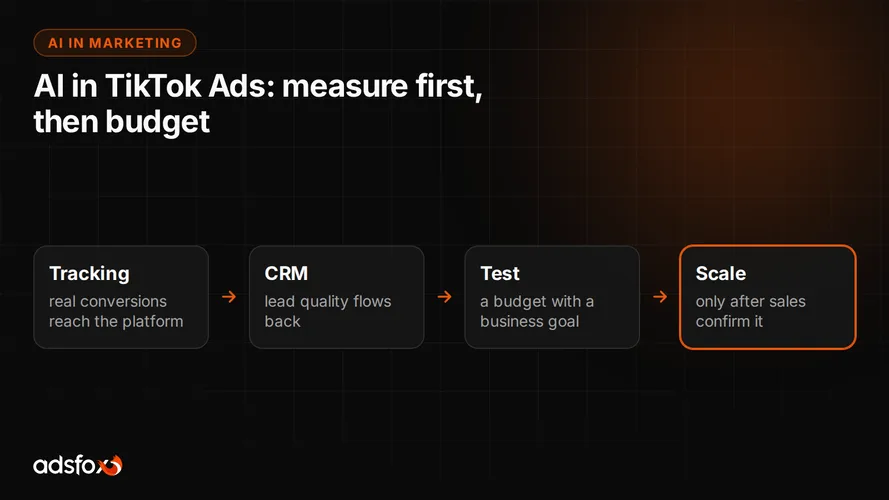
AI in marketing is not magic and not a replacement for strategy. It is a set of tools that do one thing very well: analyze huge amounts of data and make thousands of small decisions faster than a person could. The catch is that an algorithm optimizes exactly what you tell it to measure. Measure clicks and you get clicks. Measure sales and you get sales. So before you raise the budget on "smart" campaigns, understand what you are feeding the algorithms.
Google Ads, Meta, and TikTok have moved more and more decisions to their own models for years. Real-time bidding, audience selection, creative variant testing, conversion probability prediction: all of it happens automatically. For a business that means a simple change of role. You no longer set every bid by hand; you make sure the platform receives clean signals: correctly counted conversions, transaction values, and information about which customers are actually valuable. The order matters: measurement first, then budget. Automation built on bad data simply scales the losses. This is exactly the problem the adsfox platform solves by sending CRM lead quality back to the ad platforms, which we describe under lead generation optimization and CRM Conversions API.
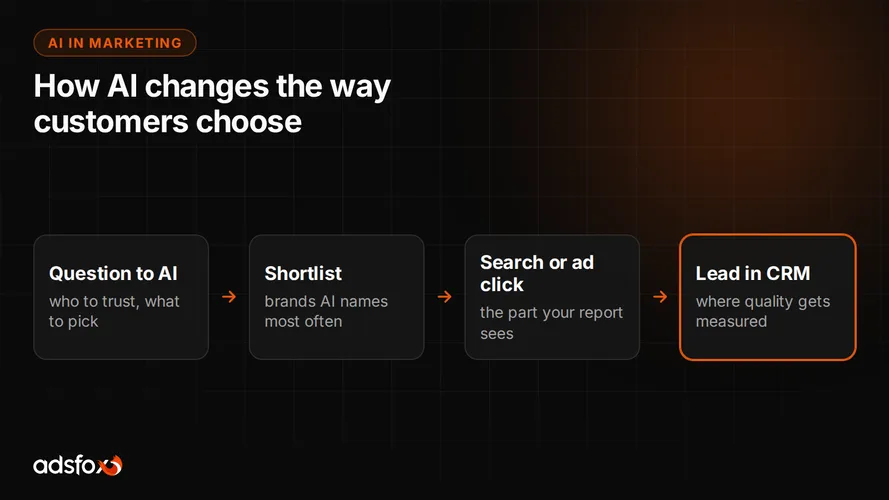
The second change is quieter but at least as important. Your customers increasingly do not start their research on Google; they ask an AI model: which marketing agency for a service business, who should run our TikTok campaigns, what to choose instead of a specific product. The model answers with concrete recommendations, often with company names. If your brand is not in those answers, you are out of the running before the prospect ever lands on your website. How that works and how to influence it is the subject of our generative engine optimization guides.
Optimizing for AI models has a name: GEO, generative engine optimization. It is the counterpart of SEO, except that instead of fighting for a position in Google's results you work to make the model cite and recommend your company. The mechanics (which sources models pick and why), the page structure that gets quoted, and the measurement (citations, AI referral traffic, branded search) are all covered in that section. If you take the channel seriously, our AI SEO agency service runs it for you alongside classic SEO.
Generative tools now write ad copy, produce image and video variants, and draft blog content. Used well, they multiply the number of creative variants you can test and cut the cost of producing pages built around specific search phrases. Used badly, they flood the web with generic text that neither Google nor AI models want to cite. Our rule: AI drafts, a human with domain knowledge edits, and every published piece contains something the model could not have invented (your data, your process, your price). That is how we produce content for clients, including the guides on this site.
In practice the two fronts reinforce each other. AI-driven ad campaigns generate fast, measurable traffic and sales. GEO builds presence where the customer forms a shortlist of vendors, often long before clicking an ad. A company that only advertises pays for every customer separately. A company that also works on visibility in AI answers starts showing up in recommendations for free. A good strategy does not pick one channel; it sets them up so that the ad closes what the model's recommendation started.
Do not start with a tool; start with a question: are you measuring what happens in your marketing correctly? Without reliable measurement neither campaign automation nor GEO has anything to work with. adsfox has worked in performance marketing since 2018, and we help companies put these pieces in an order that makes sense: measurement and data first, then automation, then scale. To go through it on the concrete example of your business, book a free consultation.
No, but it changes their role. AI is excellent at automating repetitive campaign decisions: bids, audience selection, creative tests. Someone still has to set up correct measurement, define business goals, and control what the algorithms are fed. Without that, automation scales losses instead of sales.
Because they get a finished answer instead of ten links to click through. More businesses and consumers start research with an AI model and ask for specific recommendations. If your brand is not in those answers, you lose the customer before they reach your site. Our generative engine optimization guides cover how to change that.
SEO competes for a position in Google's search results. GEO (generative engine optimization) works to get an AI model to cite and recommend your company in its answers. The goal is similar (visibility at the moment of decision), but the techniques and the measurement differ.
Ad platforms use AI for real-time bidding, audience selection, creative testing, and conversion prediction. Advertisers use it for copy and creative variants, and increasingly to feed better data back to the platforms (lead quality, revenue) so the algorithms optimize for customers rather than clicks.
As a draft, yes; as a finished product, no. Generic AI text is rarely cited by Google or AI models. Have a person with domain knowledge edit it and add what the model cannot know: your data, your process, your pricing. That is what gets quoted.