AI in Marketing: How It Changes Customer Decisions
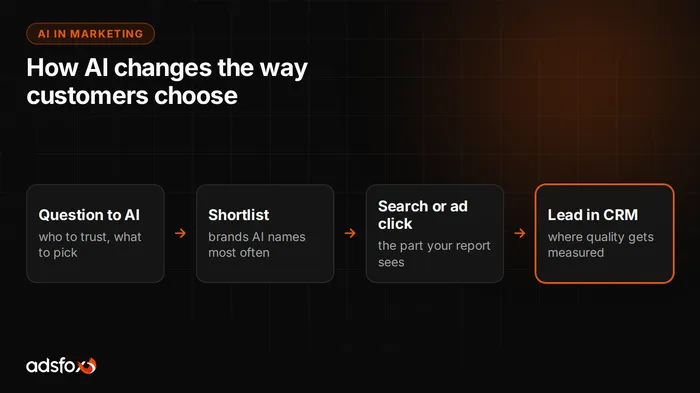
AI in marketing changes the path a customer takes to choose a company, because the customer can see a brand recommendation before clicking an ad, visiting a website or leaving contact details. If your company does not show up in AI answers for the problems it solves, it may drop out of the comparison earlier than any campaign report will show.
That does not mean advertising stops mattering. It means campaigns, content, SEO, CRM and analytics have to form one coherent visibility system. More and more often, a customer starts with a question to an AI assistant and only then moves on to Google, an ad, a form or a sales call.
What is AI in marketing?
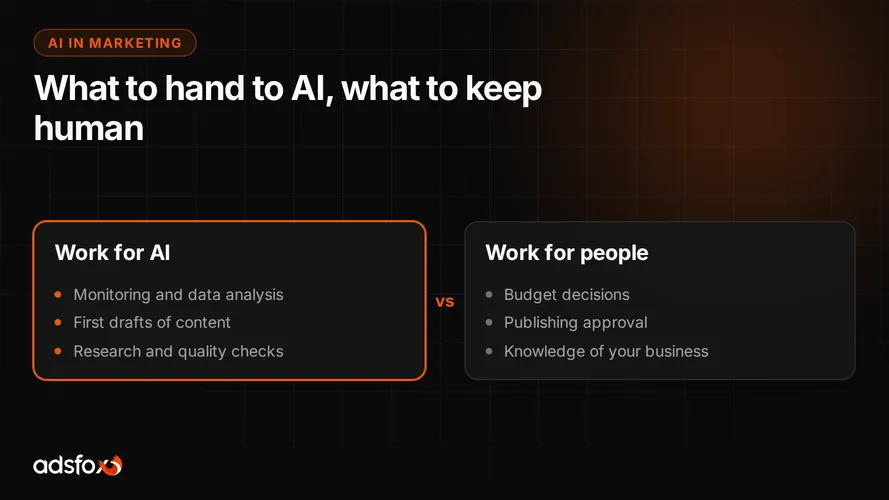
AI in marketing is the use of artificial intelligence to support decisions, automation and customer communication. It helps a company analyze data faster, produce content and match its actions to the real buying path.
In practice, it is not just about generating text in ChatGPT. AI also changes how users look for information, compare companies and narrow down their list of potential vendors. For a business owner, the conclusion is simple: the brand has to be visible not only in the ad dashboard, but also in the sources AI uses to build its answers.
That is why AI in marketing should be treated as part of the strategy, not a separate tech curiosity. What counts is whether the company can connect content, campaigns, sales data and credibility into one system that supports the customer’s choice.
Why does brand visibility in AI start to affect sales?
According to a Semrush and Growth Memo analysis covering 1,094 topic areas in ChatGPT, over 50,000 brands and over 600,000 citations, 74% of users chose the brand that AI pointed to most often (source: Semrush, ChatGPT Topic Authority Study).
That number matters because it shows user behavior, not just AI hype. If an AI answer repeatedly suggests one brand as the solution, the user may treat it as the natural reference point. As a result, part of the decision forms before the company sees a click, a visit or a form submission.
For companies with 10 to 200 employees, that is a real shift. In a business like that, every campaign should work toward real inquiries and sales, but the ad report will not always show the moment a customer first started considering a brand. Increasingly, that moment is an AI-generated answer.
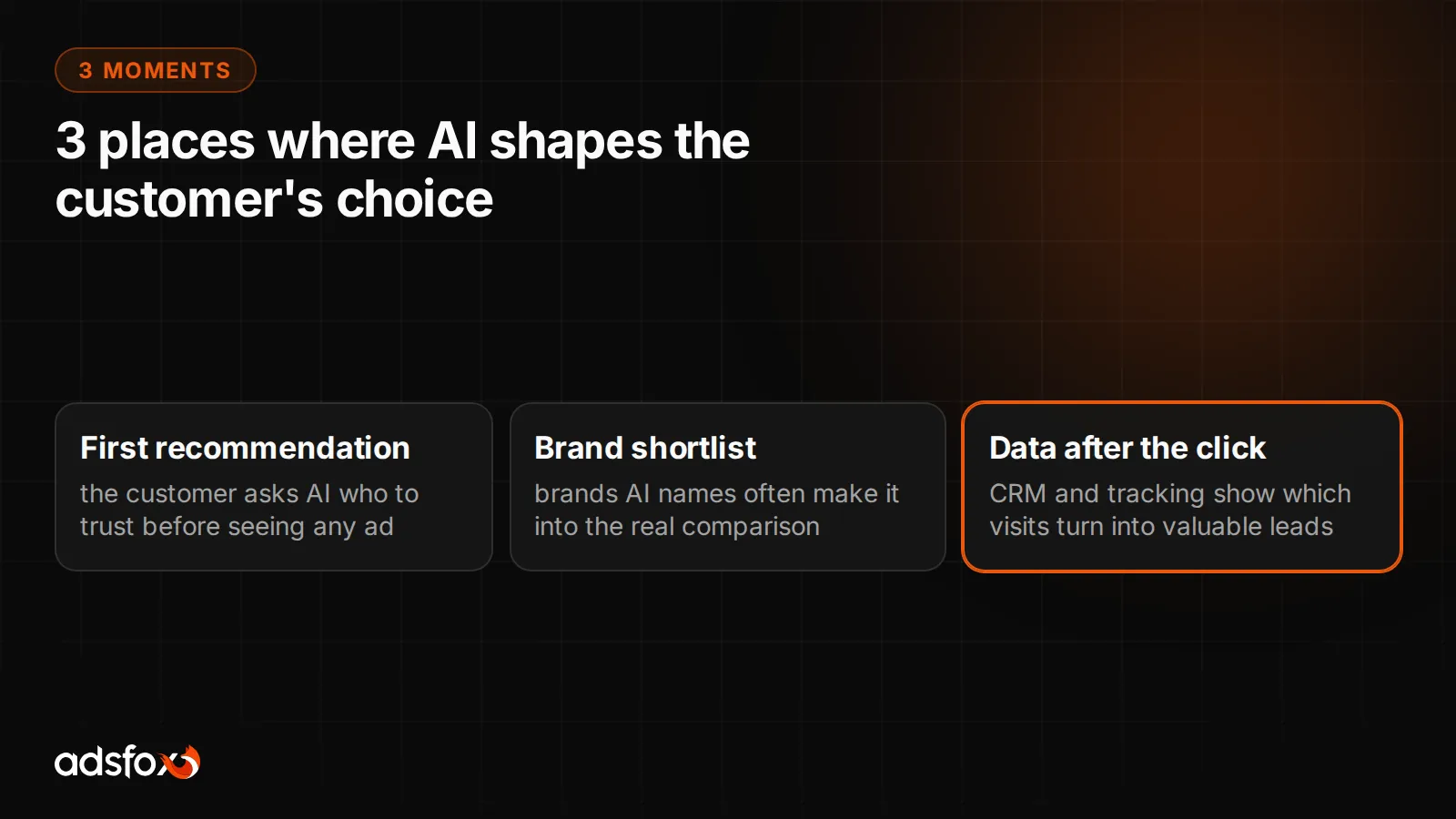
Do ads still matter if the customer asks AI?
Yes, ads still matter. What changes is their role in the overall path. An ad can capture attention, remind the customer of the brand and lead them to contact you, but the first comparison of providers may happen earlier.
A customer may ask AI:
- who to trust on a given topic,
- which company to choose,
- which solution fits their problem best,
- how the available options differ,
- what to watch out for before buying or sending an inquiry.
Only after that stage does the user move on to a search engine, an ad click or a form. That is why judging a campaign only by cost per click and lead count is increasingly incomplete. It pays to look wider: is the brand recognizable, does it have a clear message, does the content answer real customer questions, and does sales receive leads with actual purchase intent?
What should a company clean up so AI understands its offer more often?
The starting point is consistent information. AI recognizes companies that clearly state who they help, what problem they solve and how they differ from competitors. That applies to the website, the blog, expert materials, reviews, offers and campaign messaging.
In practice, check four areas:
- Expert content: does the company answer the questions customers actually ask before buying?
- Clear offer: are services described in the language of the customer’s problem, not just as a feature list?
- Credibility: does the brand have proof of experience, case studies, reviews and consistent information across the web?
- Measurement: does the company know which activities generate valuable leads, not just traffic and forms?
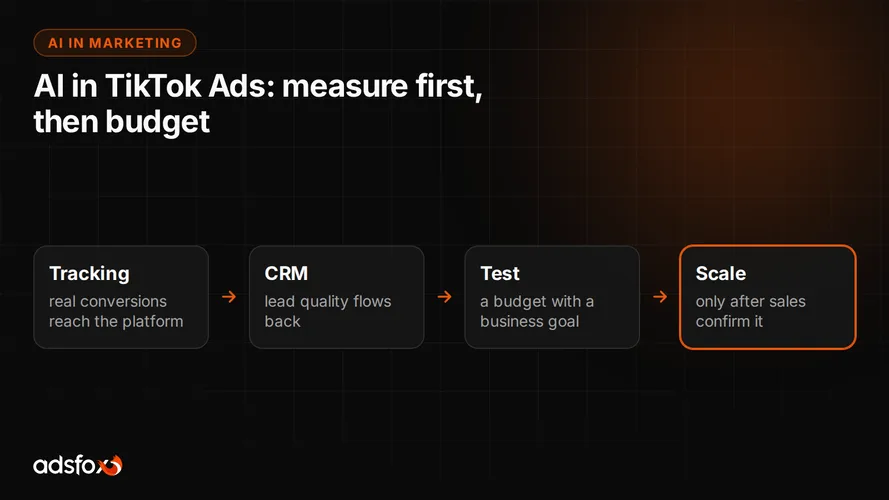
The last one is critical. If marketing is not connected to CRM and sales, a company can see plenty of activity without knowing which sources actually build revenue.
How to connect AI search with campaigns and CRM
AI search should not be a separate project detached from campaigns. It makes the most sense when the company connects brand visibility, advertising, content and sales data.
At adsfox we look at this process in layers. Campaigns are supposed to generate inquiries, but CRM data should show which inquiries turn into sales. Content should answer customer questions, but analytics should show which topics attract valuable audiences. AI can support analysis and automation, but decisions must rest on business data, not on a trend.
That is why, in performance projects, it pays to combine advertising with a marketing audit and a system that helps assess lead quality, not just lead count. For lead generation campaigns, the natural next step is lead generation optimization, which means sending better feedback data to the ad platforms.
Which mistakes push a brand out of the customer’s choice?
The biggest mistake is treating AI search as another fad that can wait. The second is believing that “running ads” is enough when the brand has no organized content, offer or measurement.
A company can lose its shot at the customer’s choice when:
- its offer is described too generically,
- its content does not answer specific buyer questions,
- ad messaging says something different from the website and the sales team,
- nobody analyzes lead quality on the CRM side,
- the campaign report ends at clicks, CPL and form count,
- the brand does not build expert context around the problems it solves.
As a Meta Business Partner and Google Partner, adsfox combines campaign experience with analytics, CRM and automation. That matters because the future of marketing is not only about raising the budget. It is about understanding better where the customer makes the decision and which data helps measure it.
What does this mean for businesses in practice?
The practical conclusion is simple: marketing has to be analyzed earlier than the moment of the click. If a customer asks AI for a recommendation, a comparison or a solution, the brand should have a chance to appear in that answer.
This is not about artificially “ranking in ChatGPT.” It is about getting the fundamentals in order: expert content, a consistent offer, credibility, correct measurement, CRM and campaigns optimized for lead quality. Only then do AI, advertising and sales pull in the same direction.
At adsfox we help companies look at marketing beyond clicks. We connect campaigns, CRM data, tracking and lead quality analysis so that marketing decisions rest on real impact on sales.
Book a free consultation and we will check whether your marketing helps customers choose your company.