How to Use AI in Marketing: What Actually Works
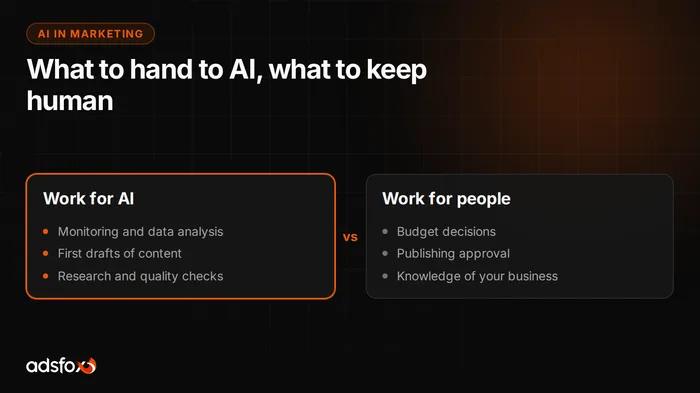
AI in marketing works best where the work is repetitive, and worst where it requires responsibility for money and the brand. That one sentence separates real use from hype. AI tools and agents are great at monitoring data, comparing, preparing drafts and checking visibility; decisions about budget, strategy and what goes live should stay with a person. This post shows the split we use every day, with both sides of the coin.
We write this as practitioners, not evangelists: we have used AI in day-to-day client work for a long time, and we see both the savings and the places where unsupervised automation does damage.
Where does AI deliver real results?
Data analysis and monitoring. Comparing periods, catching anomalies, pulling data from many sources into one picture. This is work people do slowly and reluctantly, and tools do quickly and daily. Our agents check campaign results and site visibility, and the specialist receives conclusions to act on, not raw tables.
First drafts of content. A blog post outline, ad headline variants, description proposals. AI shortens the road from a blank page to material you can work with. The key word is work. A draft is an input for editing, not an output for publishing.
Research and preparation. Collecting the questions customers ask in an industry, organizing topics, reviewing competitors. Hours of work turn into minutes of review.
Checking and quality control. A role reversal few people talk about: AI is good at catching errors, inconsistencies and gaps in finished materials. A second pair of eyes that never gets bored.
Where does AI fail or do harm?
Money decisions. Ad platform automation places ads within the limits a person sets, and that is the right boundary. Handing AI the decisions about budgets and strategy means optimizing on data whose quality nobody is watching; the system will amplify mistakes as eagerly as successes.
Publishing without oversight. Mass-generating content straight to the web produces generic text that does not help the reader, does not build the brand and can contain fabrications. That is not a theoretical risk: models invent numbers and facts convincingly, and the company is responsible for what it published. Our rule: nothing goes out without a human review.
Knowledge of your business. AI does not know your customers, your margins, your history or what your failures taught you. Content without that knowledge is correct and empty. The difference comes from a person who brings specifics; the tool only speeds up the form.
The division of labor we use ourselves
At adsfox we boiled it down to a simple rule: AI tools and agents do the repetitive work, the specialist makes the decisions. In practice, agents monitor campaign data, check visibility, prepare copy and reports for review; the specialist reads, corrects, approves and decides on direction. Nothing goes to publication or to ad accounts without a human sign-off.
The effect is measurable: the same team handles a wider scope without a drop in quality, because hours no longer go into copying data around. That is exactly what lets us run a company’s entire marketing in one place at a price that traditionally buys a single channel.
A separate chapter: AI as the place your customers search
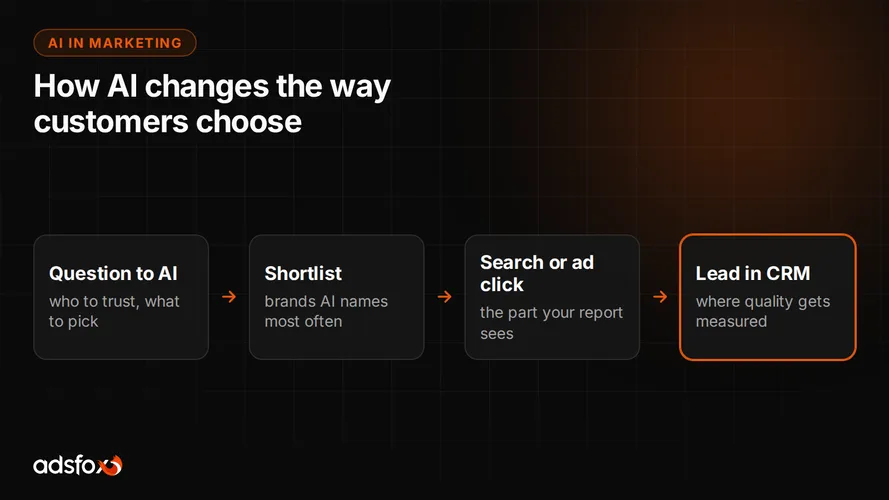
Using AI in marketing has a second side, more important than the tools: your customers increasingly ask AI models instead of scrolling search results. The answer contains a few names, and that is where the research ends. Being present in those answers is a new visibility discipline, one we build as part of SEO and AI search optimization, and we explain its mechanics in our posts on Google AI Overviews and on how AI models pick their sources.
The practical takeaway: before you invest in AI tools for content production, check whether AI knows about your company at all. That is a neglected foundation more often than a lack of automation.
Where to start in your own company
- Pick one narrow use case in an existing process: content drafts, research, data analysis. Do not rebuild everything at once.
- Put a person at the end. Every piece of material and every recommendation passes through someone who knows the subject and answers for the result.
- Measure the effect in time, not in trendiness. If a use case does not save hours or improve quality, drop it without sentiment.
- In parallel, take care of visibility in AI. That works regardless of whether you use the tools yourself.
If you want to see what this division of labor looks like in practice and what it would do in your company, book a free consultation. We will show you from the inside what our agents do and what a person always does, and we will count where your recoverable hours are.