
AI SEO agency and generative engine optimization agency that gets you cited in AI answers
Your customers increasingly ask ChatGPT, Perplexity, and Google AI Overviews instead of scanning search results.As an AI SEO agency, also called a generative engine optimization (GEO) agency, we make sure your business is the one named in those answers.We have run performance marketing since 2018 (Meta Business Partner, Google Partner) and apply this to our own site first.Book a free consultation.


Join 350+
happy clients.
AI SEO services: visibility in AI answers
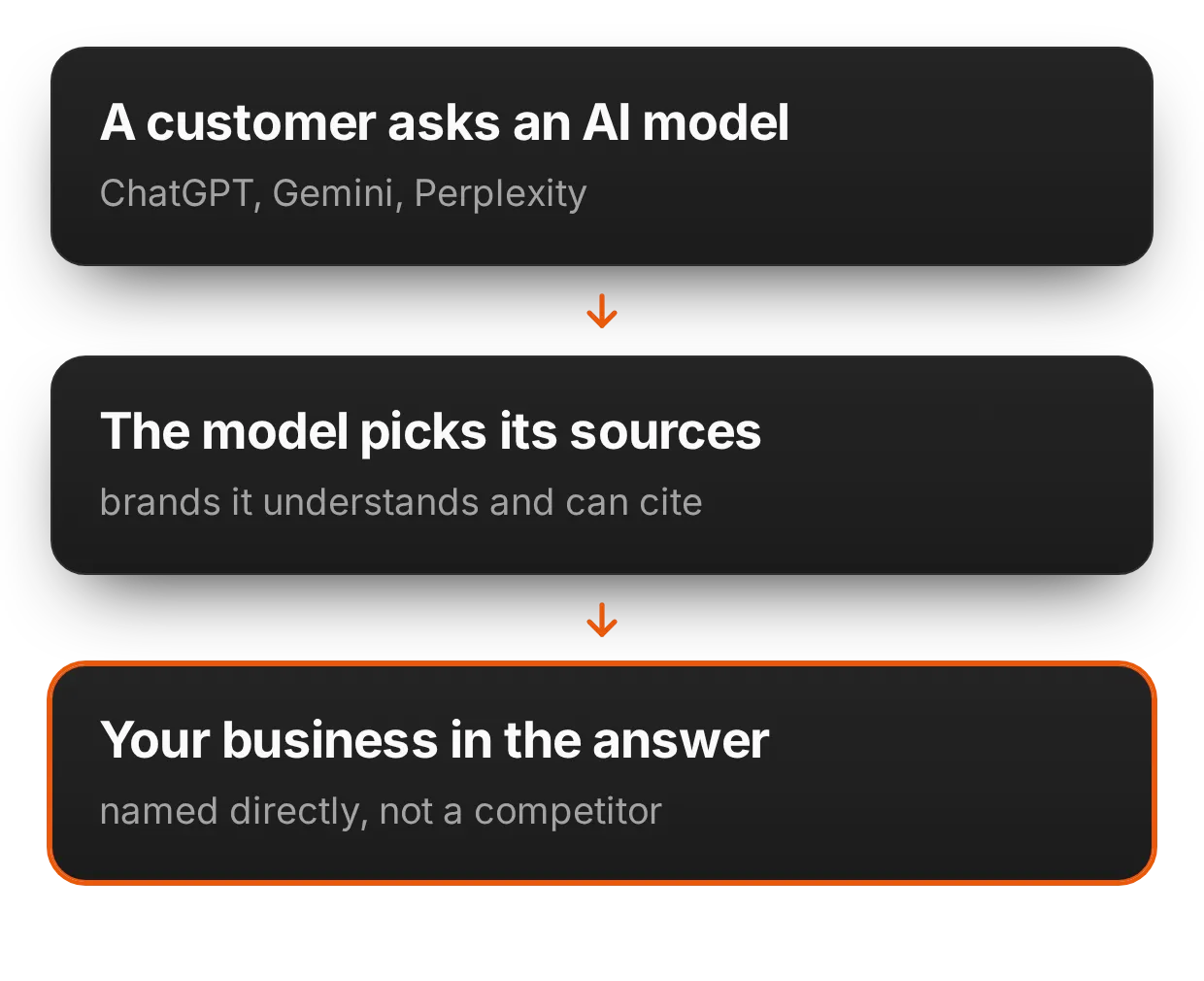
More and more buyers ask ChatGPT, Gemini, or Perplexity instead of typing phrases into Google.
Our AI SEO services make sure it is your company that gets cited in those answers, not a competitor.
Generative engine optimization is the work of making AI models know your brand, understand your offer, and present it as a recommendation.
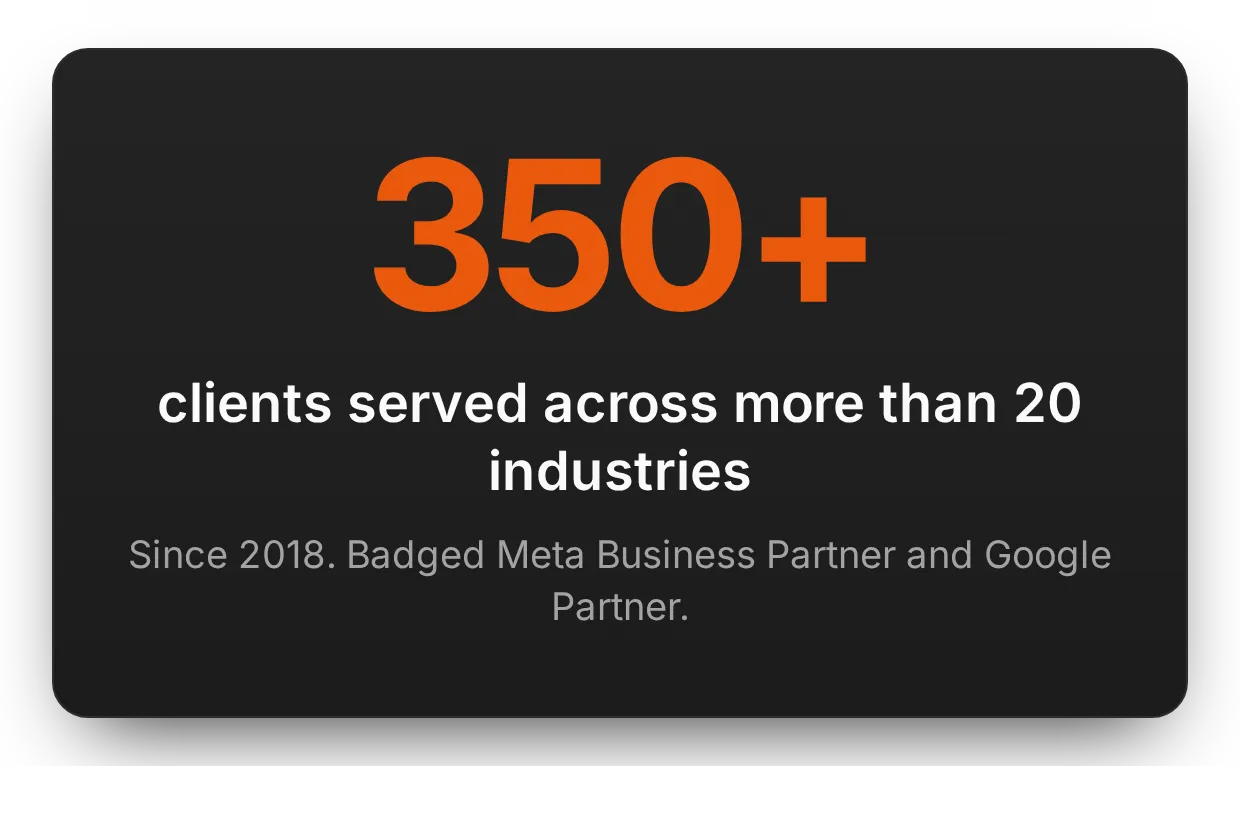
adsfox has run performance marketing since 2018, for more than 350 clients in over 20 industries, and now applies the same data-driven approach to visibility in AI tools.
What generative engine optimization (GEO) is
Generative engine optimization is the optimization of your content and business data for AI models that generate answers instead of lists of links.
Instead of fighting only for a position in the results, you make sure the model picks your brand when it composes an answer for the user.
In practice GEO combines content quality, structured data, domain authority, and how easily your sources can be quoted.
It is a young field, but a concrete one: not magic or a buzzword, but a set of actions you can measure and repeat across projects.
AI search optimization vs. traditional SEO
AI search optimization is not a choice between one or the other.
GEO extends SEO; it does not replace it.
Solid SEO foundations (a fast site, sensible structure, valuable content, links) are still required, because AI models learn from the same sources Google indexes.
The difference is the goal: classic SEO fights for the click, while AI SEO and GEO fight for the model to cite your company in a finished answer.
So we combine both.
Traditional SEO builds the base, and GEO adds visibility in generative results on top of it.
ChatGPT, Perplexity, and Google AI Overviews
AI search engines change how people look for things.
Google AI Overviews shows a finished summary above the classic results, while Perplexity and ChatGPT give an answer right away with citations to sources.
In this world what matters is whether your company makes it into that answer.
AI Overviews and similar features can take traffic away if your brand is not in the generated response.
We analyze which questions in your industry AI engines already answer today, whom they cite, and what it takes for your content to become the source material.
What an AI SEO agency actually does
The work is concrete.
First, content optimization: we write and restructure pages so AI models can easily extract facts and quotes from them.
Second, authority and citability: structured data, a clearly defined company entity, consistent information across the web, and an llms.txt file, so the model knows who you are and whom to trust.
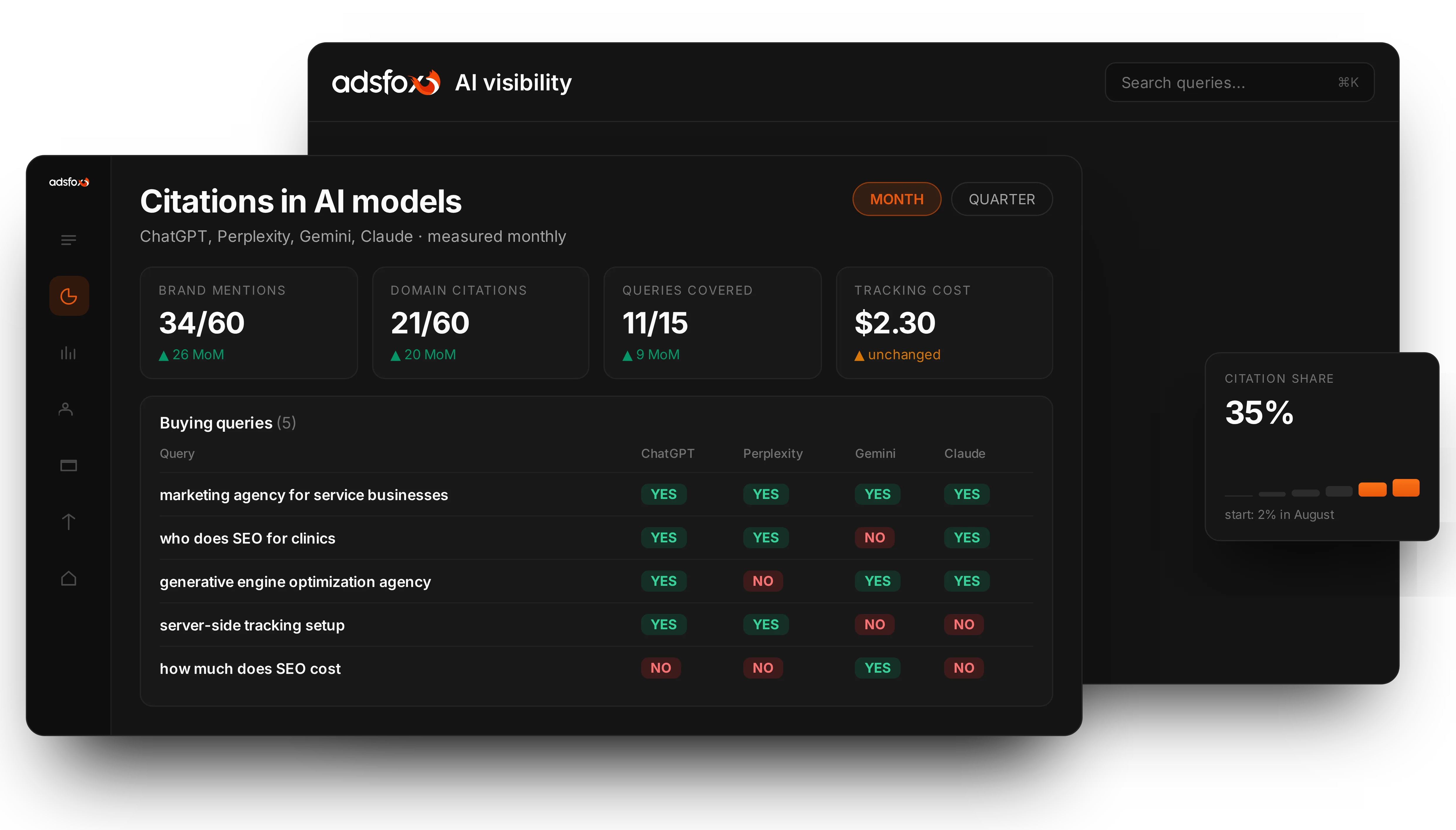
Third, citation monitoring: we check which AI answers mention your brand and how that changes over time.
We use the same GEO on our own site, so we are not selling theory, we are selling what we have tested.
GEO for e-commerce and product businesses
In e-commerce GEO has a very practical meaning.
Customers increasingly ask an AI model to recommend a product, compare options, or tell them what to buy.
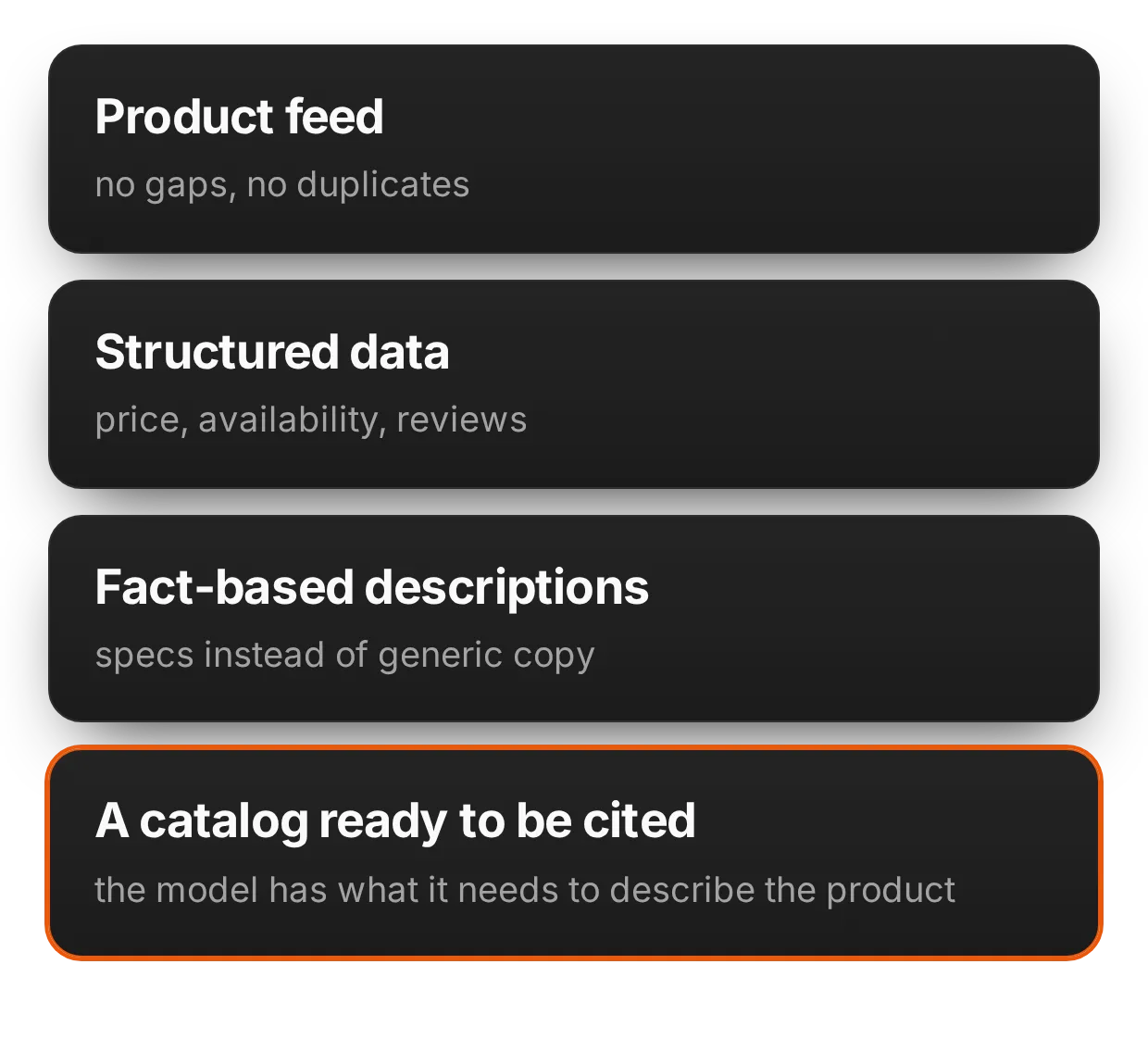
If you want your products to show up in those answers at all, you need clean structured data, fact-rich descriptions, and consistent information on price, availability, and reviews.
For stores we clean up the feed, product data, and category content so AI models can cite them safely.
A well-described catalog is an advantage today not only in Google, but in every AI assistant.
GEO strategies built on data
Our GEO strategies are not built on hunches.
The methodology is based on citability: we measure where and how often your brand appears in AI answers, test changes, and scale what works.
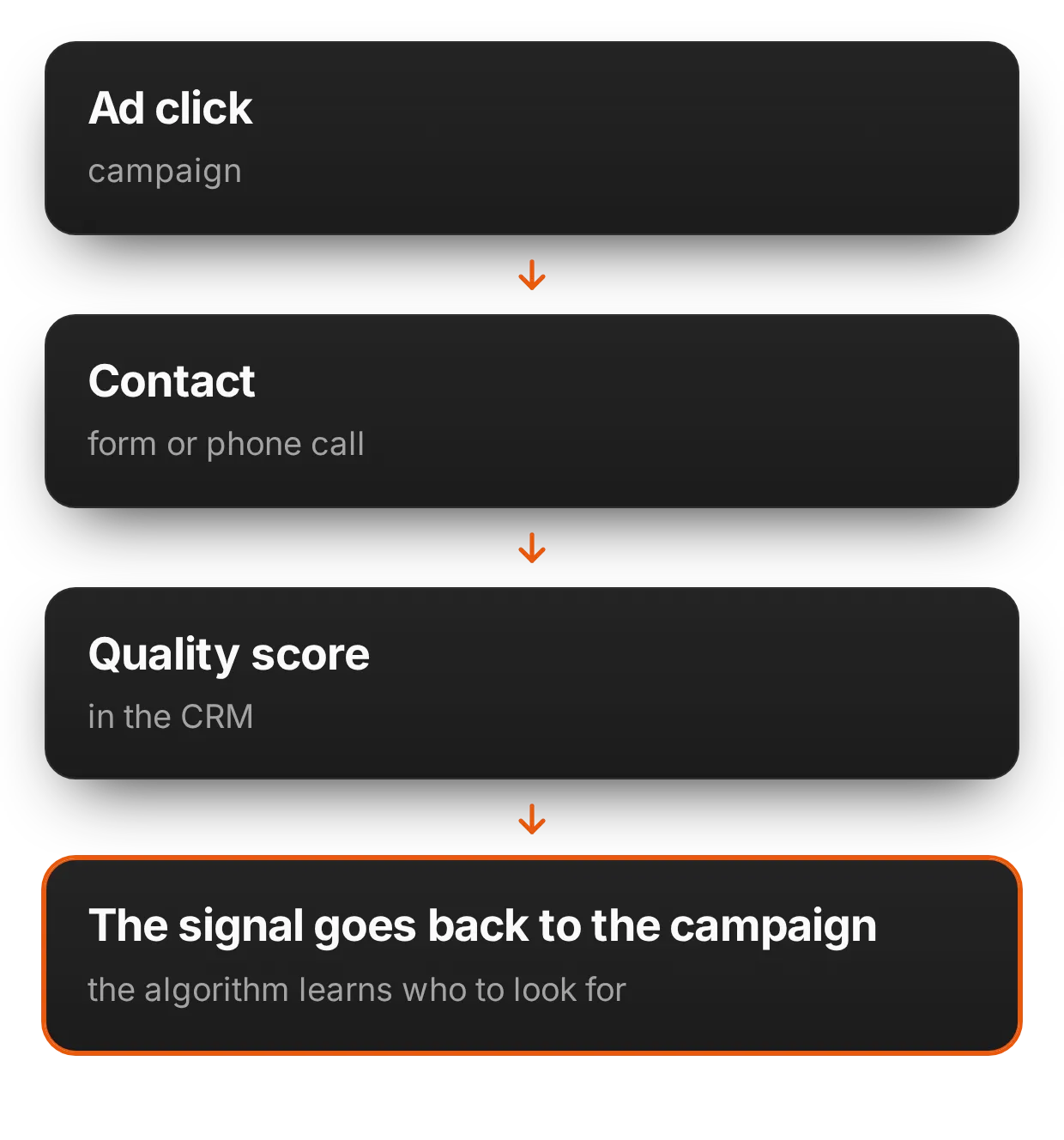
We use our own tools, server-side tracking, and CRM-to-ads integrations, and we build our own AI agents, so we take data seriously.
As a Meta Business Partner and Google Partner we fold GEO into one plan with performance marketing.
See how we work in our case studies, and let's talk about implementing GEO in your company.
Digital marketing services for small and mid-sized service businesses: web design, SEO and AI search, paid ads
Web design
Fast websites for service businesses and e-commerce, built for SEO and AI search and connected to a regular publishing plan.
SEO services
Technical upkeep, service pages for buying-intent keywords, and link building with the budget included. Inquiries, not just rankings.
AI SEO (GEO)
We get your brand cited in ChatGPT, Perplexity, and Google AI Overviews. We apply generative engine optimization to our own site first.
Paid ads (PPC)
Google Ads, Meta Ads, and TikTok Ads campaigns managed for leads and sales, not for clicks.
Social media marketing
Graphics, video, and publishing across every channel. Content is built on your brand, and every piece is approved by a specialist.
Analytics and tracking
Server-side tracking, the Conversions API, and CRM integration close the measurement loop, so decisions rest on data instead of guesses.
Why adsfox?
adsfox has run marketing for service businesses since 2018: more than 350 clients across 20+ industries.
We work with businesses in the US and Europe, fully remote.
We are a Meta Business Partner (Badged) and a Google Partner.
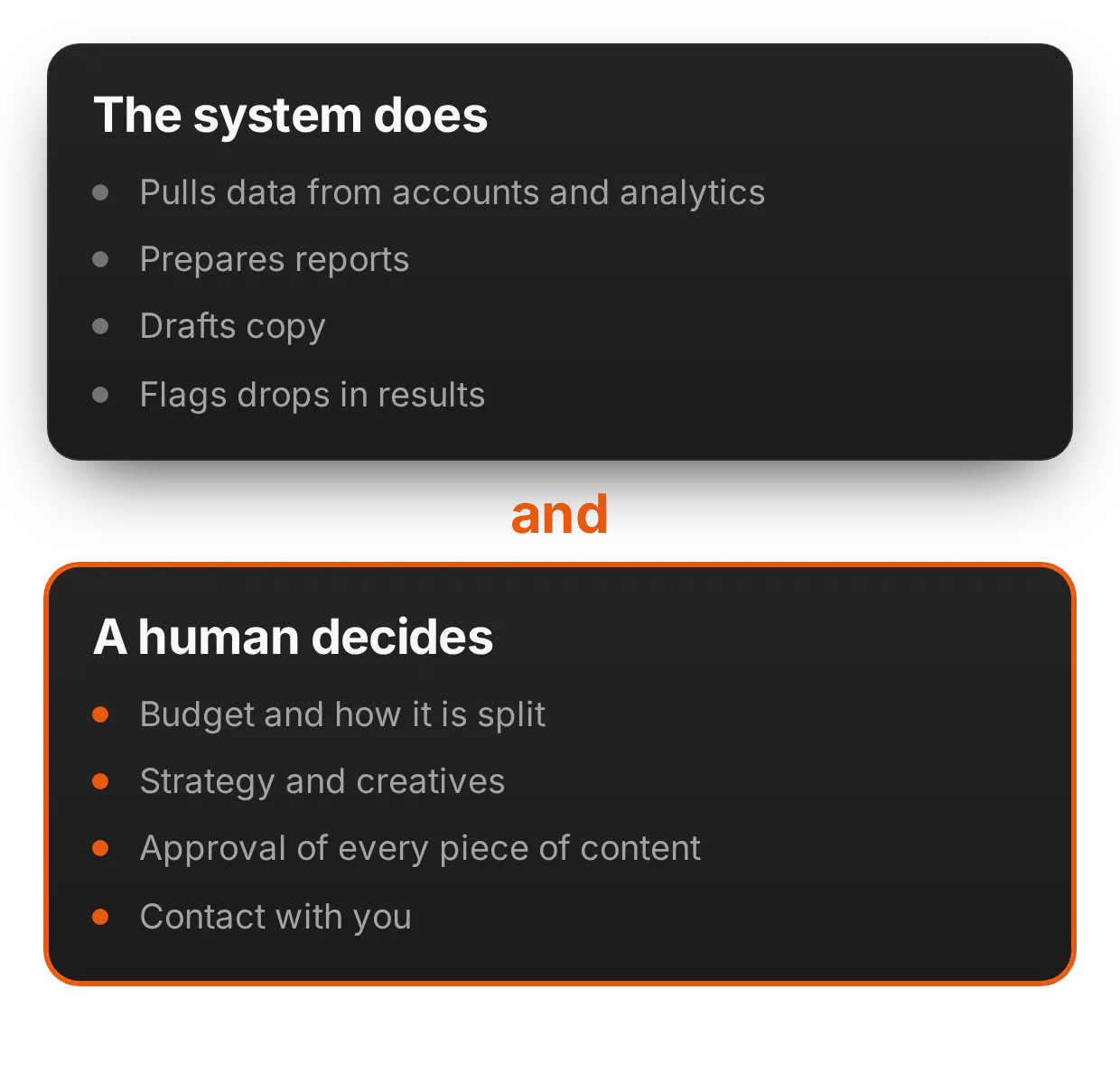
Over those years we built our own tools and AI agents that take over the repetitive work, so our specialists spend their time on analysis and decisions.
Websites, SEO and GEO, paid campaigns, and measurement come from one team, instead of four vendors you have to coordinate.

What our clients say
What I value most about working with you is having a dedicated specialist. The person matters, what they can do and how they communicate, and that is what I appreciate at adsfox. With other agencies and freelancers I could never get satisfying results. Now, after two years of working with you, it simply works.

Piotr
Owner, outdoor LED lighting manufacturer (luminous paving stones)
Given my own marketing background, I would definitely recommend working with adsfox. Highly recommended. These guys know what they are doing. I think adsfox is a great partner to work with.

Przemysław
Marketing director, event services company (crew and technical staffing)
What I value most about adsfox is that it is not a "pay and wait" arrangement. At any moment I can see where the money goes and what return it brings, and I have direct contact with specialists who advise me not only on ads but also on my offer and strategy. I delegate the complicated stuff and still keep full control over the outcome.

Dawid
Owner, e-commerce store (personalized wooden gifts)
Our revenue grew significantly and we won a lot of new clients, which is not easy in our business. That month was a record in terms of revenue, and a lot of women decided to book our services. Our schedule was packed, so we actually had to pause the ads for a while.

Justyna
Owner, women's body shaping and fitness studio
I am very happy with the cooperation. Many more customers started calling. We also see much higher traffic in our stats, both from Facebook and from Google, and it turns into phone calls and new bookings. I am very pleased with working with you.

Marcin
Owner, paintball park and outdoor events venue
With you I now pay almost 10 times less per conversion and get 200 new subscriptions a month, so for me this is a game changer.

Łukasz
Marketing manager, online courses and consulting (personal development)
AI SEO, LLM SEO, GEO: are they the same thing
Yes. They are three names for the same service. AI SEO and AI search optimization are the terms most of the market uses. LLM SEO stresses the large language models behind the answers. GEO (generative engine optimization) is the industry term, more precise but less recognized. All of them mean one thing: preparing your business so that AI models name it in their answers.
We say this plainly because the naming in this field is chaotic, and it is easy to get the impression you are buying three different things. If you are looking for a ChatGPT SEO agency, an AI SEO agency, or a GEO agency, you are looking for the same scope of work.
The difference from classic SEO is single but fundamental. SEO fights for a spot on the results list and for the click. AI SEO fights for the model to treat your content as a credible source and weave it into a finished answer. Classic SEO is measured in positions and traffic; AI SEO is measured in citation frequency and the context of mentions. There, click-through rate matters; here, the mention itself matters, even without a click.
AI SEO does not replace SEO
It is important not to fall into either-or thinking. AI models rely heavily on the same content that is well indexed in search engines, so solid SEO is a precondition for effective GEO, not its opposite. First you build visibility in classic results, then you add a layer of citability in AI answers on top.
That is why we treat this as one coherent service rather than two disconnected projects. If you already run SEO, AI SEO is the logical next step. If you are starting from zero, plan both layers in parallel. The foundation is described on our SEO agency page, and if your site needs rebuilding first, on our web design agency page.
Generative engine optimization services: what's included
- Baseline measurement: which questions in your industry AI engines answer today, which brands they cite, and where you stand before we touch anything.
- Query and question research: the buying questions your customers ask AI, mapped to the pages that should answer them.
- Content optimization for AI models: answers in the first sentence, headings phrased as real questions, definitions in a consistent pattern, sections that can be read on their own.
- Structured data and entity work: schema.org markup, a clearly defined organization entity, consistent business data across the web, llms.txt.
- Authority and citations: getting your brand described in the sources models trust, from industry directories to expert publications.
- Citation monitoring: a monthly check of how often, in what context, and next to which competitors your brand appears in ChatGPT, Perplexity, Gemini, and Google AI Overviews.
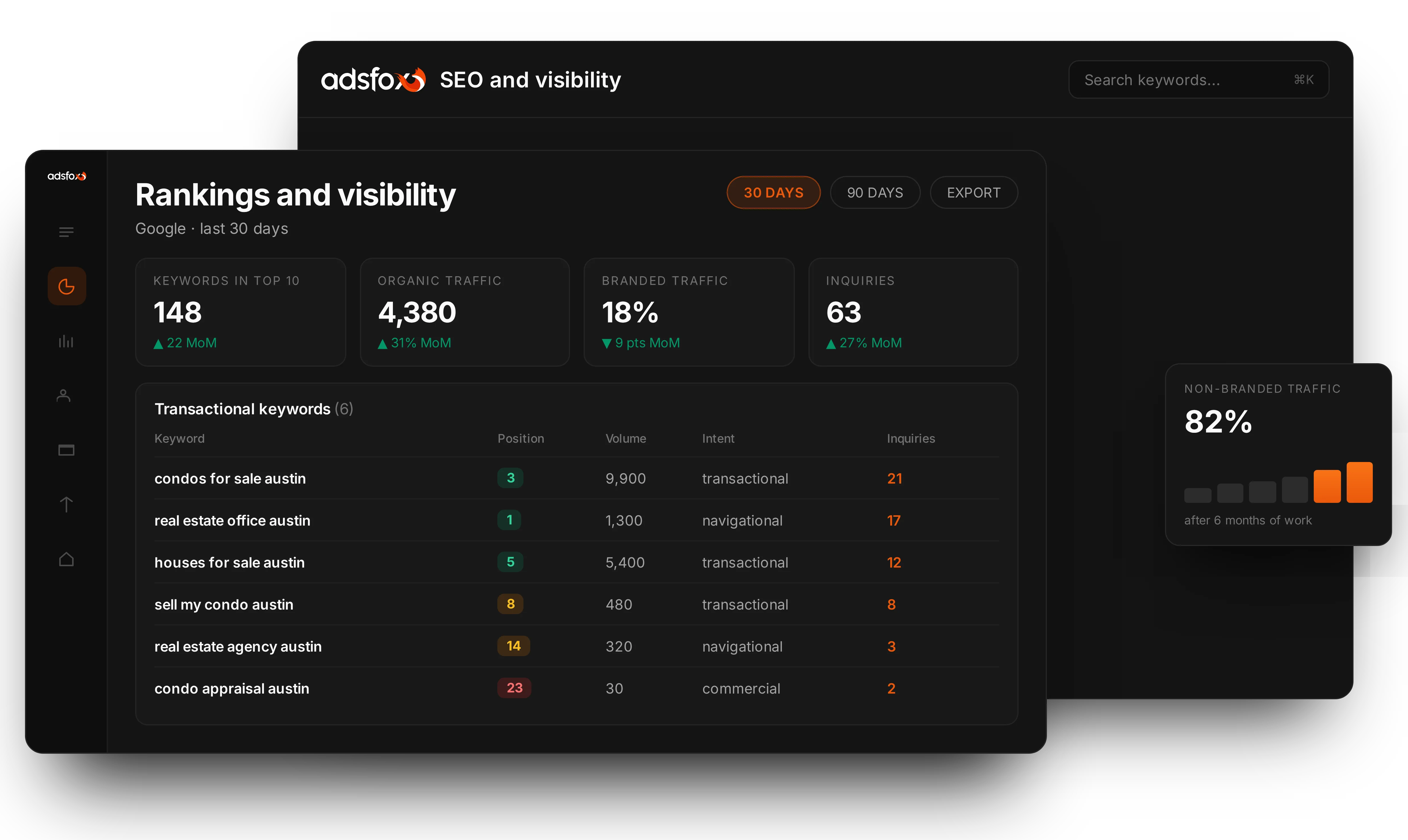
- Reporting tied to business outcomes: AI referral traffic and inquiries, measured through server-side tracking and your CRM.
Optimizing for ChatGPT, Perplexity, Gemini, and AI Overviews: how they differ
All of these tools generate answers, but they pick sources differently, and that changes the tactics.
- ChatGPT combines training knowledge with live search. Both matter: whether your brand is described in widely available sources, and whether your page can be processed quickly during a search.
- Perplexity relies almost entirely on content retrieved in real time and shows citations. Here the biggest factor is whether a paragraph answers the question directly in its first sentence.
- Google AI Overviews generates a summary above the classic results from several sources at once. Without decent Google rankings it is hard to get in, so this layer depends most on classic SEO.
- Gemini draws on the Google ecosystem, so it rewards consistent business data across the web, including your Google Business Profile and structured data.
The practical conclusion: you cannot optimize "for AI" in one move. Language models favor specific, well-organized content, but each weighs sources differently. So we start by measuring which tools in your industry answer buying questions at all, and whom they cite today.
Why a model picks one source and skips another
Language models favor content that is clear, specific, and well structured. If a paragraph answers the question directly in its first sentence, it has a much better chance of making it into an AI answer than a long text where the point is buried. AI Overviews and similar mechanisms also reward topically coherent sources, those that cover a subject thoroughly rather than superficially. Understanding this mechanism is the starting point for any serious LLM SEO work.
AI systems also increasingly draw on structured data and well-organized FAQ sections, because that makes it easier to match an answer to a question unambiguously. Google AI Overviews can lift such a section and present it as a finished snippet. That is why the technical layer of a site matters as much as the content in GEO.
Scope of AI SEO work: four areas
A good AI SEO agency combines content, technical, and analytical skills. The work covers four areas that have to function together for a brand to actually start appearing in AI-generated answers.
- Content optimization for AI models: we rewrite and expand content so it answers real user questions directly. Content has to be structured, have logical headings, and answer the question in the first sentences. This is the core of any content optimization in GEO.
- Structured data: we implement schema.org markup and entities, because structured data helps AI understand the context of your services and products. A well-described organization entity increases the chance the model correctly associates your brand with your industry and topic.
- Authority building (E-E-A-T): AI models favor sources with strong experience, expertise, authoritativeness, and trust signals. We work on authorship, citations, consistency of brand information, and credibility signals across the web.
- Citation monitoring and visibility score: we regularly check how often your brand appears in AI answers, in what context, and next to which competitors. This monitoring closes the loop and lets us improve the strategy based on data rather than hunches.
Each element strengthens the others. Content optimization without structured data gives a weaker effect, and authority building without monitoring is shooting blind. That is why a GEO agency should treat these tasks as one system, not a list of disconnected services.
How to measure GEO
In GEO we do not measure ranking positions, because there is no such ranking in AI answers. Instead we look at how often the brand is cited in answers generated by AI models and at the context of those mentions. The key questions: does the model name your brand, for which queries, does it present it positively, and does it appear alongside competitors or instead of them.
The most important GEO metrics:
- Citation frequency: how often the brand is referenced in AI answers to a set of key questions from your industry.
- Visibility score: an aggregate measure of brand visibility in AI-powered search, used to track the trend over time.
- Context of mentions: whether the brand appears as a recommendation, an example, or a data source, and with what sentiment.
- Share of AI answers: what percentage of relevant queries end with your site being cited, compared with competitors.
This approach makes GEO accountable in the same way as other performance work. You can see whether citations grow, whether the context improves, and whether the brand gains an edge over competitors in AI answers. That separates a mature GEO agency from companies selling GEO as an unmeasurable buzzword.
The AI search market and where it is heading
The GEO market is at an early, fast-moving stage. Forecasts put the global generative engine optimization market at around $33 billion by 2034, which shows how large this area could grow within a decade. These are projections, not certainties, but the direction is unambiguous.
The main trend is that in 2026 GEO is becoming a standard complement to classic SEO. Companies that build citability in AI answers early gain an advantage that is hard to catch up with later, because language models reinforce credible sources. Presence in AI answers sends users who are late in their decision process, and as AI Overviews and AI assistants grow, this channel will only gain weight.
AI SEO pricing
Our AI SEO services start at $750 per month as an add-on layer for a site that already has solid SEO, or as part of a combined SEO and GEO retainer. The upper end depends on how competitive your industry is, how many phrases and questions you care about, and the state of your site at the start. Companies with a broad offer and strong competition should plan budgets well above the entry point. We also recommend a one-time baseline measurement of your visibility in AI models before the work starts, so that after a quarter there is something to compare the result against. A specific quote comes after a call, because a price without knowing your business and goals would be a guess.
Case studies
Our published case studies come from performance campaigns for European clients, and they show the measurement discipline we bring to GEO: every inquiry tracked, cost per lead reported, and results compared period over period. For example, for a law firm we reached about 99 qualified inquiries a month at roughly $11 each, and for an optical store we cut cost per conversion by 44.3% on the same budget. GEO results (citation frequency, visibility score, AI referral traffic) we show one on one, starting with our own site, where we monitor citations across four models every month.
Best AI SEO agency: how to choose one and what to watch out for
Because the GEO market is still forming, plenty of companies sell slogans without substance. When choosing an AI SEO agency, check a few things that separate real competence from a marketing shell.
- Does the agency measure results? If it cannot show how it tracks citations and visibility score, it is not doing GEO, it is talking about it.
- Does it combine GEO with SEO? A solid agency understands that generative engine optimization stands on the foundation of traditional SEO and does not sell one without the other.
- Does it handle structured data? Without the technical layer of entities and schema, AI models understand the context of your site less well.
- Does it use GEO on its own site? The best proof of competence is the agency's own visibility in AI answers, not declarations.
- Does it show real results? Specific implementations and outcomes say more than a list of buzzwords.
- Is the reporting tied to business outcomes? Citations are the leading indicator; inquiries and revenue from AI referrals are what you are paying for.
Beware of promises of a guaranteed first place in AI answers, because no such place exists. Beware also of agencies that treat GEO as a magic trick instead of systematic work on content, authority, and data. Good content optimization for language models is a process, not a one-time stunt.
Why adsfox as your AI SEO agency
adsfox has done performance marketing since 2018. We are a Meta Business Partner and a Google Partner, and over that time we have worked with more than 350 clients in over 20 industries, in the US and Europe. That gives us a practical understanding of the customer's path from question to purchase decision, which is exactly what effective GEO is built on.
We build our own tools, implement server-side tracking and CRM-to-ads integrations, and create our own AI agents. So the technical layer of GEO, from structured data to citation measurement, is handled in-house, not outsourced. That is a real advantage, because generative engine optimization is as much engineering work as content work.
Most importantly, we use GEO on our own site. We have a described organization entity in structured data, an implemented llms.txt file, and citable content and FAQ sections prepared for AI models. This is not theory from a slide deck, but solutions we test on ourselves before implementing them for a client. If you want to see how we turn this into results across industries, look at our case studies. We treat AI SEO as one coherent service, in which traditional SEO builds the foundation and GEO gives your brand visibility in AI-generated answers. To feed both, we can add content marketing services written for search and for AI. If you want your site cited when your customers ask AI, book a free consultation and let's talk about a GEO strategy for your industry.
Frequently asked questions about AI SEO and generative engine optimization
Yes. AI SEO, AI search optimization, LLM SEO, and GEO (generative engine optimization) are different names for the same service: preparing your business so that AI models name it in their answers. AI SEO is the term most of the market uses; GEO is the industry name, more precise but less recognized. If you are looking for an AI SEO agency or a GEO agency, you are looking for the same scope of work.
Start by checking what your customers ask the models and whom they cite today. Then restructure content so it answers those questions directly in the first sentence of a paragraph, because models pick fragments they can quote without editing. Add structured data, a described organization entity, and consistent brand information across the web. Perplexity relies mostly on content retrieved live, ChatGPT combines it with training knowledge, and Google AI Overviews depends heavily on your positions in classic results. We break the process down step by step in our guides on generative engine optimization.
An AI SEO agency analyzes what users ask AI models in your industry and prepares content and site structure so it can be easily cited. On top of that comes the technical layer: structured data, an llms.txt file, cleaning up business information, and building brand authority. The agency also monitors AI answers, measures visibility, and adjusts the work as the models change.
Generative engine optimization (GEO) is the optimization of content and brand presence for AI models such as ChatGPT and Perplexity. The goal is for your company to appear in AI answers when a user asks about products, services, or recommendations in your industry. In practice GEO combines work on content quality, structured data, and source credibility, so that AI models are more likely to cite you.
SEO optimizes a site for classic search engines and the list of blue links; GEO optimizes for generative AI models that return a finished answer instead of a list of results. In SEO you fight for a ranking position; in GEO you fight for your brand to be named and cited in AI answers. The techniques partly overlap (content quality, authority, structured data), but the goal and the way results are measured differ.
No. GEO extends and complements SEO. Classic SEO still drives traffic from search engines, and GEO adds visibility in AI answers, where more and more people look for information. The best results come from running both together, which is why we treat GEO and SEO services as one coherent system rather than competing services.
Our AI SEO services start at $750 per month as a layer on top of existing SEO, or as part of a combined SEO and GEO retainer. The budget looks different when content and structure have to be built from scratch versus when you already have strong SEO and only need to optimize for AI models. Book a consultation and we will assess your situation and propose a scope that fits your goals and budget.
The first citations in AI answers can appear within a few weeks, but a real, stable GEO effect usually builds over several months. AI models update their knowledge at different rates, so there are no guaranteed citations or fixed deadlines. GEO is continuous work, like SEO, not a one-time action that delivers overnight.
Primarily by the number of citations and brand mentions in AI answers and by the visibility score, meaning the share of answers to key questions that include you. The context of mentions matters too, because it is not only whether AI models mention you but how and for which queries. On top of that we add classic metrics such as AI referral traffic and inquiries, which we also show in our case studies.
Check whether the agency really understands how AI models work and can show how it measures results, rather than just promising citations. Beware of promises of guaranteed places in AI answers, because nobody fully controls what a model generates. A good agency is upfront about limitations, combines GEO with SEO, and shows specific case studies and experience.
Yes. GEO works well in e-commerce, because customers increasingly ask AI models for product recommendations, comparisons, and reviews. With clean descriptions, structured data, and expert content, your store can appear in AI answers exactly when someone is looking for what you sell. In e-commerce GEO pairs well with product SEO, because both layers strengthen the same content.
GEO covers the most important generative AI models and answer engines, including ChatGPT, Perplexity, Google AI Overviews, and Gemini. Each of these systems selects and cites sources a little differently, so a GEO strategy accounts for their differences instead of optimizing for one model. The set of models changes quickly, so we keep tracking new answer sources and add them to the work.
Yes. The market is at an early stage and the share of search happening through AI models is growing fast. Brands that build visibility in AI answers early gain an advantage that is hard to catch up with later. This is a good moment to combine GEO with solid SEO and build your position before all of your competitors do.
adsfox has operated since 2018, is a Meta Business Partner and Google Partner, and has worked with more than 350 clients, so our GEO is based on real performance marketing experience, not on trendy slogans. We use GEO on our own site (llms.txt, structured data) and develop our own tools, so as an AI SEO agency we know what actually works in AI answers. We show results in case studies and combine GEO with SEO. If you want to discuss your case, book a consultation.