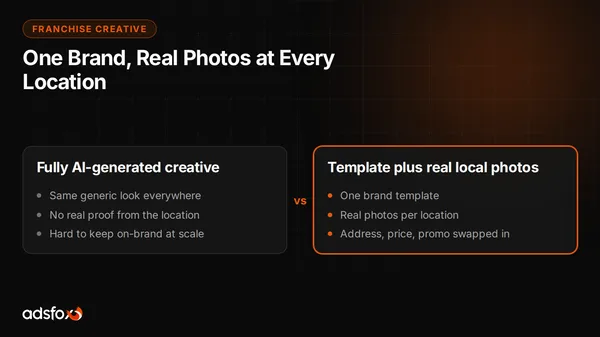
How franchise creative works at scale: one brand template, real photos swapped in per location, and how corporate keeps brand consistency across hundreds of versions.

This is the adsfox digital marketing blog, written by the people who build websites, run SEO and AI search campaigns, manage Google Ads and Meta Ads, and maintain the adsfox tracking platform every day. You will find step-by-step documentation for the adsfox platform, case studies with real campaign numbers, and guides on SEO, generative engine optimization, paid ads, web design and conversion tracking. Browse the latest posts below, or scroll down to see how the blog is organized.
How franchise creative works at scale: one brand template, real photos swapped in per location, and how corporate keeps brand consistency across hundreds of versions.


adsfox is a digital marketing agency for service businesses and online stores. We build websites, run SEO and AI search campaigns, manage Google Ads and Meta Ads, and we also build our own software for tracking leads and sales. This blog is where we write down what we learn doing that work. No "marketing revolution" pieces, just practical answers: how to set up a campaign, how to track conversions correctly, how to get a site ranked in Google and cited in AI answers, how to connect the adsfox platform to your website and CRM, and what real campaigns looked like for clients in more than 20 industries.
We write for business owners, marketing managers and anyone responsible for leads and revenue. Whether you are launching your first ad campaign or trying to get more out of a budget you already spend, the goal is the same: information you can apply the same day, from an agency that has been a Google Partner since 2018 and a Meta Business Partner, working with clients in the US and Europe.
Posts are grouped into categories. Two of them are fully stocked today: the adsfox platform documentation and the case studies. The rest are topic hubs we are filling in with new guides written for the US market, so check back or subscribe to the RSS feed if a category you need is still short.
The largest section of the blog is the implementation documentation for the adsfox platform: 46 step-by-step guides that cover every part of the setup. They show how to connect adsfox to your website (WordPress, Webflow, Wix, Squarespace), to funnel and landing page builders (ClickFunnels, Instapage, Unbounce, Leadpages, Kartra, systeme.io, GoHighLevel), to forms like Typeform, and to your ad accounts on Meta, Google Ads, LinkedIn and TikTok. There are guides for CRM integrations (Pipedrive, Zoho, webhooks and Make), for Google Analytics 4, for lead tagging, for sending CRM lead values back to Meta and Google Ads, and for the adsfox CRM module itself: workspaces, contacts, tables, A/B tests, team permissions, campaign imports and data migration. A troubleshooting section covers the most common issues, such as a missing Instagram business account.
If you are rolling out adsfox in your company, these guides take you through each stage of the configuration without guesswork. If you are evaluating the tool, start with the lead generation optimization overview and the server-side tracking page.
The best way to judge an agency is to look at finished work. Our marketing case studies cover 32 real campaigns on Google Ads, Facebook and Instagram Ads, and TikTok Ads for businesses such as law firms, dental practices, aesthetic medicine clinics, beauty salons, opticians, hotels, an amusement park, fitness clubs, language schools, online courses, real estate agencies, clothing stores, jewelry brands and other e-commerce shops. Each case study explains the goal, the campaign structure, what we optimized and what the numbers looked like at the end: cost per lead, return on ad spend, number of qualified inquiries. The campaigns were run for clients in Europe, so treat the results as a benchmark for what a well-built campaign can do, not as a promise for your market.
The SEO hub is for search engine optimization guides: technical SEO, site architecture, local SEO, link building and content that ranks. The generative engine optimization hub covers the newer side of search: how ChatGPT, Perplexity, Gemini and Google AI Overviews pick their sources, how to make a website quotable, and how GEO fits with classic SEO. If you would rather have it done for you, see our SEO agency and AI SEO agency pages.
Separate hubs cover each paid channel we manage: Google Ads, Facebook Ads (which includes Instagram), TikTok Ads, LinkedIn Ads, Microsoft Ads, Pinterest Ads, Snapchat Ads and the new ChatGPT Ads. The focus is always the same: campaign structure, targeting, creatives that convert, and optimizing for lead quality and sales rather than clicks. For managed campaigns, see the Google Ads agency and Facebook Ads agency pages.
A campaign is only as good as the page it sends people to. The web design hub is where we write about planning a small business website that ranks and converts: page speed, layouts built for lead forms and calls, choosing between a template and a custom build, and what a business website should cost. Our web design agency page describes how we build sites for clients.
Good marketing starts with good measurement. Without reliable data, the algorithms in Google Ads and Meta Ads optimize blind. The Google Analytics hub is for GA4 guides: clean setup, events and conversions, linking GA4 with Google Ads and Search Console, and filtering out internal traffic so the reports are trustworthy. Server-side tracking and the Meta Conversions API get their own coverage across the platform documentation and the server-side tracking page.
The marketing tips hub gathers shorter practical pieces: how to get more leads from the budget you already have, how to write ads that sell, how to handle online reviews, and how to choose a marketing agency. AI in marketing looks at what artificial intelligence actually changes for a business, inside the ad platforms and on the customer's side. Performance marketing news tracks platform updates and tracking changes that are worth reacting to, and separates them from the noise.
Most of what we publish comes back to one idea: every dollar of ad spend should be tied to a measurable outcome, a lead, a booked call, a sale. That sounds simple, but in practice measurement is the bottleneck. Privacy changes, cookie restrictions and ad blockers mean browser-based tracking loses a growing share of conversions, and campaigns optimized on incomplete data drift toward cheap, low-quality leads.
This is why the adsfox platform exists. It connects your ad accounts, tracks conversions server-side, and sends lead quality data from your CRM back to Meta and Google Ads, so the platforms learn which leads turned into customers and what they were worth. That loop, from click to lead to closed sale, is what decides whether advertising pays off. The blog shows how to close it step by step, and the case studies show what happens when it works.
If you run a service business or an online store and want a predictable flow of customers from search and paid ads, the case studies and channel guides show what actually works in businesses like yours. If you do marketing for a living, the documentation and tracking guides give you procedures that save hours of trial and error. And if you already use adsfox, this is where the full documentation of every platform feature lives.
Start with the posts above. If you would rather talk through your own situation, book a marketing consultation and we will look at your site and campaigns together. The FAQ below answers the most common questions about the blog.
The blog covers the work adsfox does for clients: web design for business websites, SEO and generative engine optimization (getting cited in ChatGPT, Perplexity and Google AI Overviews), Google Ads, Meta Ads and other paid channels, Google Analytics 4 and conversion tracking, plus marketing tips, AI in marketing and industry news. Two sections are the largest today: the 46-guide documentation for the adsfox platform and 32 case studies with real campaign numbers. The other categories are topic hubs that grow as we publish new guides for the US market.
All 46 setup guides live in the implementation section. They are grouped by stage: connecting websites and tools (WordPress, Webflow, Wix, Squarespace, ClickFunnels, Instapage, Unbounce, Leadpages, Kartra, systeme.io, GoHighLevel, Typeform), marketing tools (Meta, Google Ads, LinkedIn, TikTok, GA4), CRM integrations and the adsfox CRM module (Pipedrive, Zoho, webhooks, workspaces, contacts, tables, permissions), Google and Meta options, lead tagging, the cookie banner and troubleshooting. Each guide is a step-by-step walkthrough with screenshots.
Yes. Each of the 32 case studies describes a campaign we managed for a real client: the goal, the budget range, the campaign structure, what we optimized and the results, such as cost per lead, return on ad spend or the number of qualified inquiries per month. The campaigns were run for clients in Europe, with amounts converted to US dollars for readability. Percentages and multiples are reported as they were measured. Use them as a benchmark of what a well-built campaign can do, not as a guarantee for your market.
Server-side tracking sends conversion data (leads, calls, purchases) from your server straight to ad platforms like Meta and Google, instead of relying on the visitor's browser. Browser-based tracking loses a growing share of conversions to cookie restrictions, privacy settings and ad blockers, so campaigns end up optimizing on incomplete data. Server-side tracking, and the Meta Conversions API in particular, gives the platforms a fuller picture, which is why lead quality and cost per lead usually improve after it is set up. It is the core of the adsfox platform, and many of the documentation guides show how to configure it with popular website and funnel builders. The server-side tracking page explains the setup in detail.
Generative engine optimization is the practice of making your website a source that AI assistants cite and recommend: ChatGPT, Perplexity, Gemini and Google AI Overviews. It builds on classic SEO (a fast, well-structured site with clear content) and adds what language models look for: direct answers to specific questions, verifiable facts, consistent brand information across the web and mentions on the sites the models already trust. The GEO hub collects our guides on the topic, and the AI SEO agency page describes how we do it for clients.
New posts appear on this page and in their category hubs, with the newest first. You can subscribe to the RSS feed at adsfox.com/rss.xml in any feed reader. If you would rather ask a question about your own website or campaigns than wait for a post, book a marketing consultation and we will go through it with you.