
Facebook Ads for a Bedding E-commerce Store: 80 Purchases at 29.66 ROAS

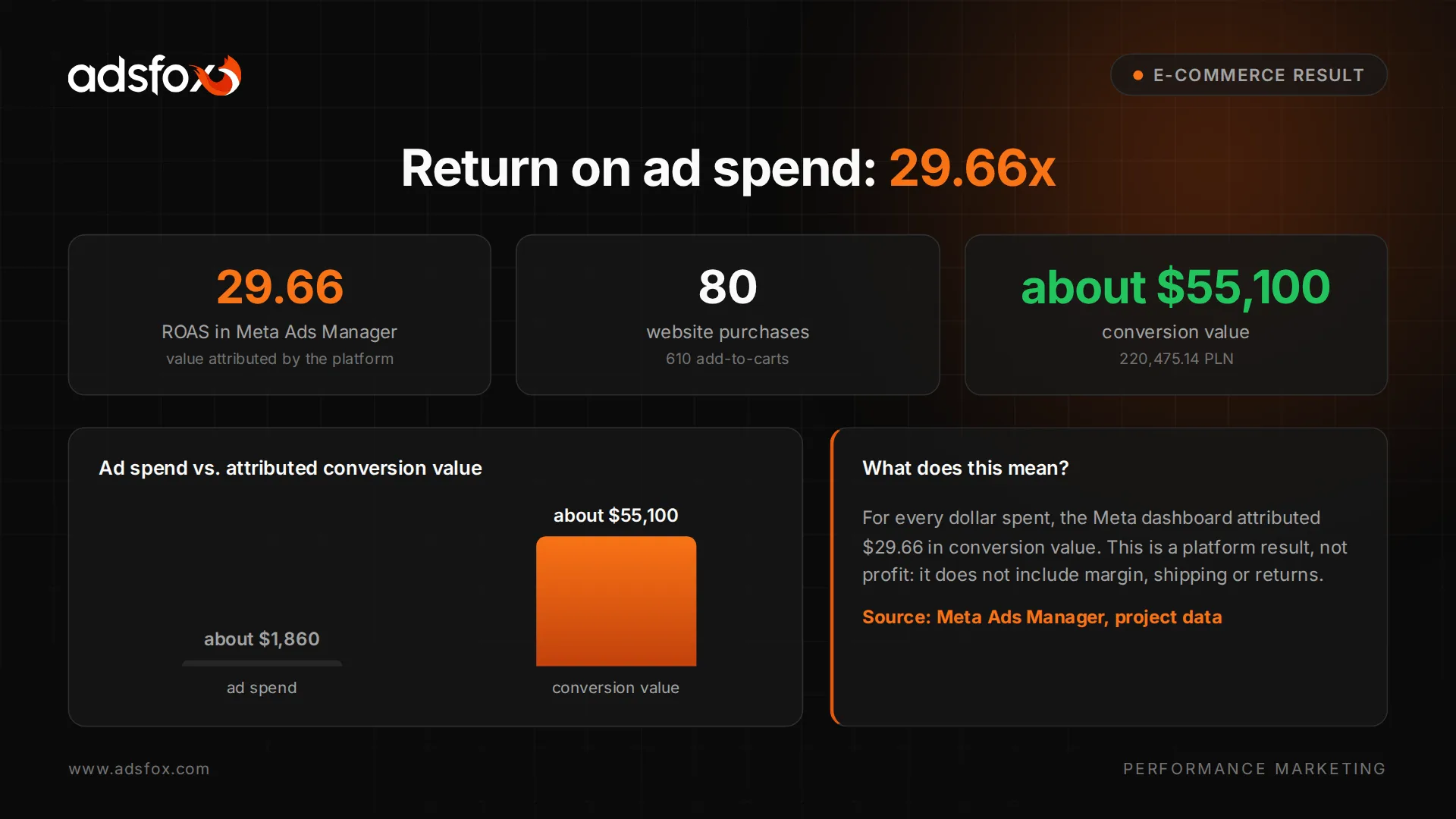
Facebook ads for an e-commerce store can generate sales when the ad platform receives a correct purchase signal. In this project, the Meta Ads dashboard showed 80 purchases, 610 add-to-carts, about $55,100 in conversion value and a ROAS of 29.66.
This case study covers the online store of a European manufacturer of bedding and home textiles. It shows how cleaning up analytics and running sales campaigns on Facebook and Instagram created a measurable channel for acquiring purchases in the online store.
Screenshots show amounts in Polish zloty (PLN); in the text we converted them to US dollars at roughly 4 PLN per dollar.
How to advertise an online store on Facebook and Instagram
How to go from no campaigns and incomplete analytics to sales measured at the purchase level.
Facebook ads are paid campaigns in the Meta ecosystem that can take a customer from the first contact with a product to a purchase in an online store. In e-commerce, their performance should be judged by sales, conversion value and return on ad spend, not just clicks or impressions.
The store’s situation before the campaign started
The owner runs the online store of a bedding manufacturer based in Poland. The range includes pillowcases, comforters, pillows, tablecloths and towels, with nationwide shipping.
Before working with us, the store was not running any ad campaigns. The main problem was low sales, but simply launching ads was not enough. At the start, Google Analytics 4, the Meta Pixel and conversion tracking were missing as well. Without those elements, the ad platform had no full picture of purchases, and the company could not reliably evaluate its marketing.
Why adsfox
The owner found adsfox on Google, and the reviews convinced her to work with us. The project required combining two areas: setting up analytics and running campaigns focused on sales.
adsfox is a Meta Business Partner. Partner status gives access to Meta’s standards and knowledge, but the result depends mostly on correct tracking, the right objective, audience testing and ongoing analysis of purchase data.
Free consultation and project assumptions
The starting point was agreeing that the primary conversion would be a purchase in the online store. Adding a product to the cart was an important intermediate signal, but it did not replace a sale.
This distinction is critical in e-commerce. A campaign can generate lots of visits and carts and still fail to close transactions. That is why purchases, conversion value and ROAS visible in the Meta Ads dashboard took priority in evaluating results.
The start of the engagement and the ad budget
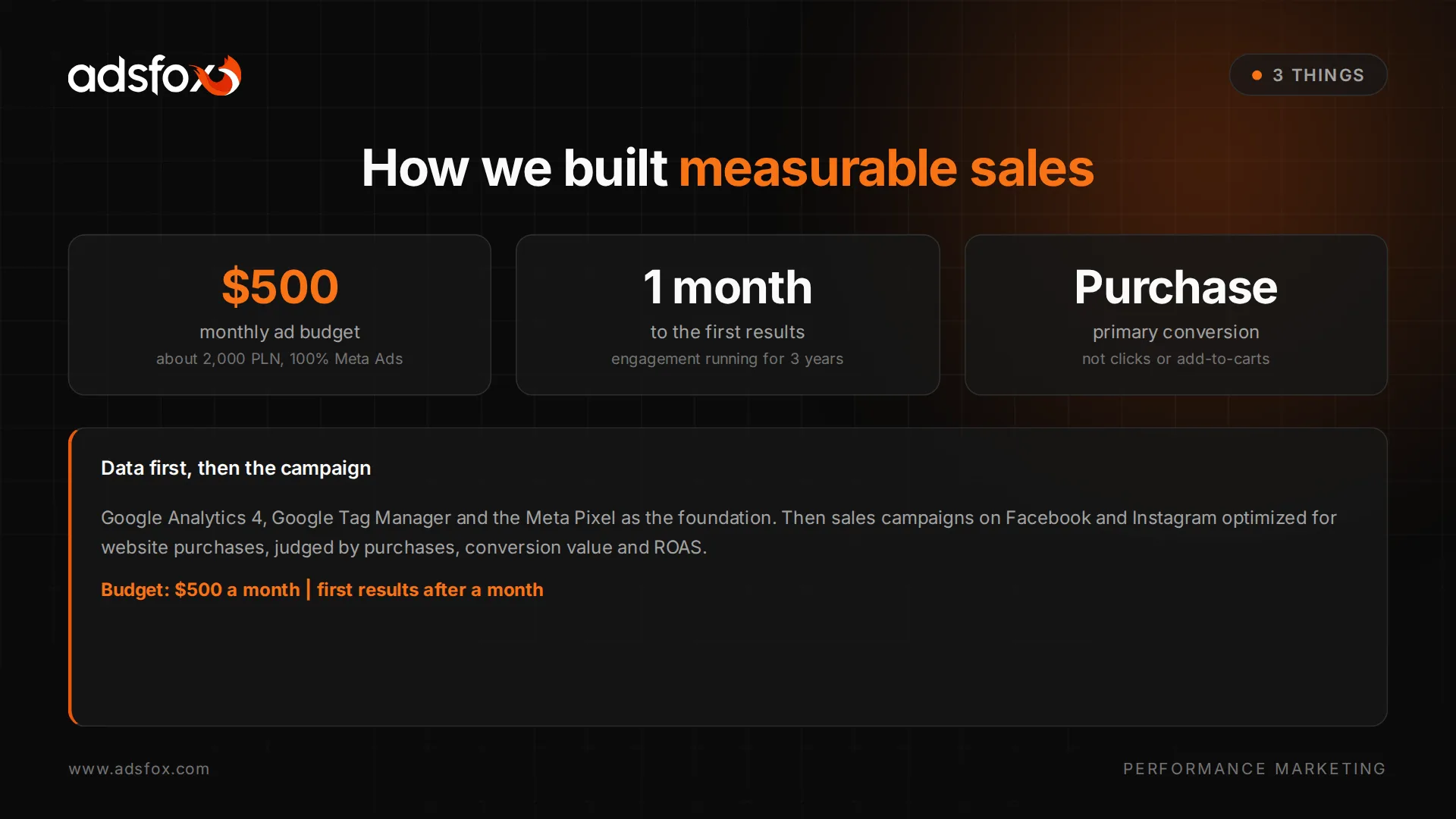
The engagement has been running for 3 years. The ad budget was about $500 a month at the start and has stayed at that level. 100% of the budget went to Facebook and Instagram Ads.
The first results appeared after about a month. The long engagement made it possible not only to start generating sales from ads, but also to test different audiences and messaging without moving budget to other channels.
Preparing for the Meta Ads campaigns
Before the actual optimization started, we implemented:
- Google Analytics 4,
- Google Tag Manager,
- the Meta Pixel,
- purchase and event tracking in the store,
- the adsfox CRM,
- sales campaigns on Facebook and Instagram.
What we implemented in the Meta Ads campaigns
Optimizing for purchases
We set the campaigns up for website sales. Meta’s system received purchase data, so it could look for users more likely to complete an order, not just visit the site.
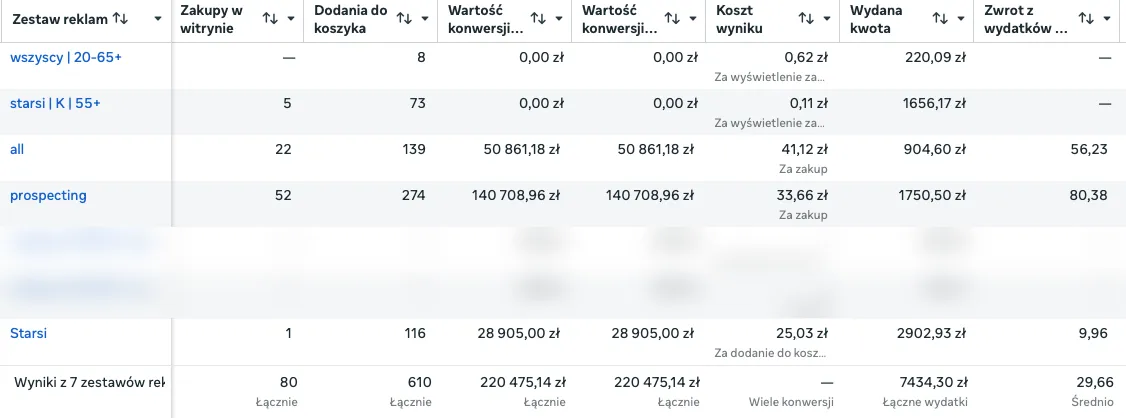
Results varied between ad sets. The strongest ad sets visible in the screenshot generated 52 purchases at a ROAS of 80.38 and 22 purchases at a ROAS of 56.23. This shows that the account’s total result was not spread evenly across ad sets.
Audiences and messaging
The 55+ audience and a broader 25-64 audience both performed well. The campaigns also used Meta’s Advantage+, which automates part of audience selection and ad delivery.
The messaging focused on bedroom products, sleep comfort and returning to an abandoned cart. We did not build the campaign on one generic slogan for the whole catalog. In this industry, matching the message to the product, the stage of the buying journey and the season matters.
Analytics and the adsfox CRM
The biggest challenge at the start was the state of analytics. Missing GA4, Meta Pixel and conversion tracking meant a data foundation had to be built before ads could be evaluated at all.
The adsfox CRM was one of the elements implemented in the project. For an online store, the purchase remained the main signal for the campaigns, and conversion value and ROAS were analyzed in the ad dashboard. That way, the conversation about performance did not end at the number of clicks or site visits.
What results did the Facebook ads deliver for the store?
The Meta Ads dashboard for the analyzed view shows:
- 80 website purchases,
- 610 add-to-carts,
- about $55,100 in conversion value,
- about $1,860 in ad spend,
- a ROAS of 29.66.
A ROAS of 29.66 means that for every dollar spent on ads, the Meta dashboard attributed $29.66 in conversion value. This is a result reported by the ad platform, not information about profit. It does not account for margin, product costs, shipping, returns or the store’s other operating costs.
The screenshot below shows the results of seven ad sets. Two ad sets with zero results are blurred; the remaining data and the totals are unchanged.
What actually changed in the client’s business
The store gained a measurable sales channel built on Meta Ads campaigns. With 80 purchases, the ad dashboard attributed about $55,100 in conversion value to the campaigns. At the same time, 610 add-to-carts showed the scale of interest in the offer before checkout.
The most important change, then, was not more visits. The company could evaluate campaigns by purchases and transaction value visible in the ad platform. That makes it possible to tell ad sets that generate sales from those that only deliver earlier events in the buying journey.
Profitability and next steps
The budget has stayed at about $500 a month, and the campaigns continue in Meta Ads. The result shown in the screenshot is an aggregate view from the dashboard and should not be read as a single month of campaigns.
Further optimization should keep relying on purchases, conversion value and ROAS. Add-to-cart events are a useful diagnostic signal, but they cannot replace sales as the store’s main measure of performance.
Want to check whether your e-commerce campaigns are optimized for sales, not just traffic? Book a free marketing consultation with adsfox.
How to run Facebook ads for e-commerce
The lessons from this project are concrete:
- implement GA4, GTM and the Meta Pixel before evaluating campaign performance,
- choose purchase as the primary conversion if the store’s goal is sales,
- analyze ROAS together with conversion value, cost per purchase and number of transactions,
- treat add-to-cart as an intermediate signal, not the final result,
- separate ad sets that work from those that do not generate sales,
- match messaging to the product, the season and the stage of the buying journey,
- do not equate conversion value in the dashboard with the company’s profit.
This case shows that Facebook ads can become a measurable sales channel for an online store. The condition is correct tracking and optimization for the event that has business value: the purchase.
Related adsfox services
We can run a campaign like this for your store too, through our Facebook ads agency. If you want accurate purchase tracking despite browser restrictions, we implement server side tracking with the Conversions API. Organic search traffic is built separately, through our SEO agency, including e-commerce SEO, and you can find results from other projects in our case studies.
Who is the client in this case study?
The client is an adsfox customer running the online store of a bedding and home textiles manufacturer in Poland. We publish only information that clients have agreed to in writing. To protect their competitive advantage, we do not disclose the company name, store address, website, contact details or the exact campaign period. See adsfox client reviews.