
Google Ads for a Local Service Business: 206% More Qualified Actions, Same Budget

Google Ads for a local service business can increase the number of qualified inquiries without a proportional increase in budget, if the campaigns are optimized for real contact actions. In this case study we show a project for a local service business in southern Germany, where with a campaign cost only 0.68% higher, the number of qualified actions grew by 206.02%.
Google Ads is an advertising platform that reaches people actively searching for a service in a given area. For local services, though, its effectiveness depends not only on bids and keywords, but above all on the quality of measurement: phone, email, configurator, location and the final steps of the path.
Google Ads for a service business case study: starting point and project goal
How cleaning up the campaigns, measurement and local ad structure increased the number of qualified contact actions for a service business in a European market.
In this project we did not treat every click as a success. What mattered was whether the user took an action that could lead to a real inquiry: clicking the phone number, clicking the email address, completing the configurator or taking a final web action. The data in this write-up comes from Google Ads reports comparing February 28 to June 30, 2025 with July 1 to October 31, 2025.
Thomas’s situation
Thomas runs a local service business in southern Germany, mainly in Bavaria. The company serves private customers and search inquiries, and its lead acquisition model relies on several paths: phone, email, an online configurator and Local Services Ads.
The Google Ads account already had a history, but it needed cleaning up. The problem was not a lack of traffic. The biggest challenge was increasing the number of qualified inquiries, improving traffic quality, getting better measurement and controlling local visibility across regions with different potential.
In local services it is easy to burn budget on overly broad keywords or regions that generate clicks but not real contacts. So the starting point was an analysis of which actions are only a sign of interest and which can be treated as a qualified step in the sales path.
First contact with adsfox
Analytical campaign management was key in this project. Thomas needed a partner who would not just report cost and clicks, but separate the different conversion types and show which actions have real value for the business.
adsfox runs Google Ads campaigns as a Google Partner, but in practice setting up ads is not enough. For service businesses, the campaign should be tied to a logical measurement system: phone separately, email separately, configurator separately and final web actions separately. Only then can the budget be optimized toward inquiries with a real chance of turning into sales.
What convinced Thomas
Three things mattered most: measurability, working from real data, and separating hard actions from soft events.
A soft event can mean the user clicked something or started a process, but has not yet shown clear intent to get in touch. A hard action is a signal closer to a sale, for example a click on the phone number, a click on the email address, a completed configurator or a phone lead from Local Services Ads. Without that distinction, a campaign can look good in the dashboard but fail to deliver the inquiries the business cares about.
Free marketing consultation
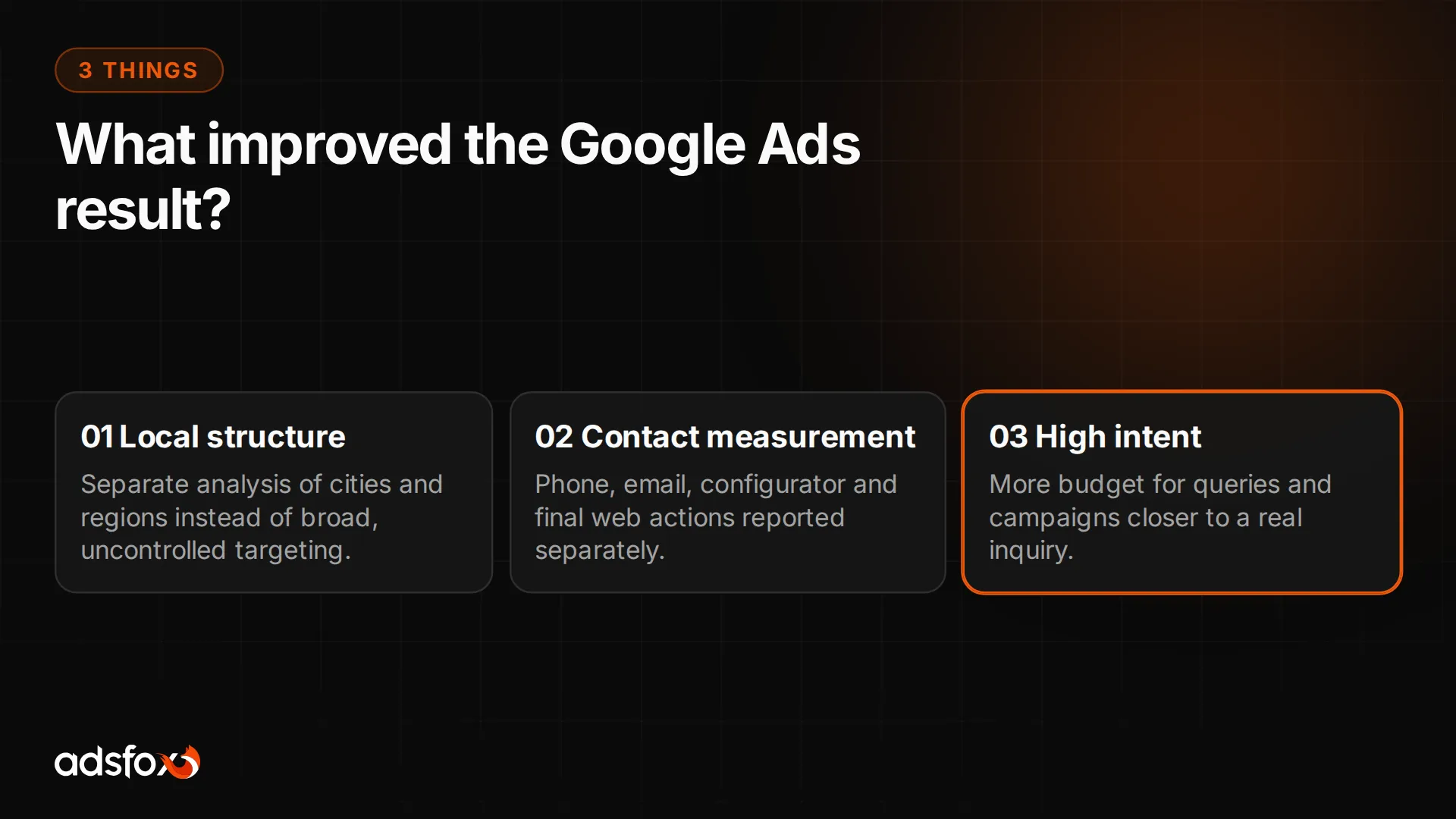
At the beginning we focused on making the Google Ads campaigns match the local way people search for services. In southern Germany, different cities and areas had different potential, so the campaign could not be run too broadly.
What needed cleaning up first: campaign structure, traffic quality, conversion tracking, location analysis, search term reporting and the separation of conversion types. This was not a cosmetic settings change. The goal was for the account to answer the question: which campaigns and regions deliver qualified actions, and which only consume budget.
If you see a similar problem in your Google Ads account, start with an audit of measurement and conversion quality, not with a bigger budget. Book a free consultation and we will check whether your campaigns measure actions that can actually lead to sales.
Start of the engagement
The ad budget was €1,700 a month and was not increased in the compared periods. That matters, because the main result in this case study did not come from scaling spend, but from making better use of the same budget.
The campaigns covered three areas:
- Google Search on service and local keywords,
- Performance Max focused on the configurator and qualified interactions,
- Local Services Ads for phone calls.
What we implemented before the Google Ads campaign started
Before the actual optimization, we had to establish what really matters to the business. In local services, some actions in the dashboard look similar, but their value differs. Starting the configurator is not the same as completing it. A click on the phone number is closer to contact than a plain website visit. A phone lead from Local Services Ads needs a different interpretation than a final web action.
So we implemented and organized measurement for several action types:
- phone number clicks,
- email clicks,
- configurator starts,
- configurator completions,
- phone leads from Local Services Ads,
- final web actions.
This approach makes campaign performance easier to judge. For a service business owner, what matters is not just how many conversions the dashboard shows, but which of them are closer to a real inquiry.
Marketing activities
Google Search campaign
In Search we focused on service and local keywords. In practice that meant tighter control over queries like service plus city, service near me, professional service or service cost. The specific keywords stay confidential, because in local services they can be part of a competitive advantage.
Search was responsible for high-intent users: people who are not just browsing, but actively looking for a provider in their area.
Performance Max for the configurator
Performance Max was used with a focus on the configurator and qualified interactions. In this channel it was important not to treat every configurator start as a ready lead. The analysis gave more weight to actions closer to the end of the path, especially configurator completions.
That distinction is critical. If the algorithm gets a signal that is too soft, it may optimize the campaign toward users who click willingly but do not leave qualified inquiries.
Local Services Ads for phone calls
Local Services Ads supported phone calls, one of the most important contact paths for a local service business. This channel was not about mass traffic, but about being present for local queries and making quick contact possible.
For service businesses, the phone is still often the strongest intent signal. So in the report we did not mix it with soft events; we analyzed it as a separate action type.
Analytics and campaign measurability
In Google Ads reporting we split actions by their role in the path. The client could see not only the total number of conversions, but the structure of the result: how many phone clicks, how many email clicks, how many configurator completions, how many phone leads and how many final web actions.
This is the approach we use at adsfox in other projects too: the campaign should be optimized for signal quality, not for the easiest number to hit in the dashboard.
Results of the Google Ads campaign
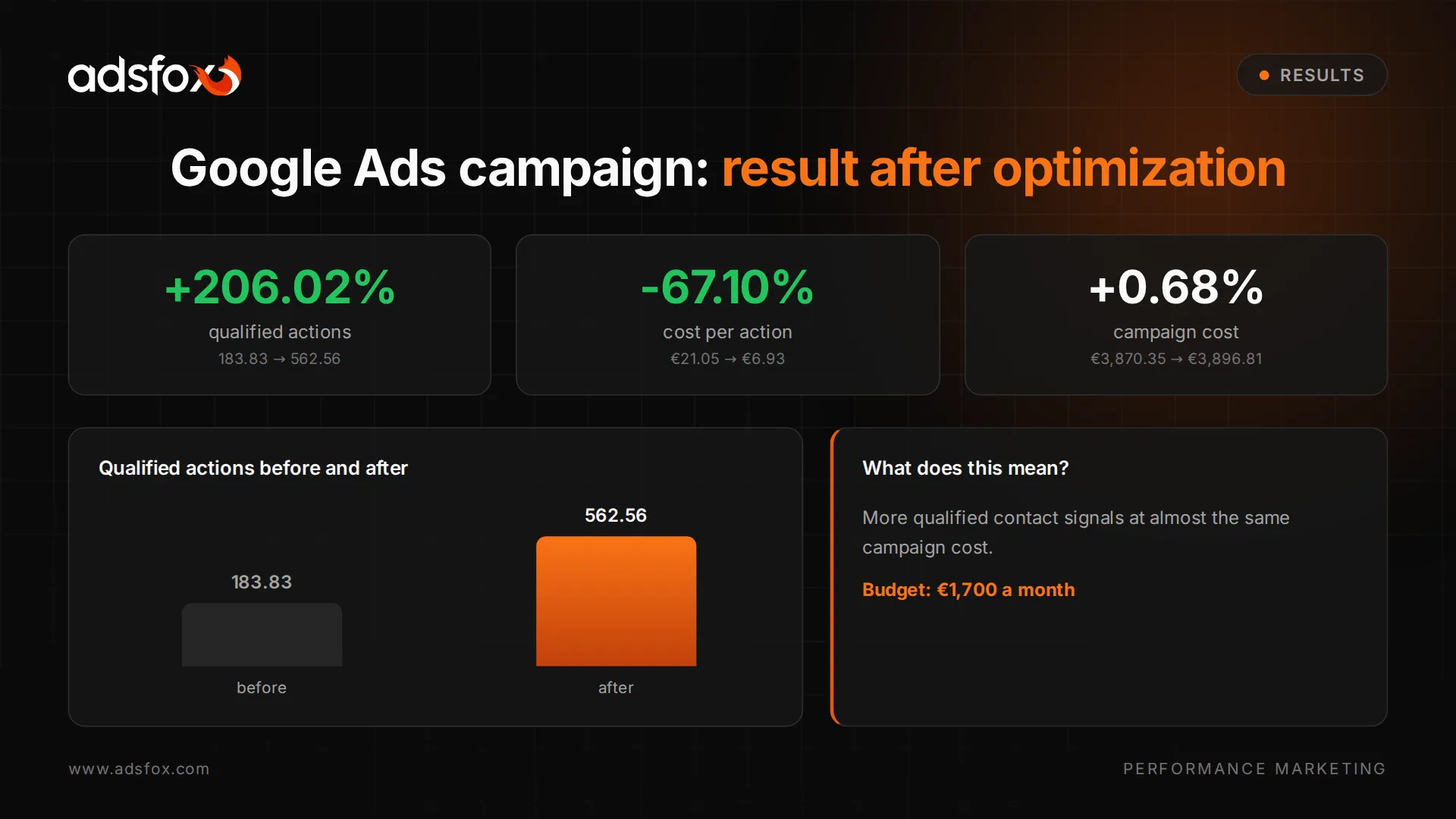
The key result: the number of qualified actions rose from 183.83 to 562.56, an increase of 206.02%. Over the same time, campaign cost rose only from €3,870.35 to €3,896.81, an increase of 0.68%.
The calculated cost per qualified action fell from €21.05 to €6.93, a drop of 67.10%. We do not describe this as “562 leads”, because the reported actions are different types of qualified contact actions and bottom-of-funnel steps, not a single uniform lead type.
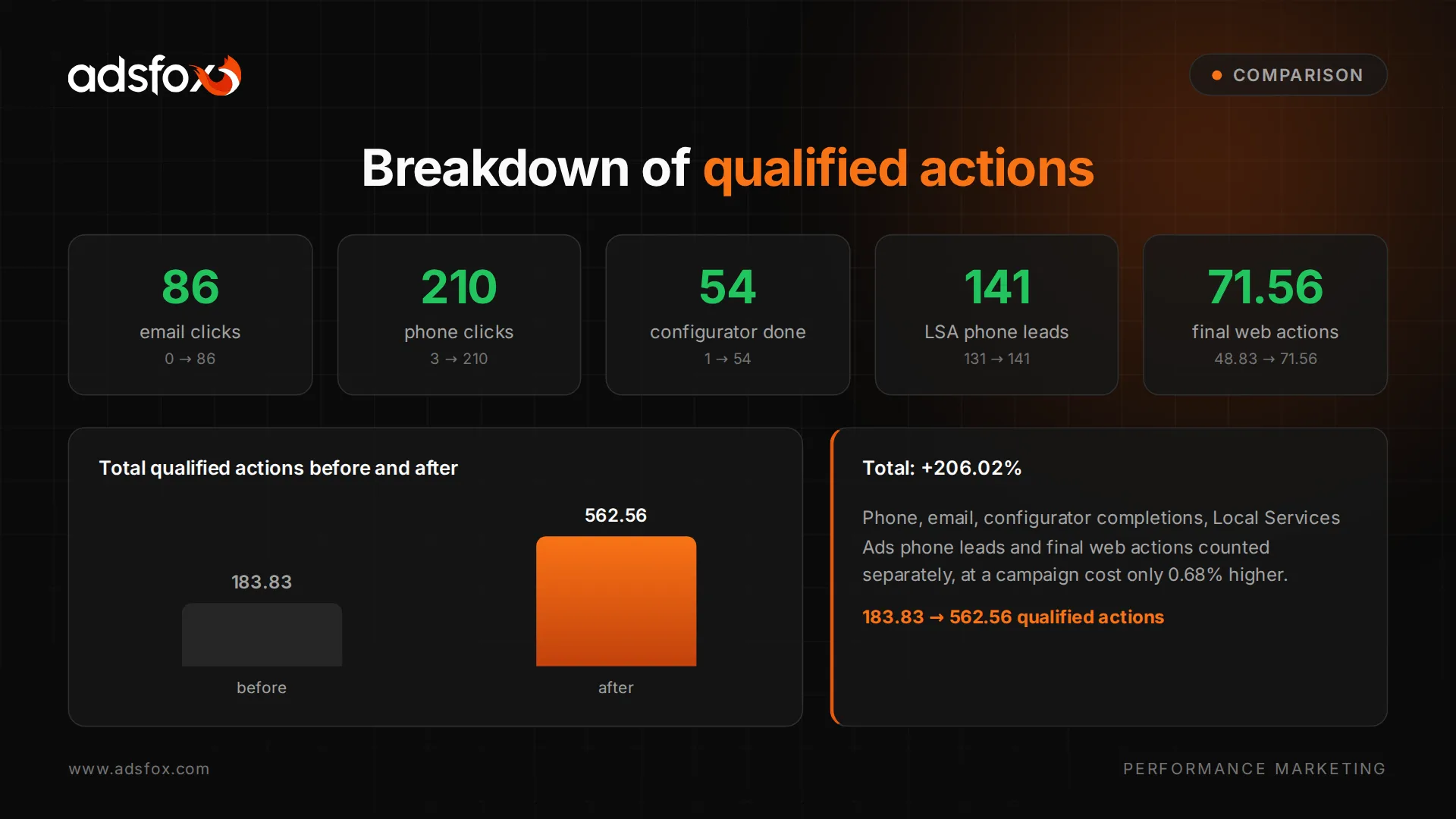
The original screenshots from the Google Ads reports show the data structure behind the result. In the text we keep the business interpretation, and we treat the screenshots as confirmation of the dashboard data.
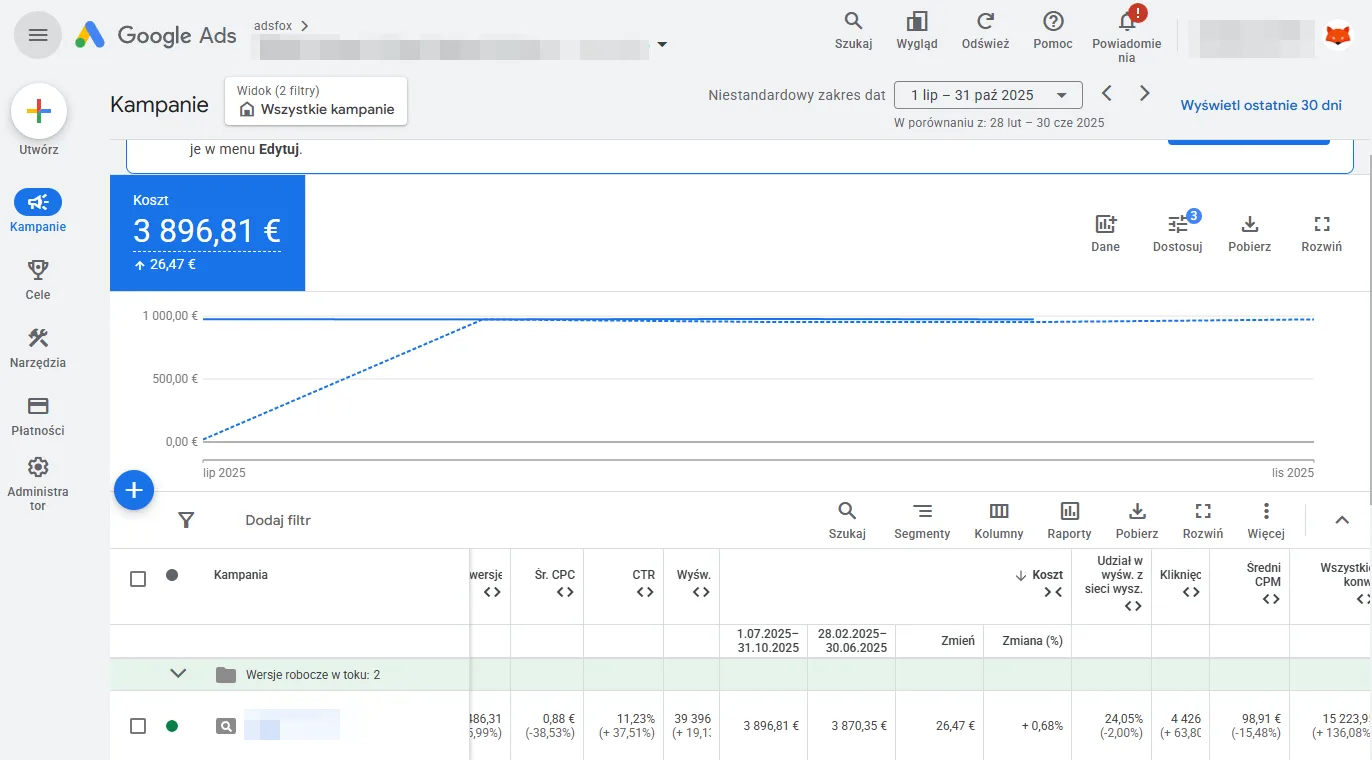
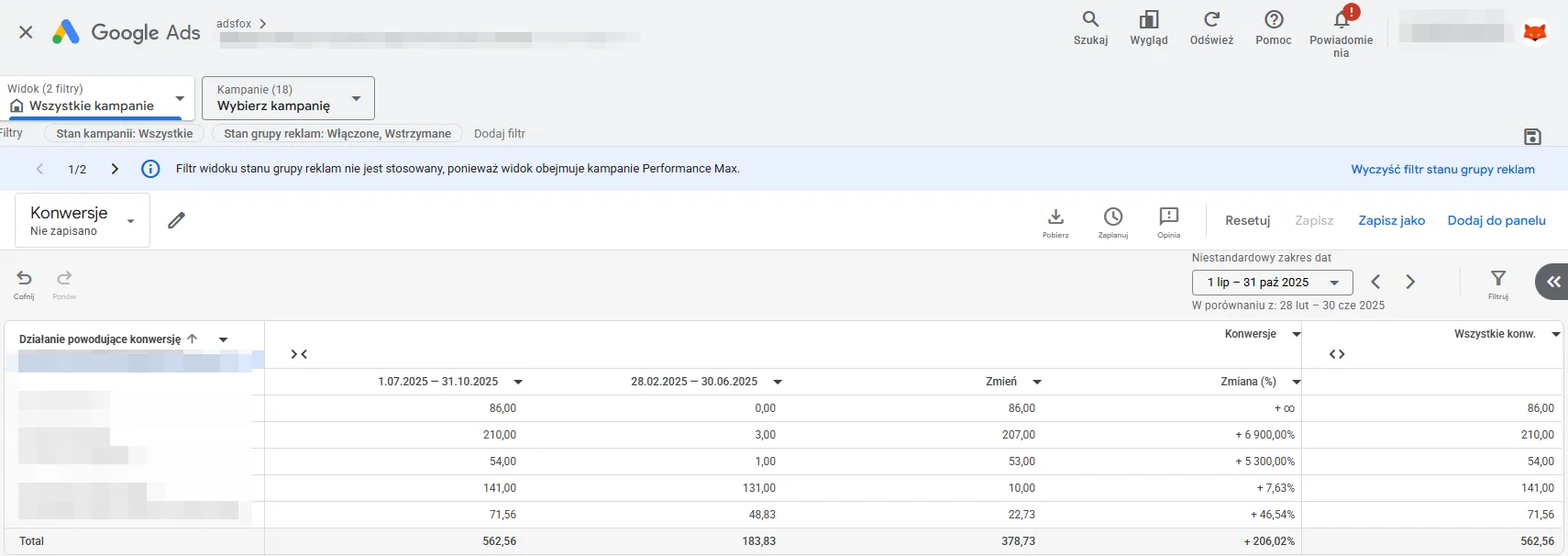
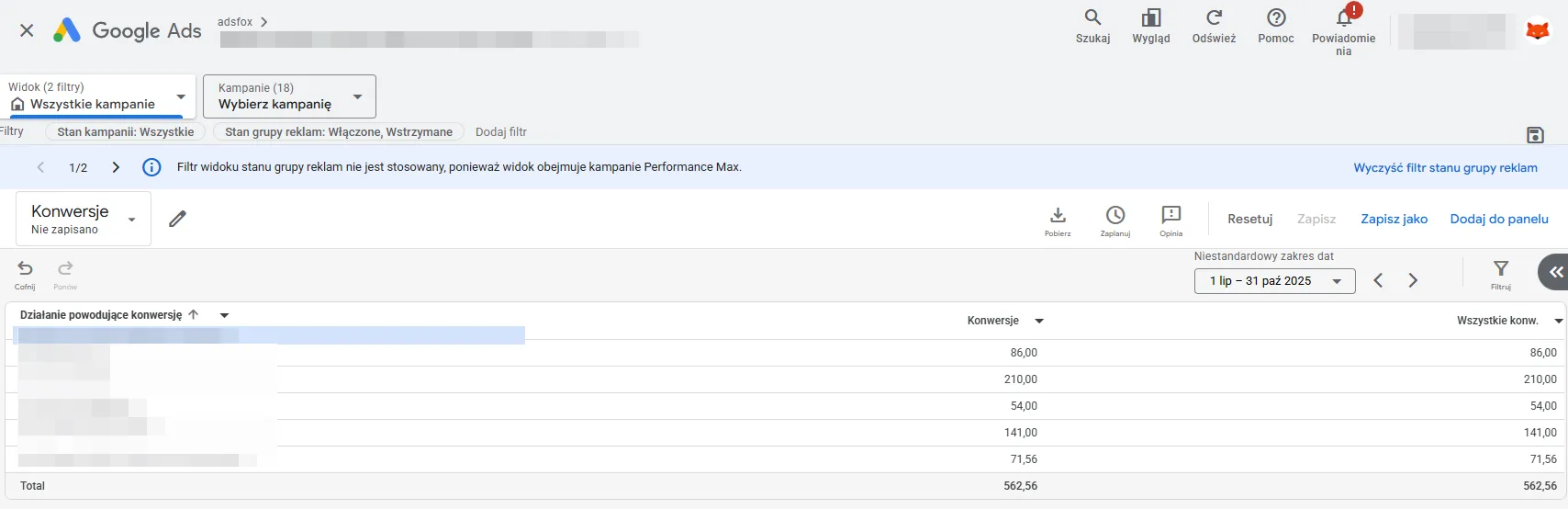
Breakdown of qualified actions in Google Ads:
- email clicks: 86.00 after optimization, previously 0.00,
- phone number clicks: 210.00 after optimization, previously 3.00,
- configurator completions: 54.00 after optimization, previously 1.00,
- phone leads from Local Services Ads: 141.00 after optimization, previously 131.00,
- final web actions: 71.56 after optimization, previously 48.83,
- total: 562.56 after optimization, previously 183.83.
The strongest business conclusion is not “more conversions in the dashboard”. It is this: at a nearly identical campaign cost, the client got far more qualified contact signals and a much better basis for deciding how to develop the local campaigns further.
Profitability and next steps
The result was especially meaningful because the budget stayed at the same level: €1,700 a month. Instead of increasing spend, we focused on improving campaign structure, conversion signals and local traffic control.
For Thomas, that meant more predictable inquiries, better control over regions and the ability to develop local campaigns based on data. For a service business that is often more important than simply “more traffic”, because each region can have different competition, different inquiry quality and different sales potential.
What’s next for the service business’s advertising
Further work should focus on scaling what has the best business potential:
- separate local campaigns for selected cities and regions,
- further Search optimization on service and local keywords,
- shifting budget to the regions and campaigns with the best potential,
- developing Performance Max with a focus on the configurator and qualified interactions,
- consistently separating soft events from hard contact actions.
That is why Google Ads management for service businesses should cover not only ad settings, but also the analysis of measurement, conversions and inquiry quality.
How to advertise a service business on Google Ads
Google Ads for a service business works best when the account is run locally, measurably and around real user intent. In practice, a few rules are worth following.
First, campaigns should not be too broad geographically. If the company operates regionally, individual cities and areas often need separate analysis. Second, not every conversion has the same value. A configurator start, a phone click and a final web action should not be lumped together without interpretation. Third, increase the budget only once you know which regions and keywords give the best signal.
The most common mistake in these campaigns is optimizing for easy conversions. The dashboard looks good, but the company has no certainty that the campaign is actually delivering qualified inquiries.
Related adsfox services
We can run a campaign like this for your company as your Google ads agency or Facebook ads agency. Organic search inquiries are built separately, through an SEO agency engagement. If you want to first check where your budget is leaking today, start with a digital marketing audit, and organizing and grading lead quality is covered by lead generation optimization. See results from other projects in our case studies.
Who is Thomas?
Thomas is the owner of a local service business in southern Germany. For confidentiality reasons we do not publish the company name, website address, campaign names, contact details or the specific keywords that could identify the client.
In adsfox case studies we show only the data our clients agree to publish. Many business owners do not want to share results with competitors, so some information is anonymized. You will find more project examples in our case studies and in our client reviews.
Want to check whether your service business’s Google Ads campaigns measure the right actions and spend the budget where inquiries actually come from? Book a free consultation and we will analyze your campaigns and show you where you are losing sales potential.