
Meta and Google Ads for a Medical Footwear Store: 77 Orders a Month, 3.58 ROAS

Advertising medical footwear can drive real sales for an online store when the campaigns are optimized for a sales goal, not just website traffic. This case study covers a client selling therapeutic footwear, where we restructured Meta Ads and Google Ads, launched measurable sales campaigns and helped move most of the sales into the company’s own e-commerce store.
The client, based in Poland, sells therapeutic footwear nationwide through an online store. Before working with us, the company relied on other sales channels, including partnerships with podiatrists, and had experience with another agency. The problem was not only that the campaigns needed work. More importantly, sales were not measurable enough, and a new e-commerce site was still being launched.
In practice, that meant building the system from the ground up: analytics first, then campaign structure, then purchase optimization. Only then could we tell which sources actually generated sales and which only added visibility.
Medical footwear e-commerce case study: project goal
The goal was to grow sales from the company’s own online store and reduce dependence on channels that were harder to control on cost. For a medical footwear store this matters, because the customer is not just buying a product. They are usually looking for a specific use case: comfort at work, shoes for healthcare staff, medical clogs or footwear built for long hours on their feet.
So the campaign could not rely on a generic message about comfortable shoes. It had to combine purchase intent with a solid product structure and measure what actually moves a shopper closer to buying.
Key assumptions for the project:
- launch measurable sales campaigns,
- restructure Meta Ads and Google Ads,
- grow sales through the company’s own online store,
- find out which campaigns generate purchases, not just traffic,
- use B2B campaigns as an additional lead source.
adsfox is a Google Partner and a Meta Business Partner, so in projects like this we look at campaigns not only through creative, but also through data, optimization goals and the quality of signals sent to the platforms.
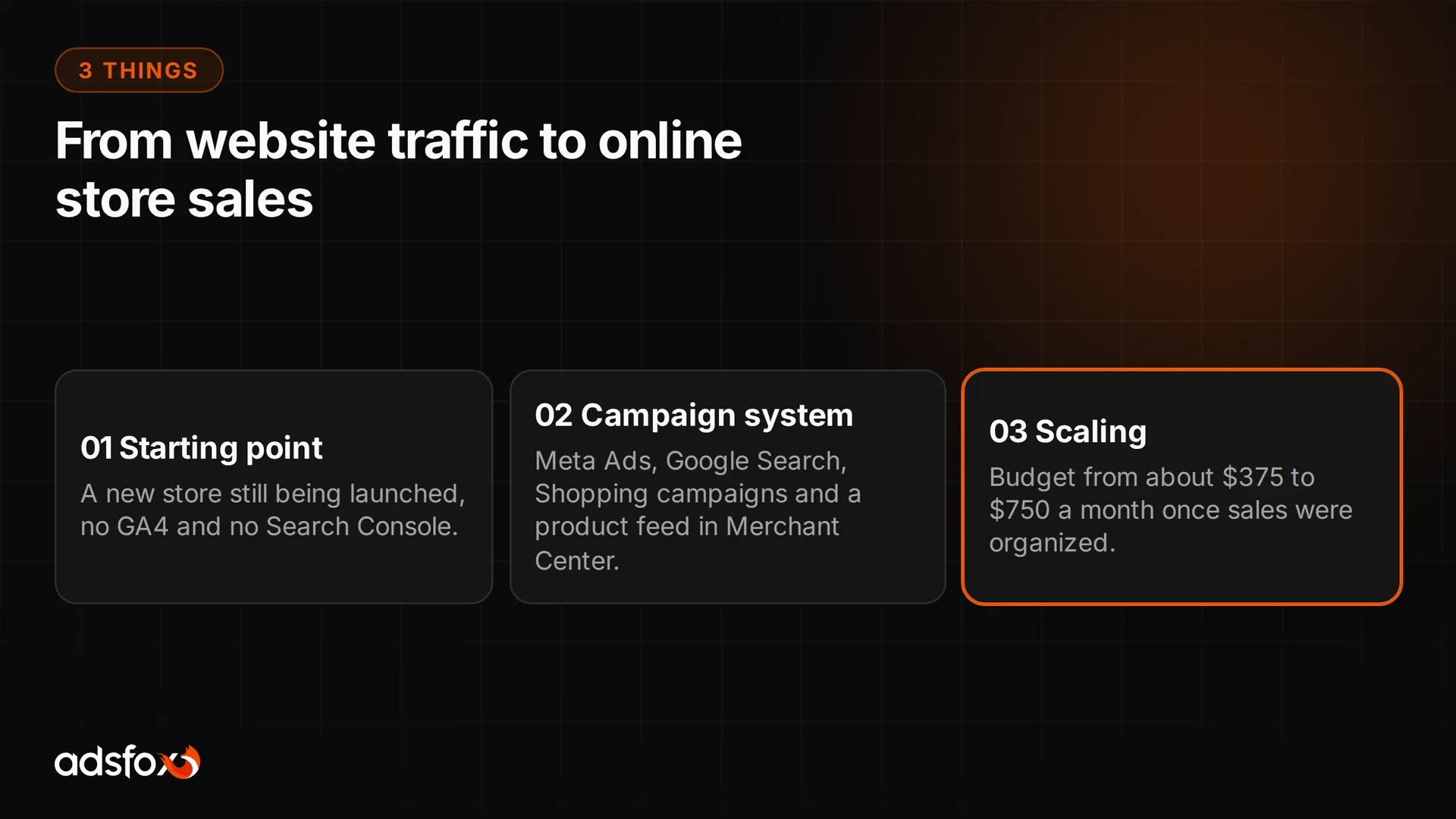
Starting point: an online store in transition
At the start, the client had a new e-commerce site still being launched. That is important context, because in e-commerce the campaign alone is not enough. If the store, analytics and conversion goals are not in order, ads can bring traffic, but decisions will still be made on incomplete data.
On the technical side, Google Analytics 4 and Google Search Console were missing. The site was in transition, so before scaling we had to put the measurement basics in place and prepare the environment for evaluating sales results.
This is a common problem in e-commerce projects. The business wants to grow sales, but the ad account does not fully answer the question: which campaigns sell, which support the purchase decision, and which only generate cheap clicks.
That is why the first step was moving from loosely measured activity to campaigns that could be judged by behavior closer to the purchase.
Ad budget and channel split
The starting ad budget was about $375 a month. It is now roughly $750 a month. That reflects a careful approach to scaling: first confirm that the campaigns generate measurable sales actions, then increase spend.
In this project the budget was split between Google Ads and Meta Ads:
- Google Ads: 40% of the budget,
- Google Search: 20% of the budget,
- Google Shopping campaign: 20% of the budget,
- Meta Ads: 60% of the budget,
- Meta purchase campaigns: 40% of the budget,
- B2B lead forms in Meta Ads: 20% of the budget.
A typical starting budget in this category is about $500 a month. The project started below that level, but once the campaigns were restructured and the direction was confirmed, the budget was increased.
The business takeaway is simple: for an online store, the budget has to allow you to collect data on purchase behavior. If a campaign is optimized only for traffic, you can have plenty of visits and still not know whether marketing is actually supporting sales.
What we ran in the Meta Ads and Google Ads campaigns
The project ran on two main channels: Meta Ads and Google Ads. Each played a different role in the sales system.
On the Meta side we used campaigns focused on sales and actions close to the purchase:
- cold campaigns optimized for add-to-cart,
- retargeting optimized for purchase,
- lead ads for B2B customers,
- catalog (product) campaigns on Meta.
On the Google side we ran search and product campaigns:
- brand campaigns,
- campaigns on product-related search terms,
- Shopping campaigns built on the product feed,
- everything connected to Google Merchant Center.
During the engagement, the product-term Search campaign was replaced by a Shopping campaign with Google Merchant Center. That is an important change, because in e-commerce the product feed often shows the shopper the specific product, price and variant far better than a text ad in search.
Technically, we implemented Google Analytics 4 and Google Tag Manager. That made it possible to organize measurement and judge the campaigns not only by clicks, but also by behavior closer to a sale.
Why campaigns without a sales goal burn budget
At the beginning, a campaign optimized for landing page views was running. Each landing page view cost about $0.05. That may look good in a report, but for an online store a cheap visit is not a business result.
The screenshot below shows exactly that type of campaign: judged by landing page views, at 0.21 PLN (about $0.05) per view, 2,611 results, a reach of 50,068 and 551.45 PLN (about $138) spent. It is a good example of a metric that looks cheap but says nothing about sales.

If a store sells medical footwear, the key questions are: does the visitor add the product to the cart, do they buy, do they come back through retargeting, and does the campaign allow sales to scale. That is why changing the campaign objective was one of the most important parts of the project.
After switching to sales campaigns, performance was judged by stronger signals:
- add-to-cart,
- purchase,
- B2B lead form,
- cost of actions closer to a sale,
- ROAS for the Meta Ads campaigns.
This is one of the key lessons from this case study. A low cost per click or per landing page view does not mean the campaign is good. A good e-commerce campaign should lead the shopper to a purchase and make it possible to check whether the spend is profitable.
Results of the medical footwear store’s campaigns
After optimization, the campaigns started generating actions closer to a sale. The client’s campaign data showed concrete numbers:
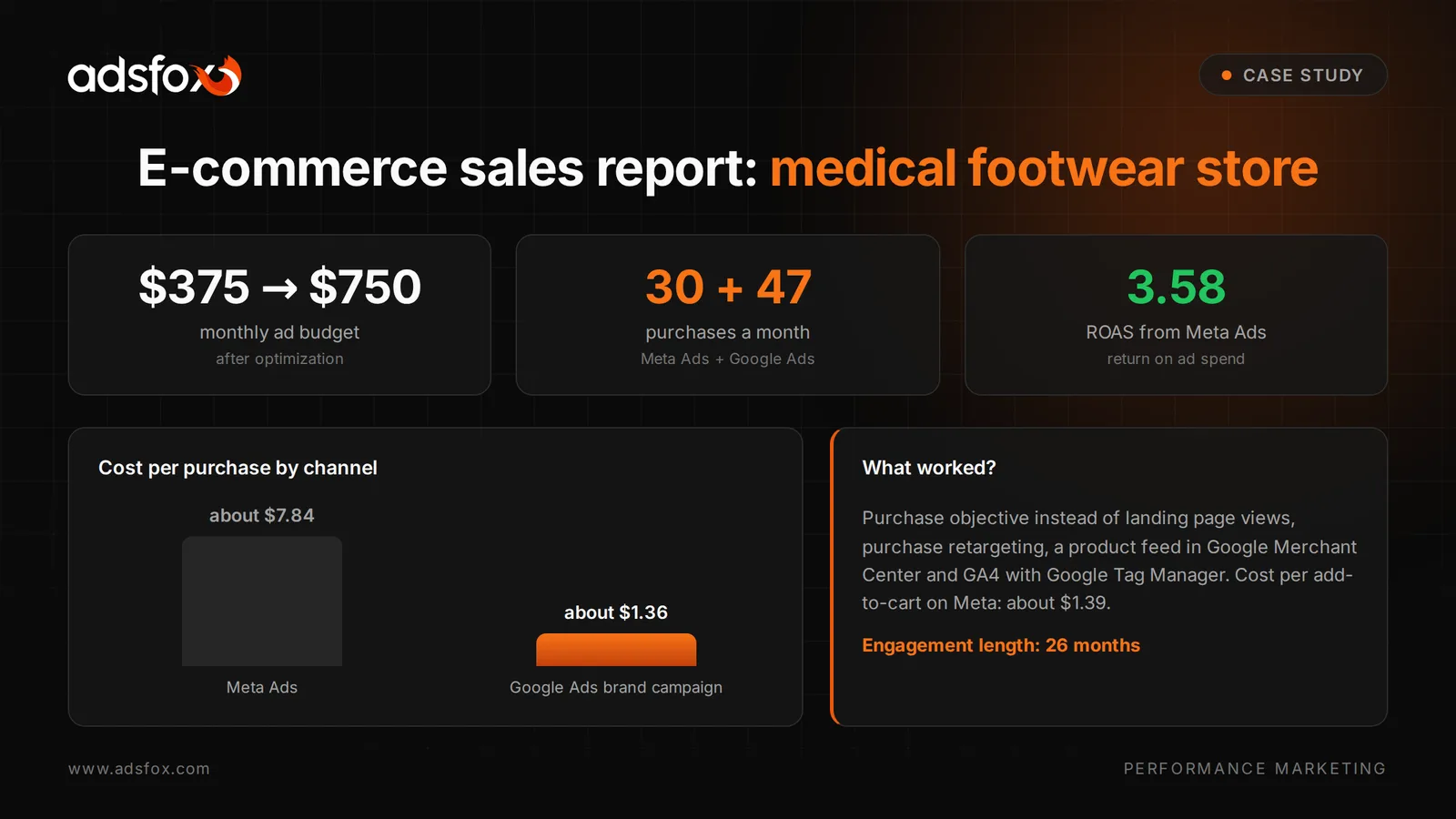
- cost per add-to-cart on Meta: about $1.39,
- cost per purchase on Meta: about $7.84,
- cost per purchase from the Google Ads brand campaign: about $1.36,
- purchases per month from Meta Ads: about 30,
- purchases per month from Google Ads: about 47,
- ROAS from Meta Ads: 3.58.
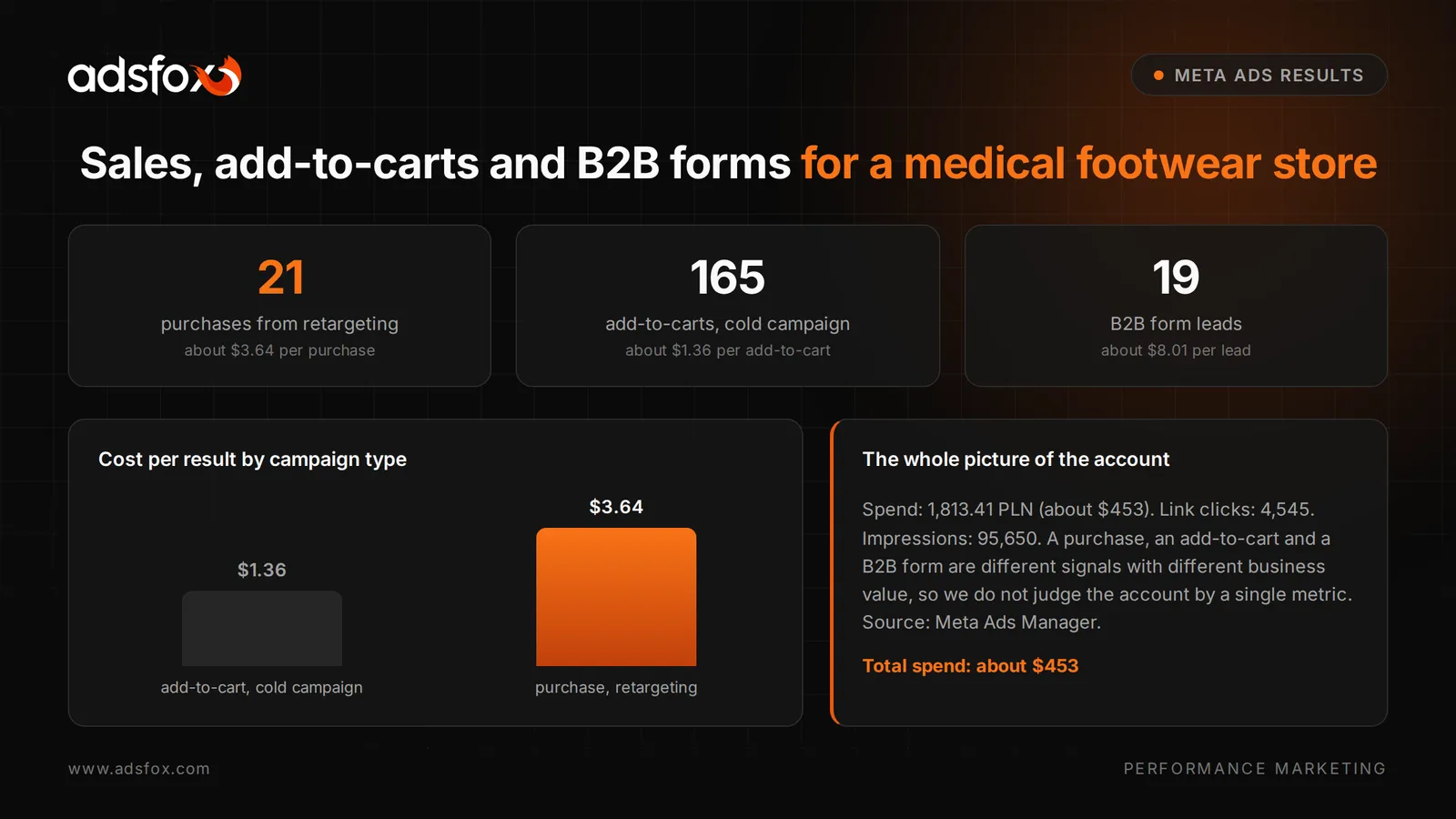
The Meta Ads Manager screenshot also shows results from the sales and B2B campaigns: 21 purchases from retargeting, 165 add-to-carts from the cold campaign and 19 B2B form leads, on a total spend of 1,813.41 PLN (about $453).
At the campaign level you can see the different roles: purchase retargeting delivered 21 purchases at about $3.64 each, the cold add-to-cart campaign generated 165 add-to-carts at about $1.36 each, and the B2B forms brought 19 leads at about $8.01 each. This screenshot shows why we do not judge the whole account by a single metric: a purchase, an add-to-cart and a B2B form are different signals with different business value.

The first results came after switching the campaign to a purchase objective. After about two weeks the campaign generated its first purchase. That matters, because in e-commerce the move from traffic to sales often takes time: the platform has to collect signals, and the store has to have tracking set up correctly.
What actually changed for the client
The most important change was not the cost per result. The client started shifting the weight of sales to its own online store. That means more control over the sales channel, the data and the cost of acquiring a customer.
Previously, part of the sales came through partnerships with podiatrists, where the issues were high commissions and limited measurability. After restructuring the Meta Ads and Google Ads campaigns, the company could grow its own e-commerce channel and see which activities actually help it sell.
In practice, the client gained:
- more control over sales from its own store,
- a clear division of roles between Meta Ads and Google Ads,
- measurable sales campaigns,
- room to grow Shopping and catalog campaigns,
- an additional B2B channel through lead forms.
This shows that performance marketing in e-commerce should not end with launching ads. What matters is building a system in which the ads, the store, analytics and the product feed all work toward one goal.
What works in medical footwear advertising
In this category, the campaigns that work best combine purchase intent with a specific product. The shopper usually knows what they are looking for, but compares variants, comfort, use case and price.
In the Shopping and Search campaigns, the best-performing terms and directions were tied to a specific product type:
- women’s medical clogs,
- medical footwear,
- medical clogs,
- medical shoes.
On Meta, cold campaigns optimized for add-to-cart and purchase retargeting made sense. Catalog campaigns helped show the specific offer, and B2B forms opened a path to business buyers.
Watch out for terms and directions that are too broad and do not necessarily lead to a purchase. In this project, areas that could burn budget included orthopedic slippers, generic “comfortable medical shoes” queries and messaging aimed too broadly at nursing.
The main takeaway: in this category, campaigns without a sales goal are not enough. If the store wants to grow, the ads should be optimized for purchase, add-to-cart or a specific form, not just cheap traffic.
What comes next
In the coming months the plan is to keep optimizing Meta Ads and Google Ads. Growing the Shopping campaigns built on the feed and Google Merchant Center is especially important, because for an online store that is one of the most important levers for scaling sales.
The next direction is to keep developing the sales and B2B campaigns as long as the results stay profitable. A TikTok Ads test is also on the roadmap as an additional channel, particularly with well-prepared product content and short-form video.
Summary of the engagement with adsfox
In this case study, the Meta Ads and Google Ads campaigns for a medical footwear store showed that a well-structured ad system can help move sales into the company’s own e-commerce store.
Key numbers from the project:
- starting budget: about $375 a month,
- current budget: about $750 a month,
- cost per add-to-cart on Meta: about $1.39,
- cost per purchase on Meta: about $7.84,
- cost per purchase from the Google Ads brand campaign: about $1.36,
- about 30 purchases a month from Meta Ads,
- about 47 purchases a month from Google Ads,
- ROAS from Meta Ads: 3.58,
- engagement length: 26 months.
The takeaway is simple: a medical footwear store should advertise for sales, not for visits. Only the combination of Meta Ads, Google Ads, a product feed and analytics makes it possible to see which activities actually support revenue.
If you run an online store and want to check whether your campaigns are optimized for sales and not just traffic, let’s talk about campaigns for your e-commerce store.
Related adsfox services
We can run a campaign like this for your store as your Facebook ads agency and Google Ads agency. Organic search traffic to the store is built separately, through our SEO agency services for online stores. If you want to find out where your budget is leaking first, start with a digital marketing audit, and sorting and scoring lead quality is handled by our lead generation optimization tool. You can find results from other projects in our case studies.
Data anonymization
This case study is based on a real adsfox engagement with a client in the medical footwear industry. Information identifying the company, the store’s address and details of the ad accounts are not published. We only show the information needed to understand the problem, the work and the business result.