
Meta Ads for an Art Print Store: Add to Cart Cost from $41 to $2.65

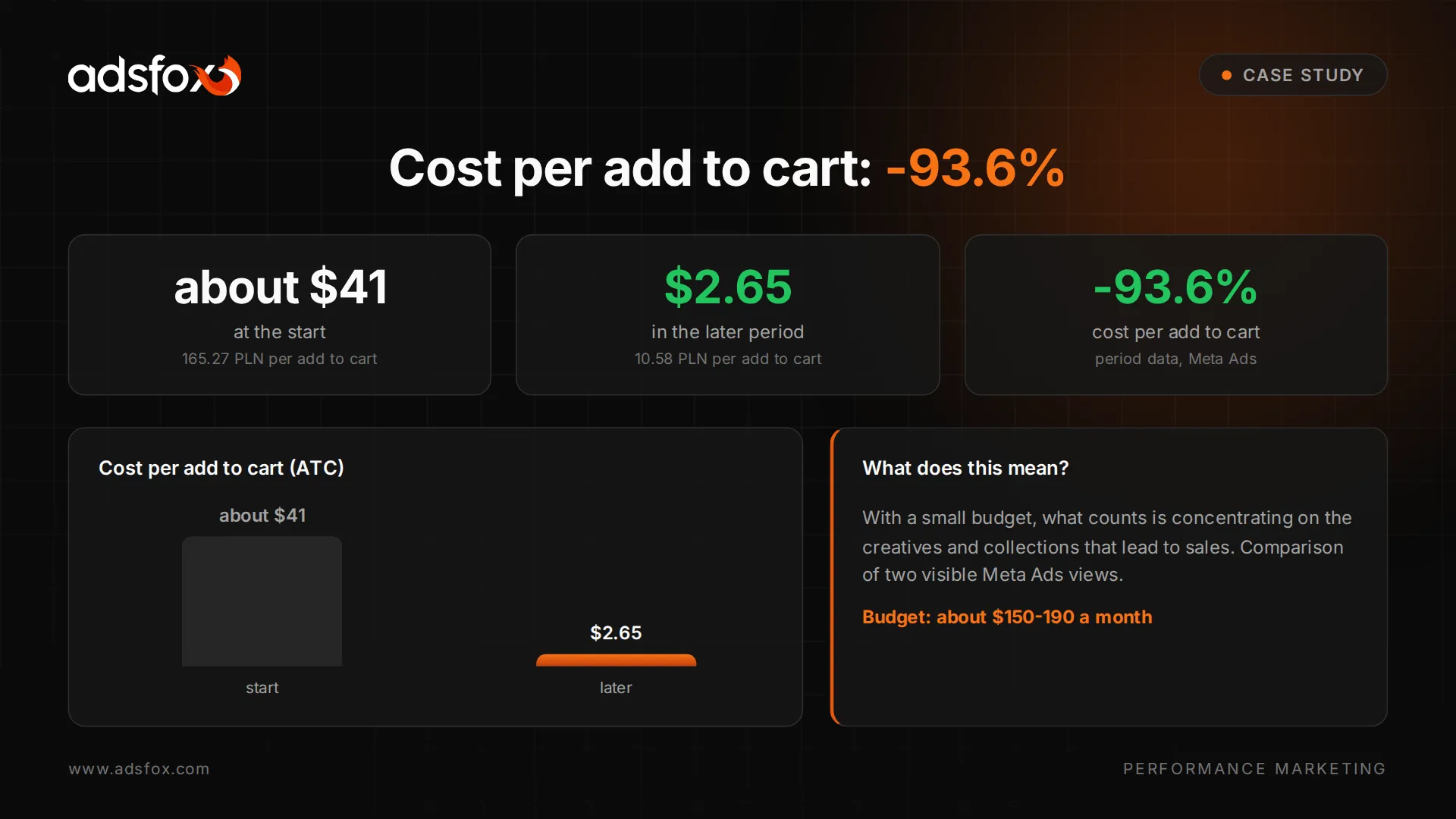
Meta Ads for an online art print store can work even on a very small budget, as long as the campaigns focus on the right purchase signal and the creatives are refreshed regularly. In this case study we walk through an e-commerce store selling original illustrations, where the cost per add to cart dropped from about $41 to $2.65 in the Meta Ads reports we can show.
The main takeaway is simple: in e-commerce, a cheap click is not a win. What matters for a store is the path to purchase, and add to cart is only one intermediate signal. That is why the natural next step in this project is optimizing all active campaigns for purchases, not just for add to cart.
How to advertise an online store with original artwork
The answer from this project: the creatives had to show the artist’s real work, and the campaign sold original prints, art prints, posters and seasonal collections on a limited ad budget.
The client is a brand selling original illustrations and wall art. The catalog includes art prints, framed prints, posters, originals, calendars and gift sets. Collections covered botanical and animal motifs, mushrooms, architecture and city sketches.
This matters because ads for a store like this cannot look like a generic e-commerce campaign. The product is visual, original and seasonal. Customers are not just buying paper or a frame; they are buying a style, an aesthetic, and an idea for a gift or a piece of decor. So the ad creatives had to show the artist’s actual work and products.
Monika’s situation before the campaign
Monika runs an online store with original illustrations and wall art. The sales model is straightforward: purchases on the website. Add to cart and checkout initiation are micro-conversions, but the real business goal is sales.
The main problem was a low and unstable number of purchases on a limited budget. Two things made it harder: the budget was spread across local campaigns and remarketing, and the seasonal catalog required regular creative changes.
We have no confirmed information about earlier marketing efforts, so we are not going to invent a “before” story. What we do know is that the project required working on a small budget and being precise about what to promote at any given time.
First contact with adsfox
The project data does not record how the client found adsfox. What we know is that the proposal is what convinced her to work with us. So in this write-up we focus on what we can show concretely: the budget, the ad channel, the Meta Pixel setup, the campaign types, seasonal creatives and the results visible in the screenshots.
adsfox is a Badged Meta Business Partner and a Google Partner, but in a project like this the badge alone does not do the work. The key was turning e-commerce campaign experience into a practical decision: where to direct a small budget and which optimization signal makes the most sense.
Ad budget for a small online store
The starting ad budget was about $150 a month. Today it is roughly $190 a month. At that level of spend, every budget split matters, because too many campaigns and ad sets fragment the data and slow down the algorithm’s learning.
The channel setup was simple:
- Meta Ads: 100% of the budget,
- sales campaigns,
- optimized for add to cart,
- Meta Pixel as the measurement foundation.
In practice that meant working with about $6 a day across three parallel campaigns. That is a tough environment for e-commerce: the store needs purchase data, but the budget does not allow endless testing of many products, audiences and creatives at once.
What we implemented in the Meta Ads campaigns
The project ran Meta Ads sales campaigns with add to cart as the main optimization signal. It is a micro-conversion that shows stronger intent than a click, but it is still not the same as a purchase.
In e-commerce that distinction is critical. If a campaign optimizes only for a weak signal, it can generate traffic or carts that never turn into sales. If it optimizes for purchases right away with very little data, the algorithm may learn more slowly. So in a project like this, the objective has to match the account’s stage, the budget and the conversion volume.
An unusual challenge was combining nationwide sales with local collections tied to specific cities. Some products had broad appeal, while others were closely tied to a local identity, for example Warsaw or Gliwice. On top of that came seasonality: fall collections, holiday sets, calendars and gift products.
What worked in this niche
Authentic material showing the artist’s real work and products performed best. A brand built around original art should not try to look like a big retailer’s catalog. The strength of the message is the real style, the product detail and the character of each collection.
In the best month we analyzed, Facebook Feed was an important placement. Local campaigns for city collections also worked well, along with remarketing to people who already knew the brand and its products.
The best-performing audience was women aged 35-44. That does not mean the store should speak only to that group. It means that with a limited budget, it is worth checking which segments actually respond to a given collection and creative format.
Results of the Meta Ads campaign for the art print store
In the first Meta Ads report we can show, the campaigns generated:
- 9 form leads at about $11 per lead,
- 2 add to carts at about $41 per add to cart,
- total spend of roughly $183,
- reach of 51,107 Meta accounts,
- 91,670 impressions.

In the later report, the campaign generated:
- 14 add to carts,
- about $2.65 per add to cart,
- roughly $37 in spend,
- reach of 9,465 accounts,
- 16,625 impressions.

In the project data, the average result after optimization was recorded as about $2.65 per add to cart at roughly 65 add to carts a month. That is a big improvement over the starting point, but we do not treat add to cart as the store’s final result. It helps gauge intent, but an e-commerce campaign should ultimately be judged on purchases.
What actually changed for the client
On the client’s side, add to carts increased, and sales grew with them. The project also introduced new recurring series of seasonal products that could be tested in ads.
That is the most important business outcome for a small online store. The campaign did not just lower the cost of a micro-conversion. It also helped identify which collections, formats and motifs have real sales potential.
If you want to check whether your e-commerce campaigns are measuring the right signal, book a free consultation and we will review your campaign structure, cost per add to cart and path to purchase.
Profitability and next steps
The plan for the coming months has four directions:
- optimizing all active campaigns for purchases,
- testing further seasonal collections, including fall and holiday lines,
- continuing the local city series for Warsaw and Gliwice,
- concentrating the limited budget on the ad sets and creatives that generate purchases, not just clicks or carts.
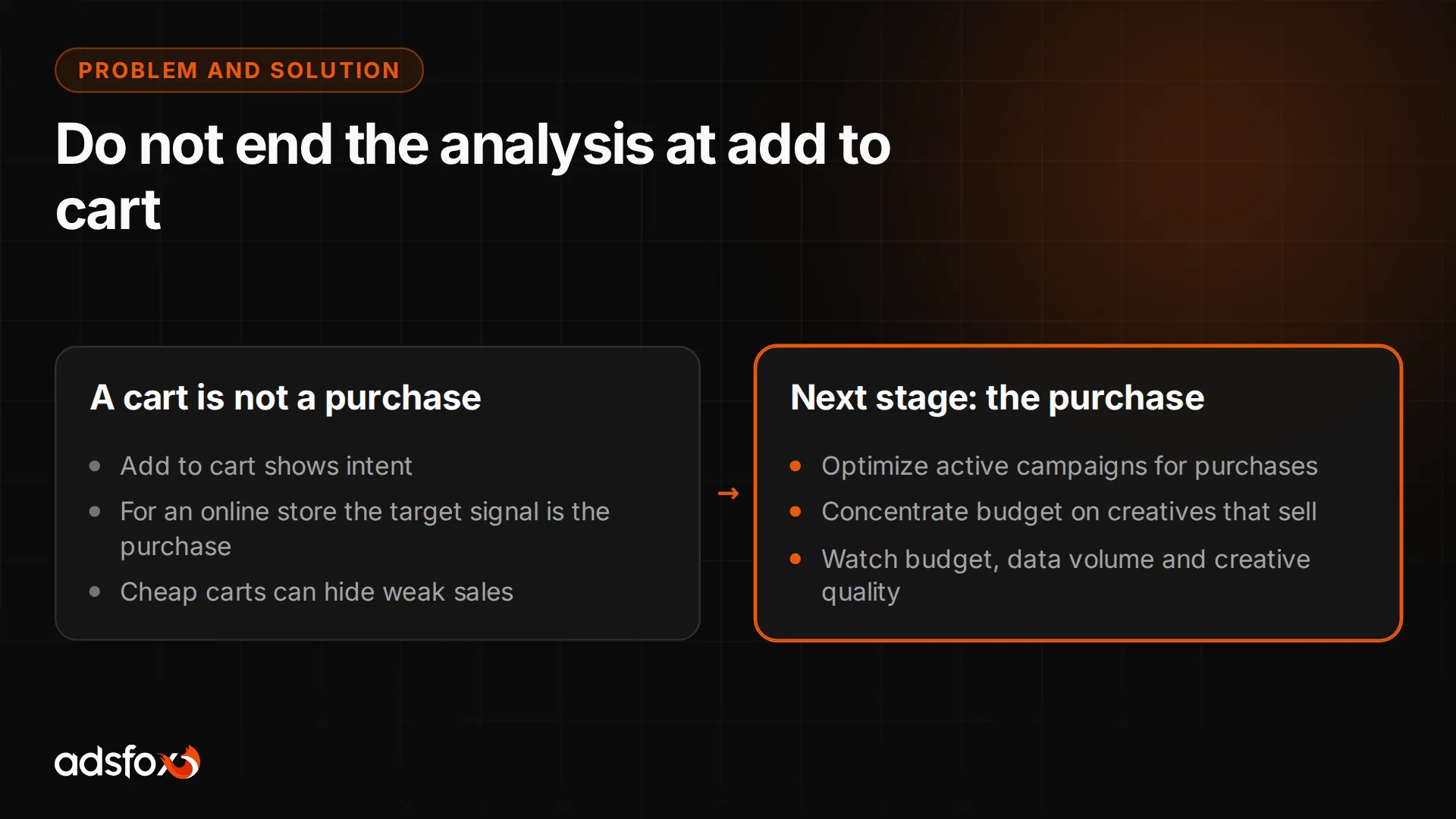
For an online store, switching from add to cart to purchase optimization is not just swapping one metric for another. It is a change of signal. The cart shows interest; the purchase shows the real sales result. So when moving to purchase optimization, you have to watch the budget, the data volume and the creative quality.
How to run Meta Ads for a store selling original products
The lessons from this project come down to five rules.
First, show the product authentically. For illustrations, art prints and posters, what matters most is the real look of the work, the detail, the framing and the context of use.
Second, a small budget demands focus. At $150-190 a month, too many campaigns, ad sets and collections at once will fragment the data. It is better to test fewer things and draw clearer conclusions.
Third, seasonality is part of the strategy, not an obstacle. Calendars, gift sets, fall and holiday collections can build demand naturally if the ads are timed to the buying moment.
Fourth, treat local city series separately. Collections tied to specific cities may need different messaging than the nationwide offer.
Fifth, the end goal is measuring purchases. That is why at adsfox, as a Facebook and Meta ads agency, we combine campaign management with choosing the right conversion objective and optimizing e-commerce campaigns for real sales.
Summary
This case study shows that Meta Ads for an online art print store can improve purchase signals even on a small budget. In the data we can show, the cost per add to cart dropped from about $41 to $2.65, and the later report recorded 14 add to carts.
The key business result is more add to carts and sales, plus the ability to test recurring seasonal collections. The natural next stage is optimizing the campaigns for purchases.
adsfox is a marketing agency for service businesses and online stores that runs the whole funnel: content, SEO and GEO, paid campaigns and the website. More than 350 clients since 2018, Badged Meta Business Partner and Google Partner.
Book a free consultation and we will check whether your e-commerce campaigns are optimized for the signal that actually drives sales.
Related adsfox services
We can run a campaign like this for your store as your Facebook ads agency. If you want to first check whether your budget is chasing the right signal, start with a digital marketing audit. Search traffic is built separately, through an SEO agency engagement, and you can find results from other projects in our case studies. Broader e-commerce lessons are collected in our marketing tips.