
Meta Ads for an Online Jewelry Store: From $20 Leads to $3.26 Add to Carts

Jewelry advertising on Meta Ads can effectively support an online store’s sales, but only when the campaign is set up for real shopping behavior. This case study covers a client in the jewelry business whose main problem was a lack of sales from the website. After cleaning up measurement and switching the campaign objective from leads to add to carts, the cost of the key action dropped from about $20 per lead to about $3.26 per add to cart.
The client sells jewelry nationwide in Poland through an online store. At the start, the biggest problem was not reach. The problem was that the ads did not lead clearly enough to sales on the website. Campaigns generating leads or phone calls were not a good fit for an online store’s model.
In jewelry e-commerce, shoppers often want to look at the product, compare variants, come back to the store and only then decide. So the campaign should guide them along the purchase path, not shift the decision to a form or a phone call.
Meta Ads for a jewelry store: project goal
The goal was to launch measurable Meta Ads activity that would support the online store, not just generate leads from ads. In practice that meant changing how campaigns were evaluated.
Instead of looking only at forms or calls, we focused on actions closer to a purchase. Add to cart became the key signal, because it shows more intent than a click or an inquiry.
Key project assumptions:
- clean up campaign measurement,
- implement Google Analytics 4 and the Meta Pixel,
- run 100% of the activity in Meta Ads,
- switch the campaign objective to add to cart,
- use both cold and remarketing campaigns,
- develop product campaigns for the online store.
adsfox is a Meta Business Partner, so in projects like this we look not only at the cost per result in the dashboard, but also at whether that result actually fits the client’s business model.
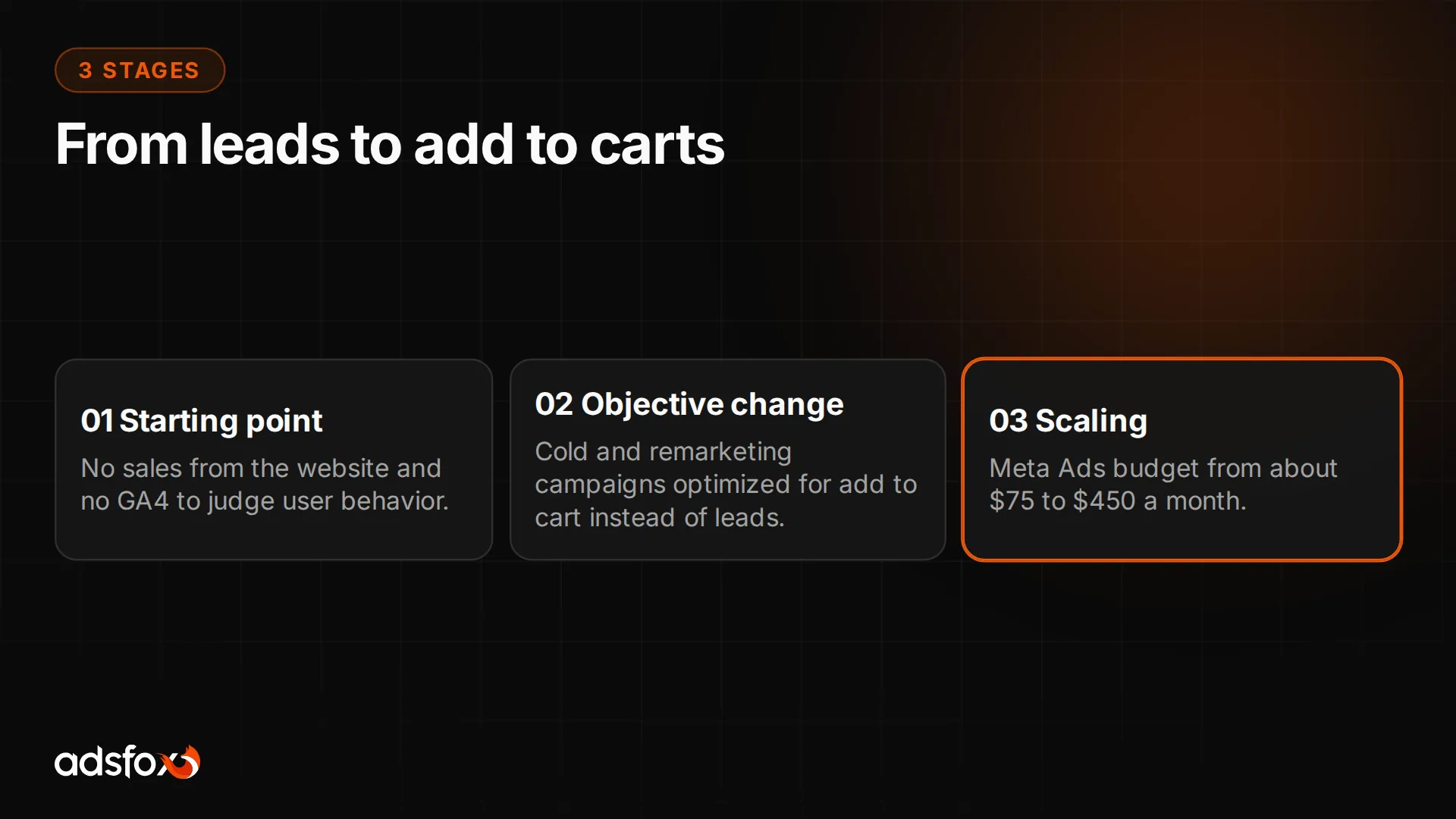
Starting point: no sales from the website
At the start, the client’s biggest problem was a lack of sales from the website. The company needed measurability and a clear answer to whether the ads were actually supporting the online store.
On the analytics side, Google Analytics 4 was missing. So before evaluating campaign performance, the measurement basics had to be put in place. Without them, a campaign can generate actions in the ad dashboard while the company still does not know which user behaviors bring it closer to a sale.
This is especially important in e-commerce. A cheap lead, a cheap click or a cheap page view can look good in a report but do nothing for jewelry sales. If users do not add products to the cart and move through checkout, the campaign needs a different objective or structure.
So the starting point was moving from leads to actions closer to a purchase.
The screenshot below shows the earlier campaign setup in Meta Ads Manager: a click-to-call campaign and remarketing. It is useful context for reading this case study, because for an online store a lead or a call does not yet mean real purchase intent.

Ad budget and channels
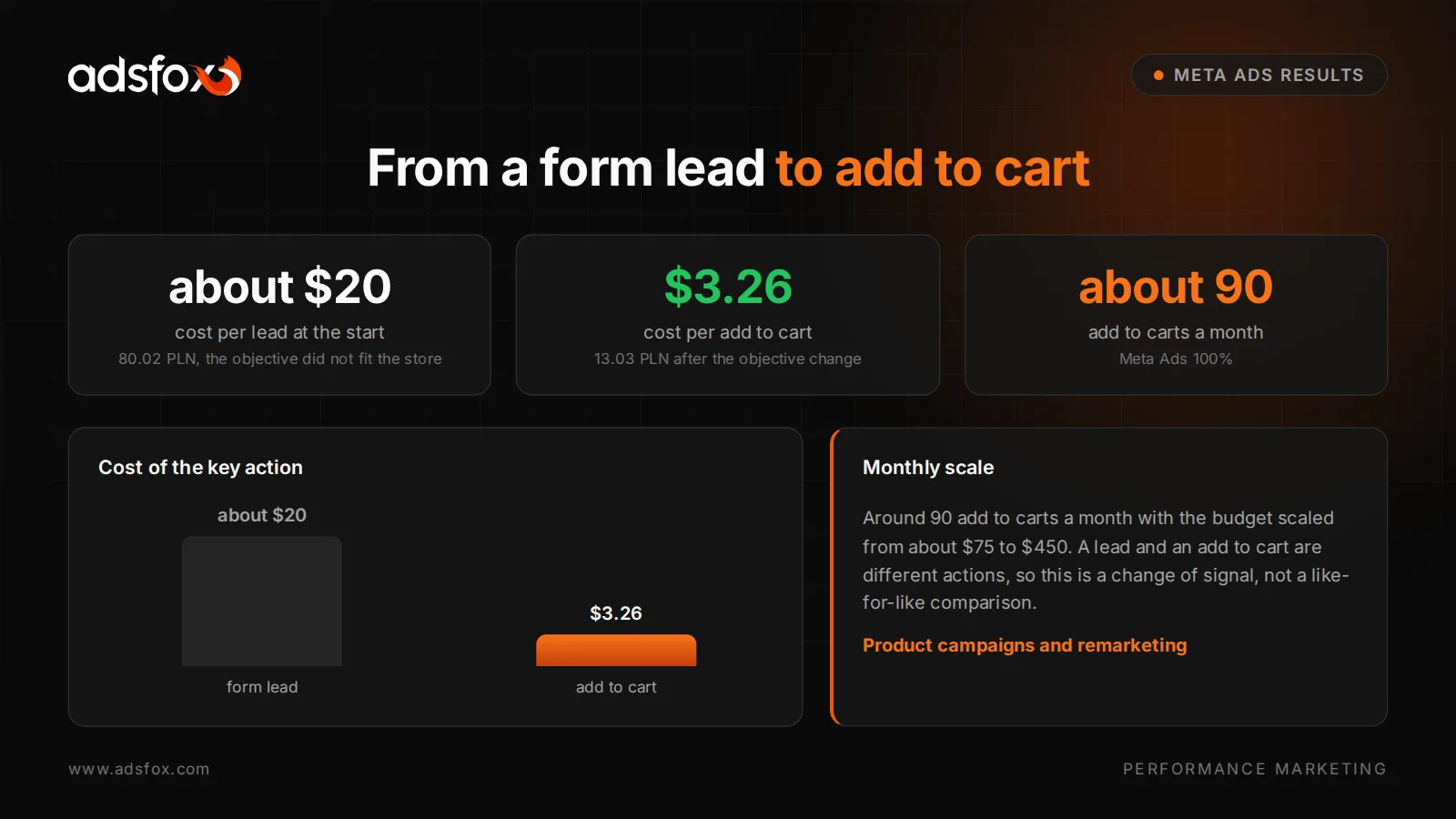
The starting ad budget was about $75 a month. Today it is about $450 a month. All activity ran in Meta Ads, meaning Facebook and Instagram.
That budget increase matters, because it shows the shift from a test-level setup to a more predictable advertising system. At $75 a month you can check initial assumptions, but it is hard to collect stable data for optimization quickly.
A typical starting budget for this niche is about $450 a month. That level gives a better chance of collecting shopping behavior data and allows remarketing, product campaigns and creative tests.
In the project we used:
- Meta Ads as the only ad channel,
- cold campaigns optimized for add to cart,
- remarketing optimized for add to cart,
- product campaigns,
- audiences related to jewelry, accessories and online shopping.
The business lesson is simple: for an online store, the budget should support the sales goal, not just keep ads running. If the campaign is supposed to sell, its objective has to match the stage of the purchase.
What we implemented on the technical side
We implemented Google Analytics 4 and the Meta Pixel. These are the measurement basics for an online store that wants to analyze user behavior and optimize campaigns for specific actions.
Google Analytics 4 gives a broader view of traffic and on-site behavior. The Meta Pixel sends the ad platform the signals it needs to optimize campaigns. In e-commerce both matter, because running ads is not enough. The platform needs data that shows what happens after the click.
With measurement in place, we could move to the more important change: optimizing for add to cart. That signal fits an online store better than a form lead or a phone call.
In projects like this we connect campaigns, the store and the data into one system. Decisions are then based on whether users take actions closer to a purchase, not on gut feeling.
Why we switched the objective from leads to add to cart
At the start, the cost per lead was about $20. That was a form lead. The problem was that for an online store, such a lead is not always the best indicator of purchase intent.
In jewelry, customers often buy emotionally, but they still need to see the product, come back to it, compare variants and feel that it fits the occasion. So add to cart was the better signal for the campaign.
After the objective change, the cost per add to cart was about $3.26. The campaigns generated around 90 add to carts a month.
This is not a like-for-like comparison of the same conversion, because a lead and an add to cart are different actions. The conclusion is clear, though: the previous objective did not match how the online store sells. After the change, the campaign started collecting signals closer to the real purchase path.
Below is a screenshot from the campaigns after switching the objective to add to cart. At the cold campaign level, there are 97 add to carts at about $3.12 each, and in remarketing 22 add to carts at about $7.13 each. This is ad platform data showing the shift from a lead signal to behavior closer to a purchase.

What works in jewelry advertising
In this niche, product campaigns, cold campaigns optimized for shopping behavior and remarketing work well. Jewelry is a category where the product image, the occasion and the emotional context carry a lot of weight.
In the Meta Ads campaigns, audiences tied to jewelry and online shopping made sense. Interests such as engagement ring, earrings, ring, jewelry, accessories, bracelet, necklace, watch, luxury goods and online shopping performed.
Life-event contexts can also be valuable, for example an anniversary in the coming weeks, or friends of women with an upcoming birthday. Such angles help match the ad to a buying occasion rather than a general interest in fashion.
The most important thing, though, is that the campaign does not stop at a lead. If the store is meant to sell online, the messaging, the product and the campaign objective should lead the user to the cart.
What to avoid in this niche
A key lesson from this project was to avoid lead ads and click-to-call campaigns as the main objective. That does not mean such campaigns never make sense. It means that for an online jewelry store they should not be the default way to judge sales performance.
If a user sees a product and wants to buy it, the natural next step is going to the store, viewing the variant and adding it to the cart. A form or a phone call can lengthen the path and generate a lead that does not necessarily turn into a sale.
Also watch out for overly broad targeting with no shopping context. Jewelry is a wide category, so a declared interest in jewelry alone can be too weak a signal. It is better to combine it with an occasion, a product style, shopping behavior or remarketing.
A good campaign in this niche should help the user picture the product in a specific situation: a gift, an anniversary, an engagement, a birthday or a purchase for themselves.
What actually changed for the client
The most important change was moving to a broader scope of work and more consistent advertising. After an earlier, smaller service package, the client expanded the engagement with adsfox, including graphic design.
That is an important business signal. When a client expands the scope, marketing stops being a one-off test and becomes a permanent part of sales.
In practice, the project made it possible to:
- move from leads to behavior closer to a purchase,
- clean up measurement in GA4 and Meta,
- scale the ad budget from about $75 to $450 a month,
- run 100% of the activity in Meta Ads,
- develop creatives and product campaigns,
- prepare the ground for restarting after a seasonal pause.
This shows that in e-commerce, the result is not always one spectacular number. Sometimes the most important thing is a change of system: from random leads to measurable actions closer to a purchase.
What’s next
In the coming months the plan is to restart activity after a seasonal pause. Further optimization is on the table, along with a proposed TikTok Ads test as an additional channel.
TikTok Ads can make sense in jewelry if the brand has good product material and can show the product in a short, visually appealing format. This is not about launching a channel because it is trendy. First you have to check whether the creatives, the offer and the purchase path allow you to measure the effect.
Further development should focus on product campaigns, remarketing and testing messaging for specific buying occasions. In jewelry, seasonality, gifting and emotional context matter a lot.
Summary of the engagement with adsfox
In this case study, the Meta Ads campaign for the jewelry store showed that changing the campaign objective can completely change how advertising is evaluated.
Key numbers from the project:
- ad channel: Meta Ads 100%,
- starting budget: about $75 a month,
- current budget: about $450 a month,
- cost per lead at the start: about $20,
- cost per add to cart after optimization: about $3.26,
- add to carts per month: around 90,
- length of engagement: 2 years.
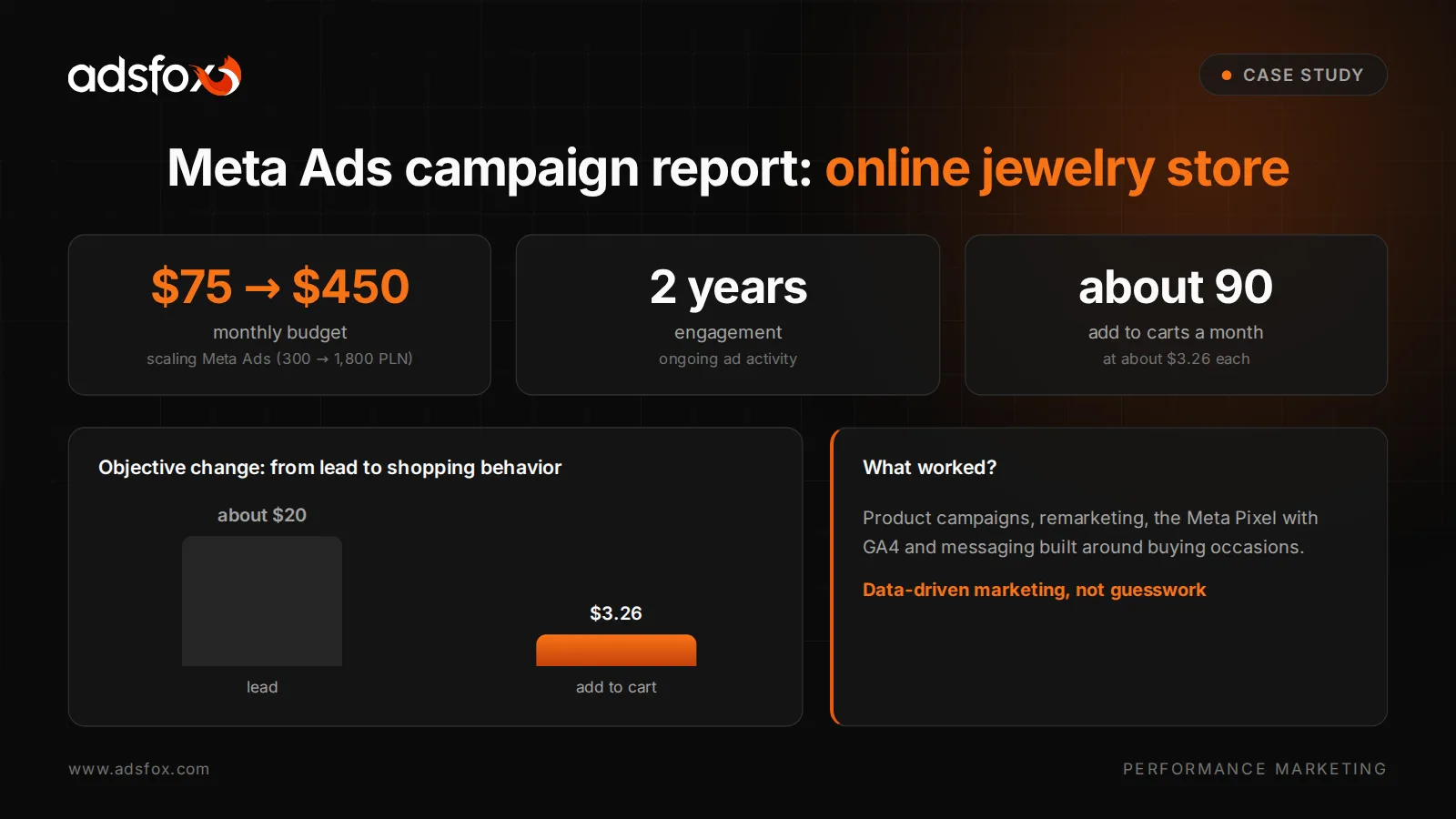
The conclusion is simple: jewelry advertising on Meta Ads should be optimized for shopping behavior, not for leads. If the store sells online, what matters most is whether the campaign helps the user reach the cart and move toward a purchase.
If you run an online store and want to check whether your campaigns are optimized for real shopping actions, let’s talk about campaigns for your e-commerce.
We can run a campaign like this for your company as your Facebook ads agency.
Related adsfox services
We can run a campaign like this for your company as your Facebook ads agency. Search traffic to the store is built separately, through an SEO agency engagement. If you want to first check where your budget is leaking today, start with a digital marketing audit, and organizing and grading lead quality is covered by lead generation optimization. See results from other projects in our case studies. Broader e-commerce lessons are collected in our marketing tips.