
Meta Ads for a Medical Aesthetics Clinic: 143.8% More Qualified Leads

A Meta Ads campaign for a medical aesthetics clinic should not be judged by the number of forms alone. This case study shows a project for a beauty and medical aesthetics brand in Europe, where lead scoring in the adsfox tool and quality signals sent back to Meta helped increase qualified leads from 80 to 195, while unqualified leads dropped from 299 to 232. The headline result is not more forms, but a much larger share of contacts with real sales potential.
Screenshots show amounts in Polish zloty (PLN); in the text we converted them to US dollars at roughly 4 PLN per dollar.
How to run lead generation campaigns for medical aesthetics
How did Meta Lead Ads, lead scoring and quality signals improve lead quality for a beauty brand running an event-based model?
In beauty and medical aesthetics, a cheap form can be misleading. A campaign can look good in the ad dashboard because it generates a lot of submissions, but some of those contacts have no real sales potential. The person may be outside the event location, may not respond to follow-up, may be undecided, or may have left their details out of curiosity.
That is why the key in this project was shifting the focus: from raw form volume to lead quality. Meta Ads was not just supposed to collect submissions, but to learn which contacts were valuable and which could realistically end in a booked appointment.
Kinga’s situation
Kinga represents a brand in the beauty and medical aesthetics industry. The company runs lead generation on Meta Ads in multiple cities across Poland, with campaigns geo-targeted to specific event dates and available treatments.
The acquisition model was built on Meta Lead Ads. A person left their contact details in a form, and the team could then qualify the submission and book an appointment. It is a natural model for services where the customer’s decision requires a conversation, scheduling and confirming interest in a treatment.
The problem was that the number of forms alone said too little about campaign quality. The questions that needed answers: which leads had real value, which ended in a booked appointment, and how to teach the ad platform that not every form is equal.
Why the number of leads alone is not enough
In lead generation campaigns, it is easy to fall into the trap of optimizing for the cheapest form. The ad dashboard shows cost per lead, number of results and budget, but it does not automatically tell you whether the contact was any good. For a service business, that is the crucial difference.
A lead from Meta Ads can be cheap but worthless. It can also be more expensive but better matched and closer to booking. In beauty and medical aesthetics this difference is especially important, because handling each contact costs the team’s time, and event slots are limited.
So the goal of the project was to connect the campaign to quality scoring. Instead of judging results only by CPL, we started analyzing the share of qualified and unqualified leads, and sending Meta information about which contacts had more business value.
What convinced the client to take this approach
The deciding factor was the ability to score lead quality in the adsfox tool. The client needed more than a report with a form count. They needed a system that showed which submissions were valuable and which could lead to a booked appointment.
adsfox is a Meta Business Partner, but in projects like this, knowing the ad dashboard is not enough. What matters is what happens after the form is submitted. Only the combination of Meta Lead Ads, the Pixel, the Conversions API, lead scoring and quality analysis shows whether the advertising actually supports sales.
If a campaign is supposed to learn from better data, it pays to invest in lead generation optimization. In practice, that means the ad platform gets a signal not only about the form, but also about whether the contact had real value for the business.
Budget and campaign scope
In this case study we analyze two two-month periods:
- December 2025 through January 2026,
- February 2026 through March 2026.
In the first period, Meta Ads spend was about $3,220. In the second period, it was about $3,030. This matters, because the quality improvement did not come from simply adding budget. The second period had lower spend, and qualified leads still went from 80 to 195.
The main channels were Facebook and Instagram Ads. The campaigns ran on Meta Lead Ads and drove sign-ups for beauty and medical aesthetics treatments in an event-based model.
What we implemented on the technical side
The project used several elements that together created a funnel for valuable leads:
- Google Tag Manager,
- the Meta Pixel,
- Conversions API / server-side tracking,
- the adsfox tool for lead scoring,
- custom events and quality signals,
- marking contacts that ended in a booked appointment,
- sending the quality signal back to Meta.
Server-side tracking sends event data from the server, which helps limit signal loss and improves the quality of the data ad platforms use. In this project, the key was not the technical implementation itself but its business effect: Meta could receive a better signal about the value of each contact.
This approach is especially important when a company wants to optimize campaigns for something more than a form submission. We describe it in more detail on our server side tracking service page.
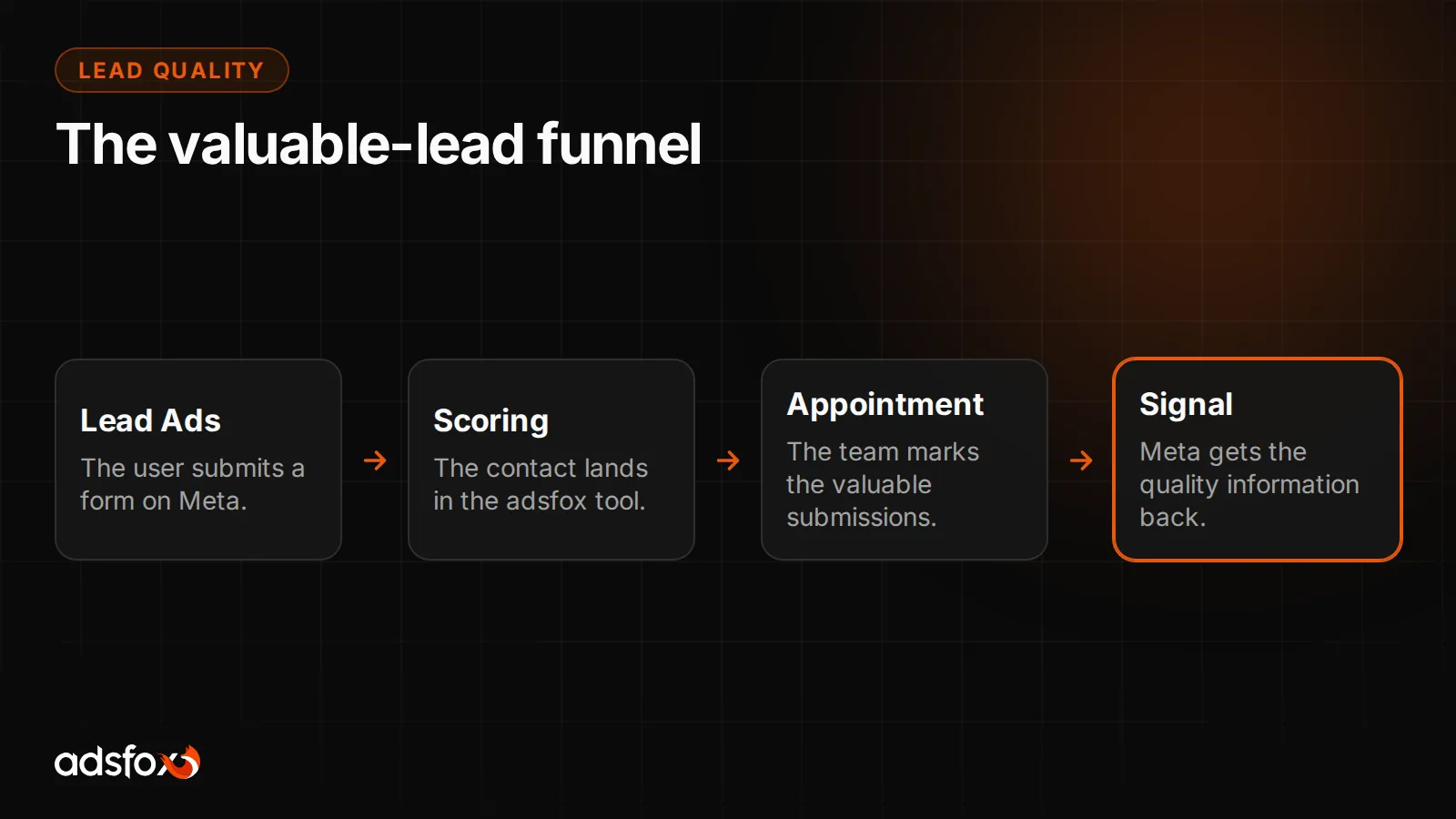
Marketing actions taken
Meta Lead Ads campaigns
In the Meta Lead Ads campaigns we focused on collecting contacts for events and treatment dates. We tested creative, audiences and campaign structures, but the most important change was in how results were evaluated.
The campaign was not judged only by how many forms were submitted. We analyzed which contacts were qualified, which were not, and which could end in a booked appointment. That way, campaign optimization was based on lead quality, not just cost per form.
Lead scoring in adsfox
Leads flowed into the adsfox tool, where contacts could be scored and their value marked. That made it possible to tell qualified leads from unqualified ones.
This difference is critical. If a campaign generates 400 forms but most of them have no sales potential, the sales team wastes time. If the share of qualified leads grows instead, the company can handle fewer random submissions and focus on contacts closer to booking.
Feedback signal to Meta
The most important element was sending quality signals back to Meta through the Pixel and the API. That let the ad platform learn from a better signal than a bare form submission.
In practice, that changed the logic: not “find more people who will submit a form,” but “find more people like the ones who turned out to be valuable contacts.” That is what separates a data-driven lead generation campaign from one judged by CPL alone.
What results did the Meta Ads campaigns deliver?
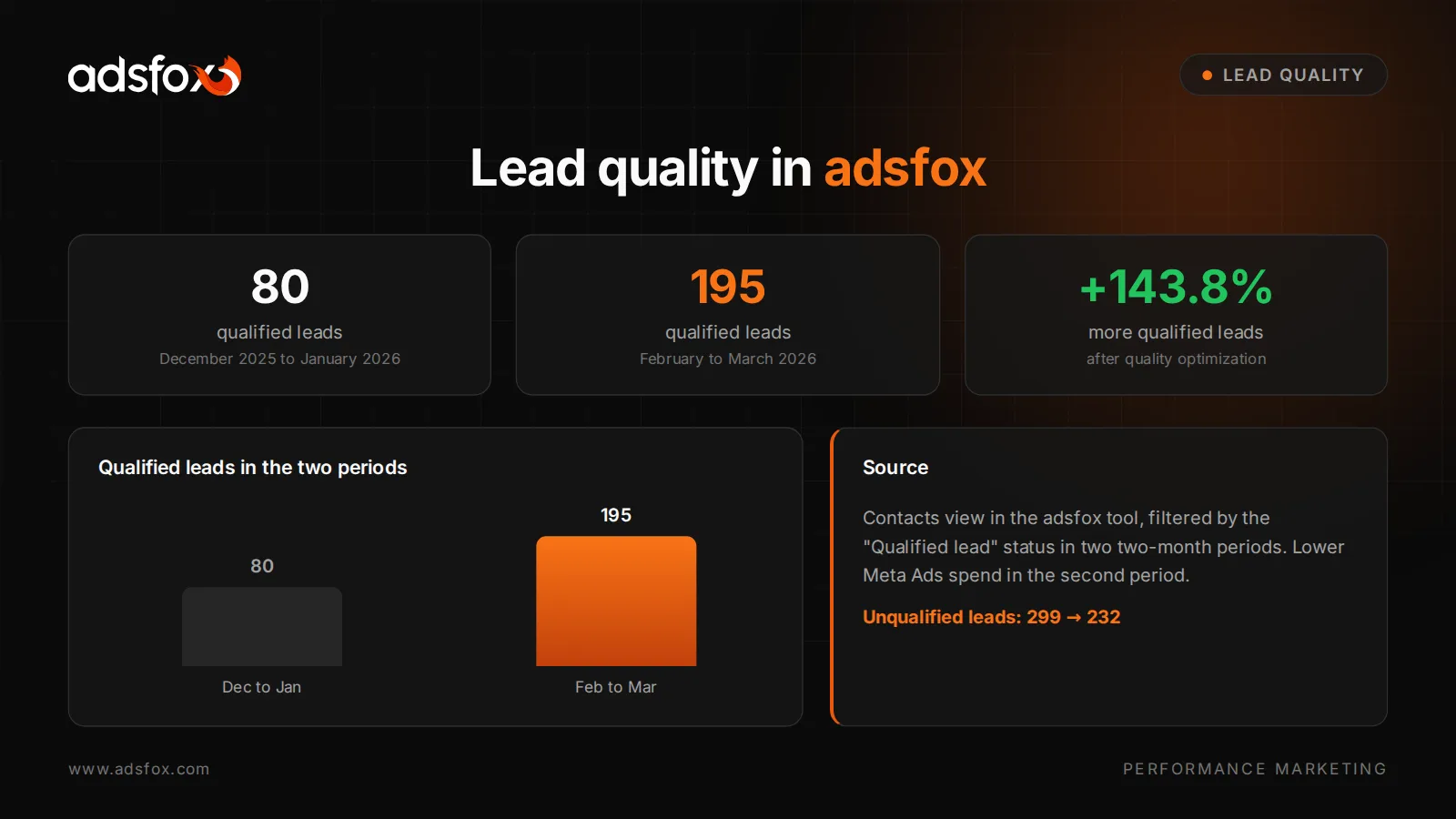
In the first period, December 2025 through January 2026, the campaigns generated 379 scored leads. 80 of them were qualified and 299 were unqualified. The share of qualified leads was 21.1%.
In the second period, February through March 2026, the number of scored leads grew to 427. Qualified leads rose to 195, and unqualified leads dropped to 232. The share of qualified leads rose to 45.7%.
The key numbers:
- all scored leads: 379 to 427,
- qualified leads: 80 to 195,
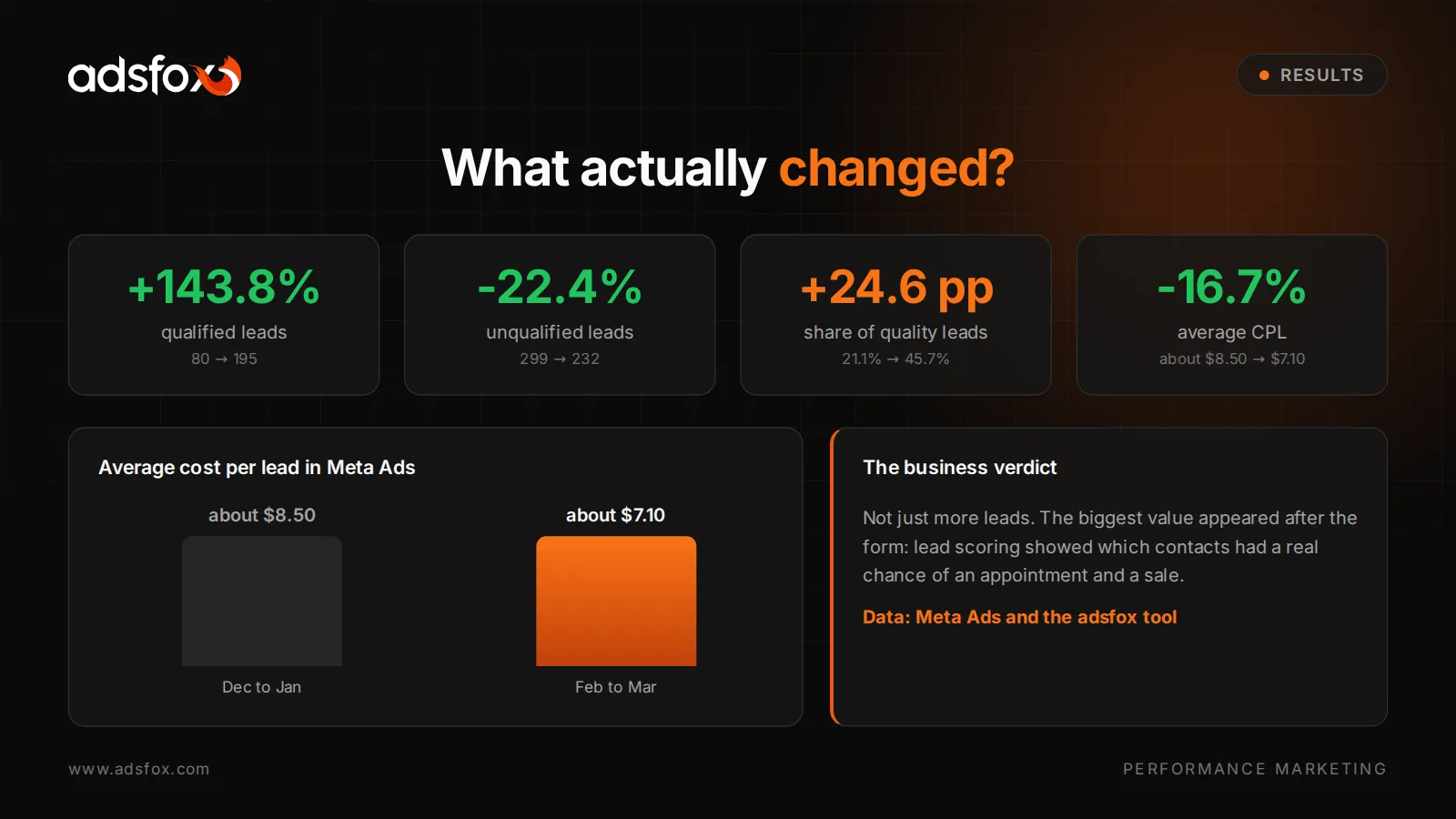
- unqualified leads: 299 to 232,
- share of qualified leads: 21.1% to 45.7%,
- increase in qualified leads: +143.8%,
- decrease in unqualified leads: -22.4%,
- increase in the share of quality contacts: +24.6 percentage points,
- average CPL in Meta Ads: about $8.50 to about $7.10.
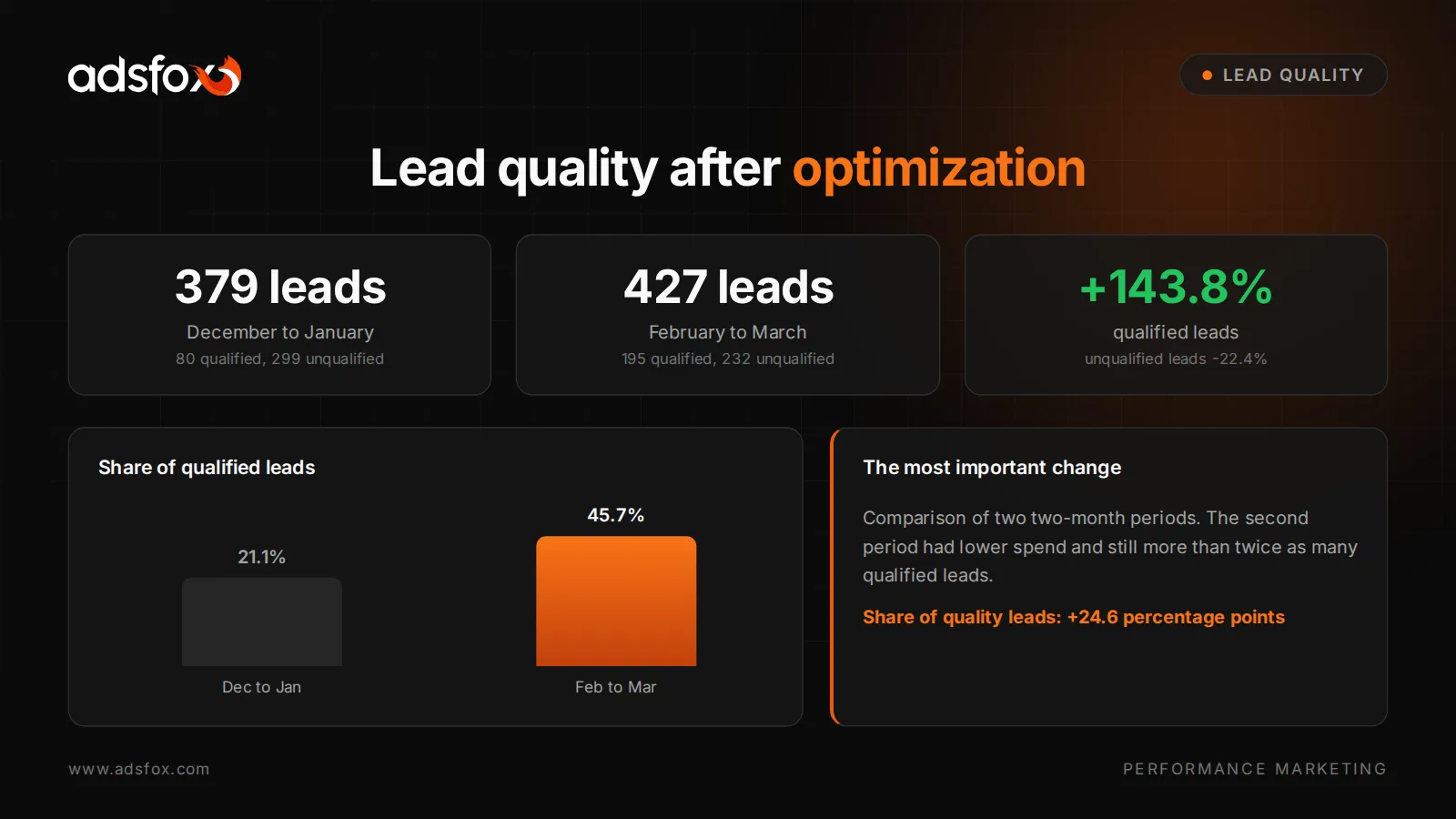
Results visible in Meta Ads and adsfox
Below you can see the results from the Meta Ads campaigns and the lead quality scoring in adsfox. The screenshots show the two analyzed periods and help compare the ad dashboard data with what happened to the contacts later, on the qualification side.
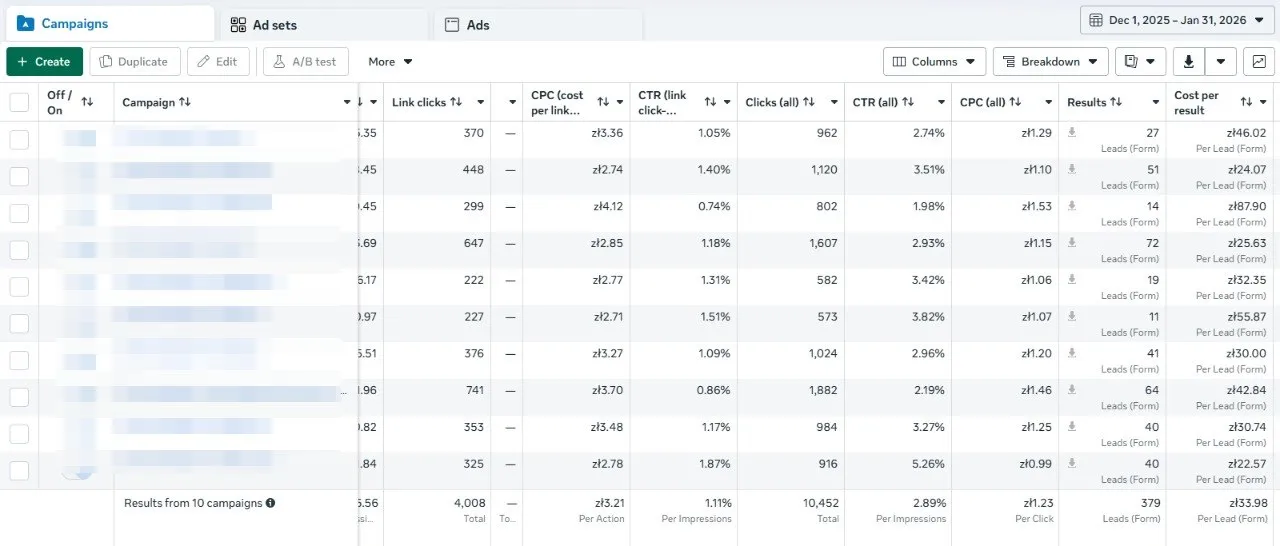
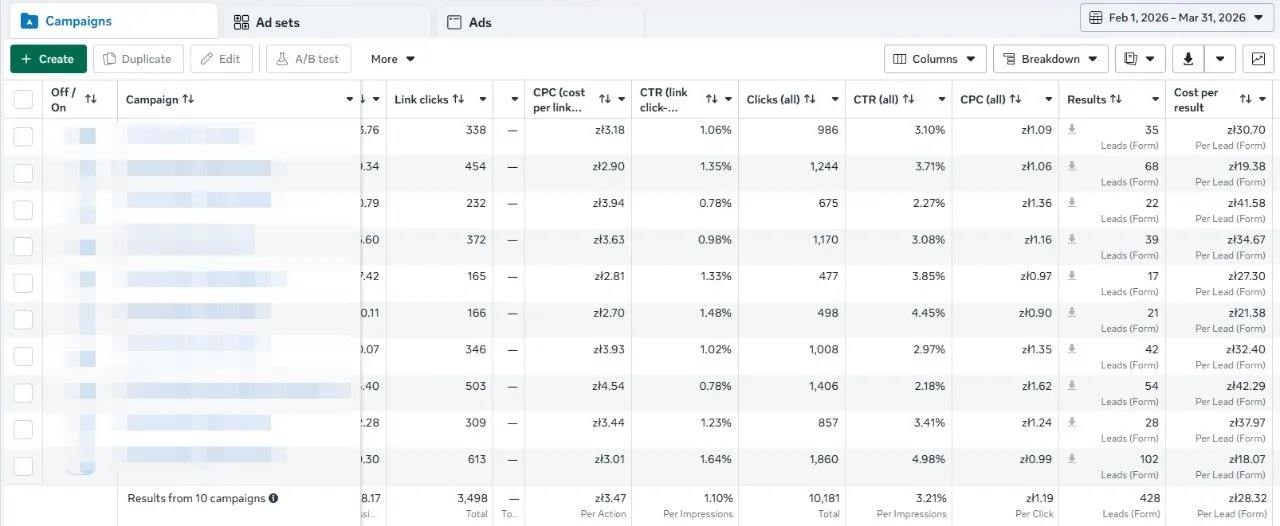
Note the difference between the Meta Ads data and the adsfox scoring. In the second period, Meta Ads shows 428 form leads, while the quality analysis uses 427 scored leads in the adsfox tool. That is a normal distinction: the ad dashboard shows the campaign result, while the scoring system shows what happened to the contacts afterwards.
What actually changed for the client
The biggest change was in the quality of work with leads. The client could evaluate campaigns not only by the number of forms but by how many contacts had real sales potential.
In practice, that meant:
- more valuable contacts to handle,
- a larger share of leads that could end in an appointment,
- fewer random submissions relative to volume,
- better information about which campaigns generate quality,
- the ability to send a better signal to Meta,
- optimization for the real value of a contact, not just the cost of a form.
That is an important lesson for every service business. If a campaign generates leads but the company does not know which ones are valuable, the algorithm can scale the wrong signal. Only lead scoring separates volume from quality.
What comes next
The next steps should focus on further optimizing the Meta Ads campaigns for qualified leads. In practice, that means continuing to send quality signals to Meta through the Pixel and the API, developing lead scoring in the adsfox tool, and marking contacts that ended in an appointment more precisely.
It also pays to keep testing creative and audiences, but not to judge them by CPL alone. In this project the key question is: which messages generate contacts that are actually worth handling?
For beauty and medical aesthetics this is especially important, because overly aggressive sales messaging can attract random submissions. A message that filters for interest and helps the person understand whether the offer is for them works better.
How to run lead generation campaigns for a med spa effectively
This case shows four practical lessons.
First, counting forms is not enough. A form is a starting point, not a definition of success. You need to know whether a contact is qualified and whether it can end in an appointment.
Second, lead generation campaigns should have a quality funnel. If the team marks leads in a system, marketing gets data that helps make better decisions.
Third, Meta needs a good feedback signal. If the ad platform sees only form submissions, it learns to get more forms. If it sees quality, it can optimize better.
Fourth, CPL is not the only metric. In this project the average CPL dropped from about $8.50 to about $7.10, but the 143.8% increase in qualified leads was far more important.
If you want to check whether your campaigns run by a Facebook ads agency are generating quality leads, book a free marketing consultation and we will review your forms, lead scoring and the signals going back to Meta.
Summary of the engagement
In this case study, the Meta Ads campaign for a medical aesthetics brand showed that the biggest value in lead generation appears after the form. Only lead scoring lets you judge whether a campaign generates a real sales opportunity.
The key results:
- +143.8% qualified leads,
- -22.4% unqualified leads,
- +24.6 percentage points in the share of valuable leads,
- +12.7% in all scored leads,
- Meta Ads CPL about 16.7% lower,
- a quality signal to Meta implemented through the Pixel and the API.
The conclusion is simple: in lead generation campaigns for beauty businesses, the point is not to have the most forms. The point is for the campaign and the algorithm to learn from the contacts that actually matter for sales.
If you want to check whether your campaigns are optimized for quality and not just for cheap leads, let’s talk about your lead generation system. We will show you where you are losing value and how to make better use of your campaign data.
The client remains anonymous. In this public case study we do not give the company name, website address or any details that would identify the brand, because real campaign results are the client’s competitive advantage.
Related adsfox services
We can run a campaign like this for your company too, through our Facebook ads agency. Organic search demand is built separately by our SEO agency, including local SEO for clinics in specific cities. If you want to first check where your budget is leaking today, start with a digital marketing audit. Scoring and evaluating contact quality is handled by lead generation optimization, and you can find results from other projects in our case studies.