
Meta and Google Ads for a Raw Dog Food Store: 10-16x ROAS After Fixing Tracking

Raw dog food e-commerce case study: how to advertise a BARF diet store
How fixing conversion tracking and combining Meta and Google Ads campaigns made it possible to actually measure the profitability of advertising for a raw dog food store and reach a ROAS of 10-16x.
The client: Maciej and his raw dog food store
Maciej runs an online store selling high-quality raw meat for dogs: beef, lamb, horse meat and other cuts that form the basis of a BARF (raw feeding) diet. The store is based in Poland, ships nationwide, and runs on a classic e-commerce model with online orders and delivery.
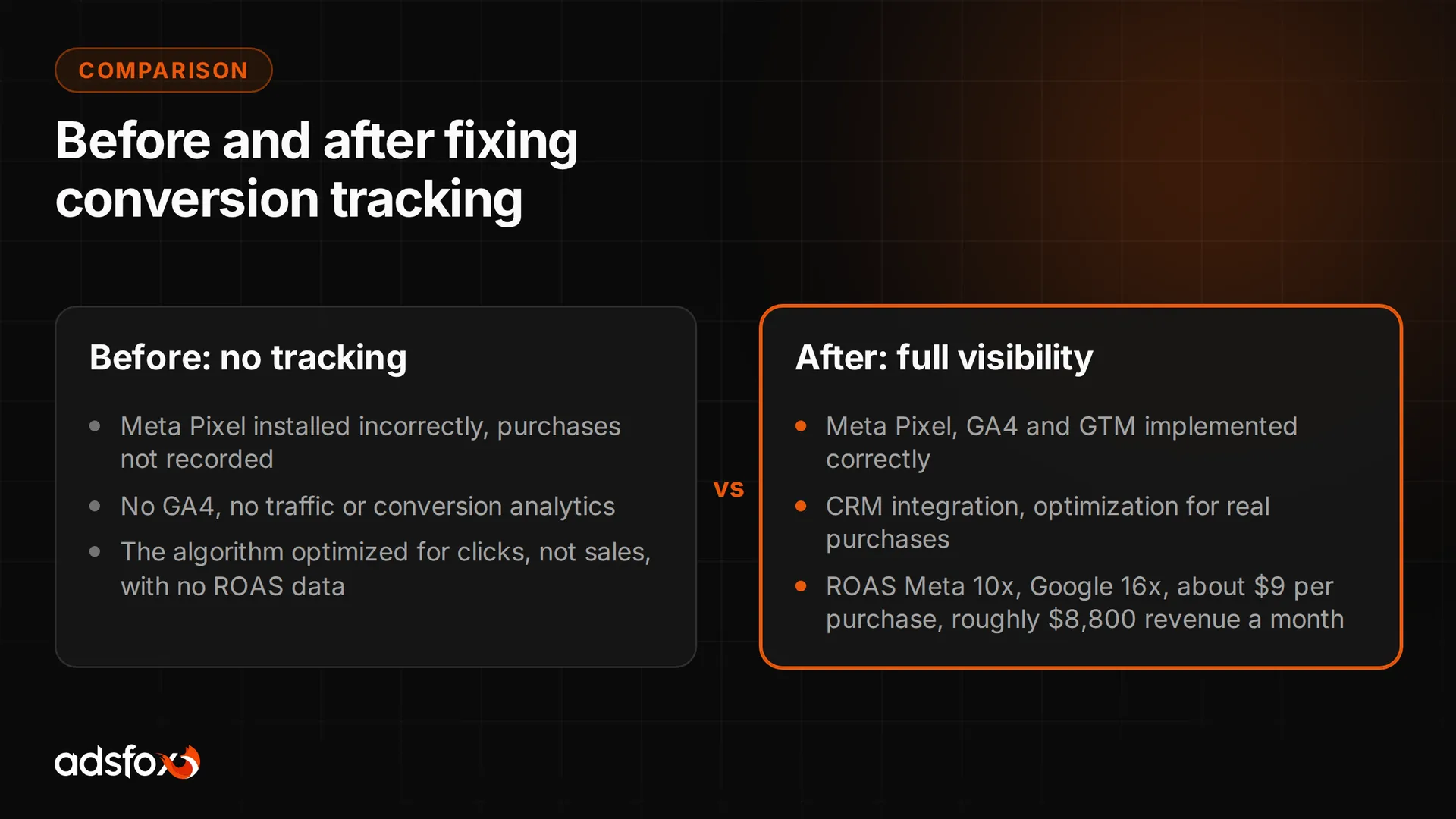
Meta campaigns (Facebook and Instagram) were already running before we came in. The ads were live and the budget was being spent, but there was a fundamental problem: the client did not know whether those campaigns were actually driving sales. The Meta Pixel was installed incorrectly on the site, and purchase events and order values were not being recorded. The algorithm was optimizing the campaigns with no signal about what was really selling.
We see this situation regularly: campaigns spend money, Ads Manager shows clicks and reach, but no purchases. For an e-commerce store, missing conversion tracking is not a technical inconvenience. It is a state in which you cannot make data-driven decisions at all.
First contact with adsfox
Maciej found us through our Meta ads. He noticed his campaigns were running, but he could not tell whether they were paying off. Without purchase data, no planning was possible. You cannot scale what you do not measure.
The free, no-obligation consultation
During the consultation we quickly diagnosed the main risk: the Meta Pixel on the store was not recording purchase events or their values. That meant the ad algorithm was getting no feedback about conversions. The campaigns were running blind, optimizing for clicks and reach instead of real purchases.
On top of that, the site had no correctly configured GA4, and the analytics were not connected to the client’s CRM. Without those pieces there was no way to tie ad spend to sales revenue.
We proposed a complete tracking fix: reinstalling the pixel, implementing GA4 through Google Tag Manager and integrating with the client’s CRM. Only after that stage could the campaigns start optimizing for purchases.
How the engagement started
The engagement started in early 2024. The first step was not increasing the budget, but putting the tracking fundamentals in order. Without correct data, every additional dollar spent on ads would have been a decision made in the dark.
Advertising budget for a raw dog food store
At the start, the campaigns ran on a budget of about $500 a month. After tracking was implemented and profitability confirmed, the budget was increased to about $1,250 a month (Meta and Google Ads combined), split as follows:
- Meta Ads (Facebook and Instagram): 50%, building demand, remarketing, product creative,
- Google Ads (Search and Performance Max): 50%, capturing purchase intent, products in Google results.
Technical preparation before launching the campaigns
This was the key stage of the whole project. Before increasing the budget, we cleaned up everything that makes results measurable.
Fixing the Meta Pixel
The pixel on the store was installed but misconfigured. Purchase events and conversion values were not being recorded. The ad algorithm was working with no information about what was actually selling. We reinstalled the pixel correctly so that every purchase is recorded together with its value.
Implementing GA4 and Google Tag Manager
The store did not have a correctly configured Google Analytics 4. We implemented GA4 through Google Tag Manager, which gave full control over the events tracked on the site and made later changes easy without touching the store’s code.
Integrating with the client’s CRM
We connected the ad data with the client’s CRM. The campaigns could now be optimized not just for clicks or add-to-cart events, but for real purchases and their value.
adsfox is a Meta Business Partner and a Google Partner. That means access to the platforms’ technical support and early information about changes that affect conversion tracking. When fixing a pixel that matters: misconfigured events are one of the most common problems e-commerce stores run into. If your setup needs the same kind of cleanup, our server side tracking service covers it.
What we implemented in the Meta and Google Ads campaigns
After fixing tracking, we launched campaigns in two channels with a 50/50 split.
Google Ads campaign
Google Ads captured purchase intent: people actively searching for dog food, raw meat for dogs or a BARF diet. On Google we ran:
- Google Search, campaigns on keywords related to dog food, the BARF diet and pet health,
- Performance Max, automated product campaigns using the store’s product feed, showing specific products and prices in Google results.
Facebook and Instagram campaign
Meta Ads built demand and reached people who might not be actively searching for BARF food but matched the target audience. We used:
- automated (Advantage+) campaigns with broad targeting and no restrictions,
- audiences: dog health, dog breeds, pet food,
- remarketing to people who visited the store but did not buy,
- creative communicating quality and care for the dog. The message “high-quality meat prepared with care for your dog” resonated with the audience and set the brand apart from generic dog food ads.
The niche category and low awareness of the BARF diet among potential customers were a challenge. Broad campaigns with no exclusions turned out to be more effective than tight targeting. The algorithm needed room to find the right people in a category where many of them do not yet know they are looking for this product.
Raw dog food store Meta and Google Ads results
Results came quickly. We saw the first results within 2-3 weeks of fixing the pixel. Without a purchase signal the algorithm had nothing to optimize for. Once the pixel started recording purchases and their value, the campaigns began learning and improving.
Key metrics after optimization:
- Cost per purchase: about $9 (after the pixel fix; before that there was no data, tracking did not work),
- Purchases per month: about 30 from Meta, about 55 from Google (about 85 in total),
- Meta ROAS: 10x (return on Facebook and Instagram ads),
- Google ROAS: 16x (return on Google Search and Performance Max),
- Revenue from campaigns: roughly $8,800 a month.
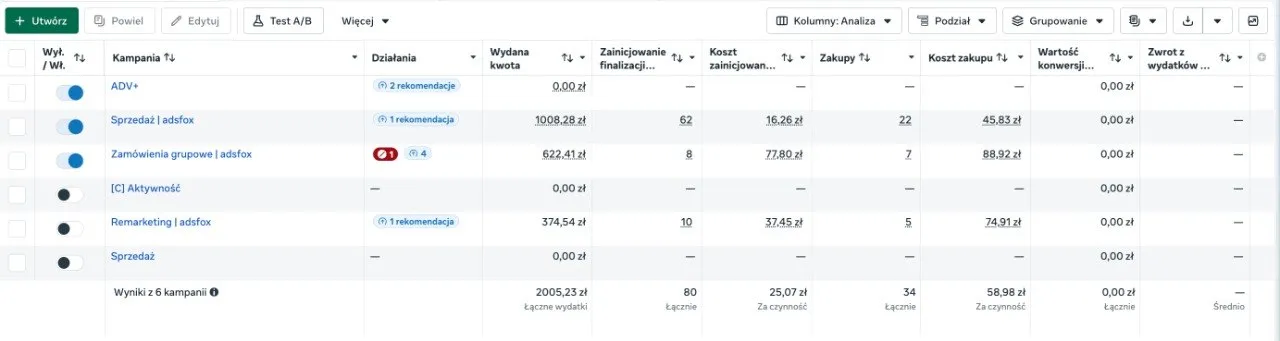
The screenshots below show amounts in Polish zloty (PLN), the client’s local currency; we converted them at roughly 4 PLN to the dollar. The Meta Ads Manager screenshot below shows the stage where the campaigns had started reporting purchase activity: 80 initiated checkouts, 34 purchases and a cost per purchase of 58.98 PLN (about $14.75) on spend of 2,005.23 PLN (about $500). It is a practical illustration of the difference between a campaign with no real sales signal and one where you can finally treat the purchase as the result.
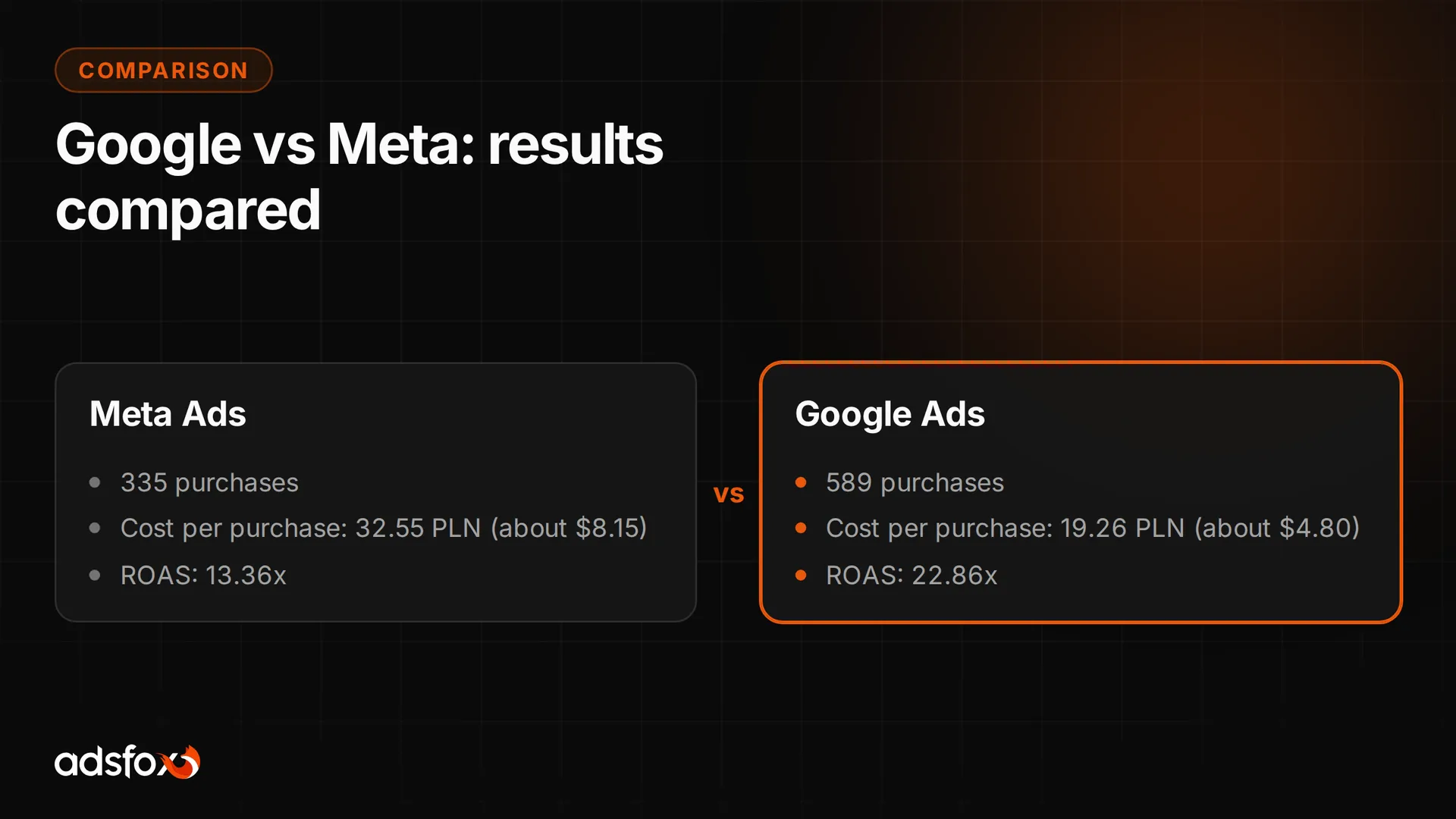
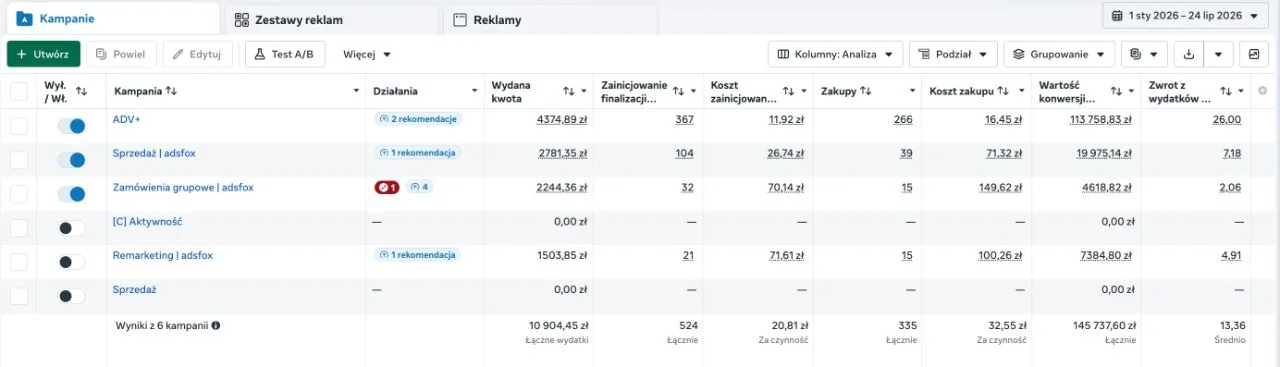
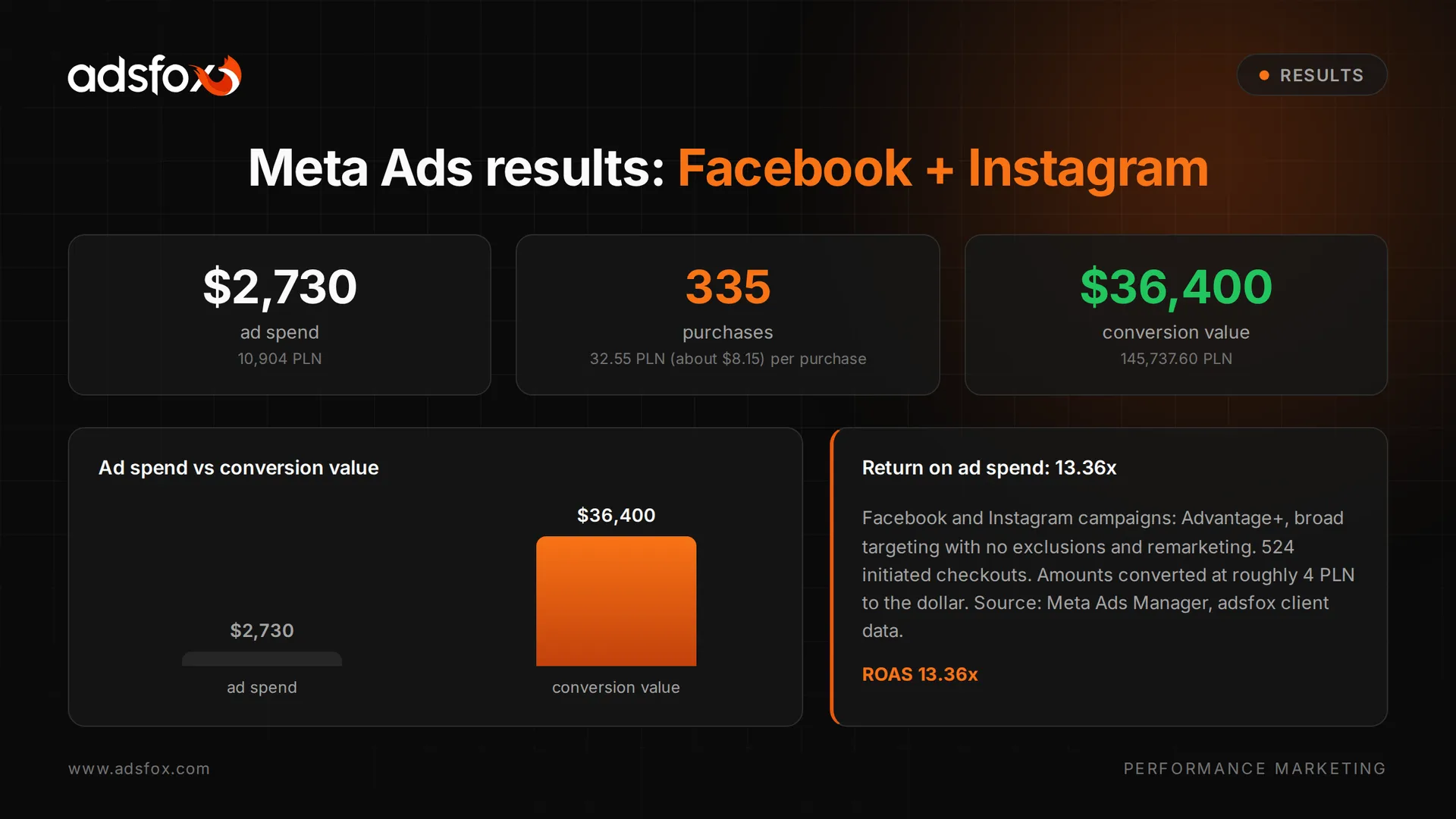
The next screenshot shows a later stage of Meta Ads optimization: 335 purchases, 524 initiated checkouts, a cost per purchase of 32.55 PLN (about $8.15), a conversion value of 145,737.60 PLN (about $36,400) and a ROAS of 13.36. You can see not only more purchases, but also the shift to judging the campaign by revenue and return on ad spend.
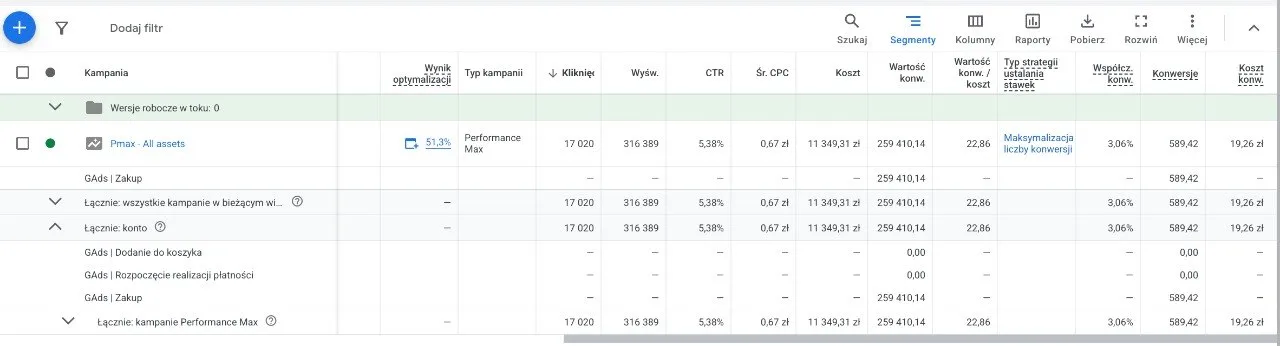
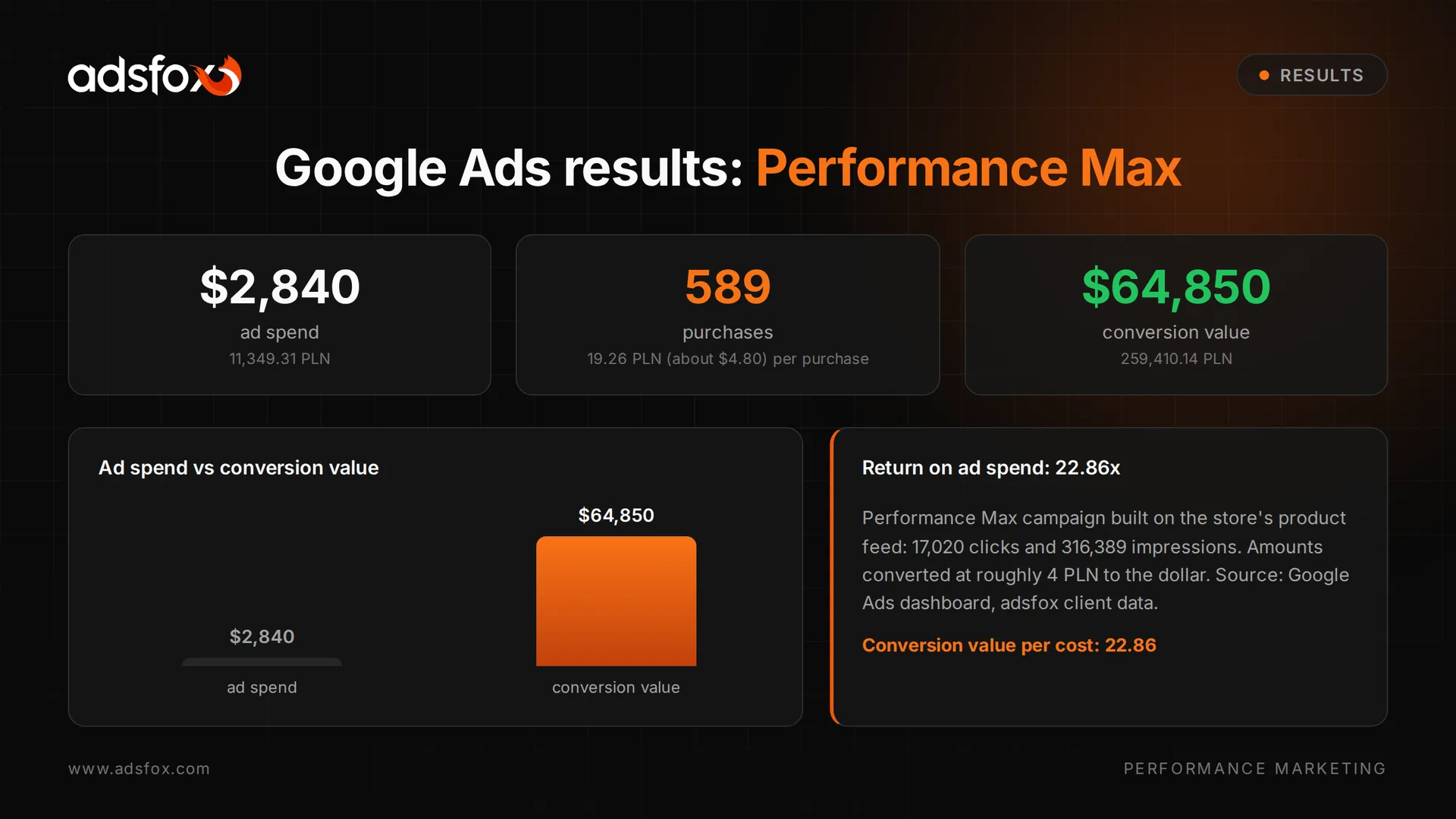
The Google Ads screenshot shows the role of Performance Max in capturing purchase intent: 17,020 clicks, 316,389 impressions, a cost of 11,349.31 PLN (about $2,840), a conversion value of 259,410.14 PLN (about $64,850) and a conversion value per cost of 22.86. This is why in this project Meta and Google were not treated as interchangeable, but as two channels with different roles in the purchase path.
An important note: before the pixel fix the client had no data on cost per purchase at all. This was not a “cost dropped from X to Y” situation. It was a situation where tracking simply did not exist. Only a correct pixel installation, GA4 and the CRM integration made it possible to see what a purchase really costs and what the ROAS is.
The different ROAS for Meta (10x) and Google (16x) is a natural result of the channels’ different roles. Google Ads captures purchase intent from people already searching for BARF food, so conversions are cheaper. Meta Ads builds demand among people who do not know the product yet, so the cost per purchase is higher, but the channel reaches a wider group and builds brand awareness.
Profitability and next steps
The biggest change for Maciej is not about ad metrics. The client can now actually analyze the profitability of paid campaigns. That sounds basic, but for many e-commerce stores it is a fundamental leap: moving from “the ads probably work” to concrete numbers. What a purchase costs. What the ROAS is. Which channel brings more revenue.
Thanks to that, Maciej can plan scaling and business growth based on data instead of intuition. A new store website is currently being built, which will allow further conversion optimization and more independence from the current platform.
Next steps
Plans for the coming months include:
- growing the number of repeat customers (a BARF diet is a recurring purchase, and a returning customer has a high lifetime value),
- building brand awareness and educating potential customers (the BARF diet is still a niche and its benefits need explaining),
- developing the new store website for conversion and SEO.
Want similar results in your industry? Book a free marketing consultation and we will check whether your conversion tracking works correctly and show you what can be improved in your campaigns.
How to advertise a raw dog food store effectively
A BARF diet is a category where educating the customer is part of the purchase path. Awareness of raw feeding is growing, but it is still a niche. That means campaigns have to sell and, at the same time, explain what this way of feeding dogs is about.
What works in this niche:
- Broad campaigns with no exclusions: the Meta and Google Ads algorithms need room to find the right people in a niche category,
- Performance Max with a product feed: specific products with prices in Google results,
- Remarketing: people who have discovered the brand come back after the first educational touchpoint,
- Quality and care messaging: in a premium category the creative matters as much as the targeting.
What to avoid:
- treating traffic and page views as success metrics (they are not purchases; in the end revenue is what counts),
- optimizing campaigns without working conversion tracking (an algorithm with no purchase signal does not know what to improve).
If you run Meta or Google Ads campaigns and are not sure your pixel and GA4 are working correctly, start with a digital marketing audit or talk to our Facebook ads agency and Google Ads agency teams.
Related adsfox services
We can run a campaign like this for your business through our Facebook ads agency and Google Ads agency. Search traffic to an online store is built separately, through e-commerce SEO with our SEO agency. If you want to first see where your budget is leaking today, start with a digital marketing audit, and the lead generation optimization system handles organizing leads and scoring their quality. You will find results from other projects in our other client case studies.