ChatGPT Ads Targeting: What Works in the US and What Doesn't
ChatGPT ads are open to advertisers, and targeting is the part of the panel where the difference between a US campaign and a European one is biggest. The one restriction no marketing material mentions: custom audiences are not supported in campaigns targeting the European Economic Area and Switzerland.
If you only sell in the US, the panel does not apply that restriction to you. If you sell into Europe, or run one international campaign, it means you cannot build remarketing or lookalike audiences there and the whole campaign works on cold traffic. That does not kill the channel, but it changes how you plan it and how you compare its cost with Google Ads and Facebook.
What you can point a campaign at
We only list what we have used in the panel, not what a launch announcement promised.
Location. You choose where the campaign serves. This is where the US and European paths split, because the audience rules below are tied to the target region.
A conversion event. The action you want people to take on your site after the click, for example creating a lead. This is not targeting in the classic sense, but it is the strongest lever you have: it tells the algorithm who to look for.
Custom audiences. Lists built from your own data, such as past site visitors or uploaded customer lists, and lookalikes built from them. Available according to the panel for campaigns outside the European Economic Area and Switzerland, so for a US-only campaign they are on the table.
We do not describe interest or demographic targeting here, because we have not run campaigns on it and will not summarize a feature list we have not tested.
What drops out for European targets
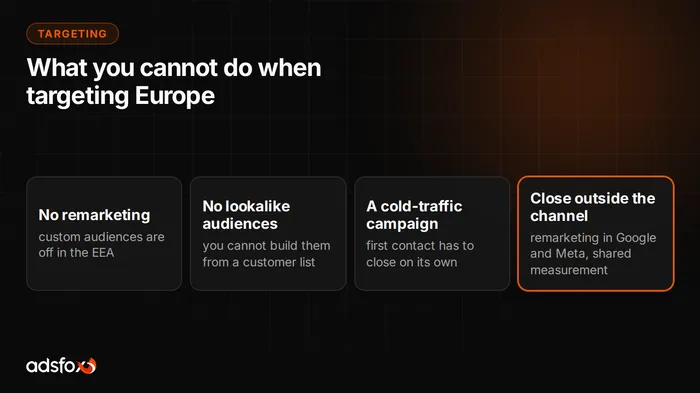
Remarketing. You cannot show the ad to people who already visited your site and did not convert. In Google Ads and on Meta that is usually the cheapest part of the campaign, because it reaches people who already know you.
Lookalike audiences. You cannot upload your customer list and have the platform find people like them. Your first-party data, the CRM base and order history, will not work that way in a European ChatGPT campaign.
Excluding existing customers. You cannot filter out people who already bought, so part of the serving reaches people who are already your customers.
The panel says this plainly in the audience settings, but the message is easy to miss, because it appears in a place you only open when you try to build an audience. By then the campaign is usually already set up.
What the restriction does not cover
It is worth separating two things, because mixing them leads to the wrong conclusion that measurement is pointless here.
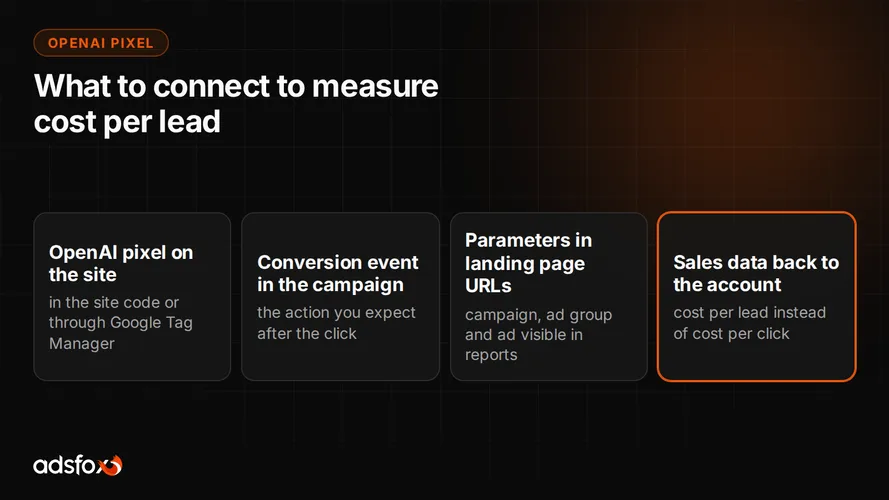
The restriction covers building audiences from uploaded first-party data. It does not cover conversion tracking. The OpenAI pixel works normally in every region: it records what happens on your site after the click and tells the platform that someone submitted an inquiry. The algorithm uses that on its own side to look for people who behave the same way.
That is an important difference. The campaign still optimizes for inquiries rather than clicks, as long as the pixel and the conversion event are in place. How to set them up is in our article on the OpenAI pixel and conversion tracking.
What this changes in the campaign plan
Three things, all to think through before launch, not in week three. They apply in full to European campaigns, and they are worth applying to US campaigns too, because a brand new channel gives you no retargeting history to lean on either way.
First contact has to close. If you will not come back to this person with an ad, the landing page and the offer have to do the job in one pass. Sending traffic to the home page instead of a specific service page is a more expensive mistake here than anywhere else.
Closing moves to other channels. People who came from ChatGPT and did not convert can still be recovered with remarketing in Google Ads and on Meta, where first-party lists work, subject to the usual consent rules under GDPR in Europe and state privacy laws such as CCPA in the US. There is one condition: ChatGPT traffic has to be tagged correctly so you can isolate it at all. That is why we set landing page URL parameters on day one.
Channel comparison needs a correction. In Google and on Meta, part of the conversions get closed by cheap remarketing, which pulls down the average cost per customer. In a cold-traffic campaign the entire budget works on new people. Comparing cost per inquiry head-on means comparing two different things, and it is fairer to set ChatGPT against the prospecting campaigns in your other channels rather than against their averages.
How to use your first-party data if not here
You do not lose it, it just works elsewhere. Your customer list, order history and the record of which inquiries turned out to be valuable still build audiences in Google Ads and on Meta and improve optimization in those channels.
For ChatGPT the same data works differently: by sending information back to the ad account about what happened to a lead next. The platform does not receive a list of people, only a signal that a specific conversion was valuable. That is allowed in every region, it works, and it does exactly the job you care about. The mechanism is described on our server-side tracking page.
Will the European restriction change
We do not know and we will not guess. It follows from personal data rules in force in the European Economic Area, not from an unfinished panel, so it is not a feature simply waiting in a queue. If it changes, we will update this article and note the date.
Until then, plan European campaigns as if it were permanent, because a plan built on an expected feature is a plan for later.
The route these restrictions do not touch
Presence in an assistant’s answer can also be built without buying impressions, and then none of the restrictions above apply. That is generative engine optimization, GEO: the work of getting the model to mention your company on its own.
There is no budget floor, no account verification and no question about retargeting, because you are not buying impressions, you are building citability. The effect is slower, but it stays after you stop spending. What ranking in ChatGPT involves is in a separate guide, and we compare both routes in our article on ChatGPT ads vs. GEO. The service is on our AI SEO agency page.
The two routes complement each other well: a company the models already cite enters advertising with a head start, because it is recognized as an entity.
Summary in three sentences
Targeting the US, you have custom audiences available according to the panel; targeting Europe, you work purely on cold traffic and have to close on first contact. The pixel and conversion events work everywhere, so the campaign can be optimized for inquiries rather than clicks. Move the closing of people who did not convert to the channels where remarketing works, and make sure measurement is shared across all of them.
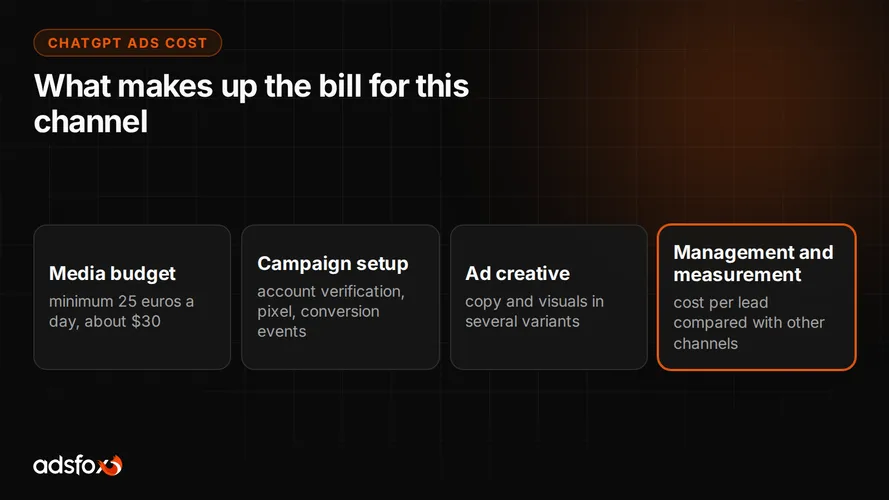
What such a test costs is in our article on how much ChatGPT ads cost. If you want to launch this channel with a plan that accounts for these rules from day one, see how we run ChatGPT ads campaigns and book a free consultation.