ChatGPT Ads vs. GEO: Which One Should You Start With
Updated September 2, 2026. The earlier version of this article said only one of these two routes was available to the advertisers we work with. The OpenAI Ads Manager has since opened up, so the choice is no longer hypothetical and the text was rewritten.
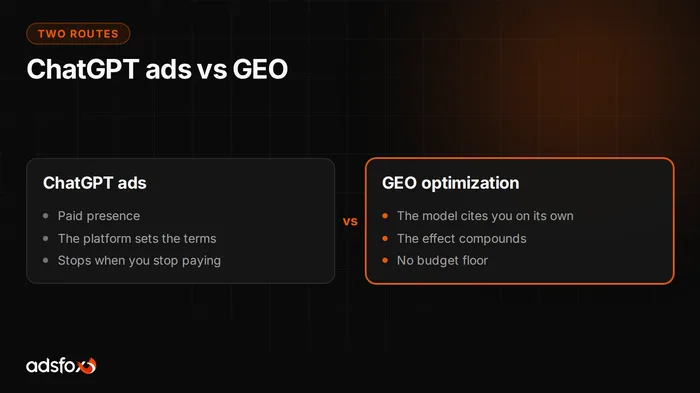
Advertising in AI models and generative engine optimization lead to the same place, the assistant’s answer, but they differ in everything along the way. Ads are paid presence on the platform’s terms. GEO is the work of getting the model to mention your company on its own. Both routes are open today, and that changes the question: it is no longer about what is possible, but about where to start and at what budget.
Why an assistant’s answer is a different playing field than a search engine
In a search engine the user gets a list and compares. In a conversation with an assistant the user gets a finished answer that usually names a few companies, and most people stop searching there. Whoever is missing from that answer is missing from the decision.
That shifts the weight from position to presence. You are not fighting to rank above a competitor on a list, you are fighting to be mentioned in a paragraph at all. So the question “how do I get visible in AI” has two possible answers: pay for presence, or earn it with content and data. Both are doable now. The entry conditions for the first, including account verification and the budget floor, are in our article on whether ChatGPT has ads.
What generative engine optimization is
GEO is optimizing your company and its content to be cited by AI models. Before a model recommends anyone, it needs a way to know who does what and for whom. If your site speaks in generalities, it gives the model nothing to work with. If it speaks in specifics, it becomes a source.
In practice it is work on three levels. Content that can be lifted out of context and quoted: definitions, sourced numbers, answers to real questions. A structured description of the company in schema markup, so the model knows who you are instead of guessing. And presence in the places models draw from, because citability is also built outside your own site. The source selection mechanism is covered in our article on how AI models choose their sources, and the hands-on side in our guide to optimizing a website for ChatGPT and Perplexity.
How the two routes differ
A side-by-side table is more honest than declarations, so here it is.
| ChatGPT ads | GEO | |
|---|---|---|
| Availability | yes, after account verification | yes, no formalities |
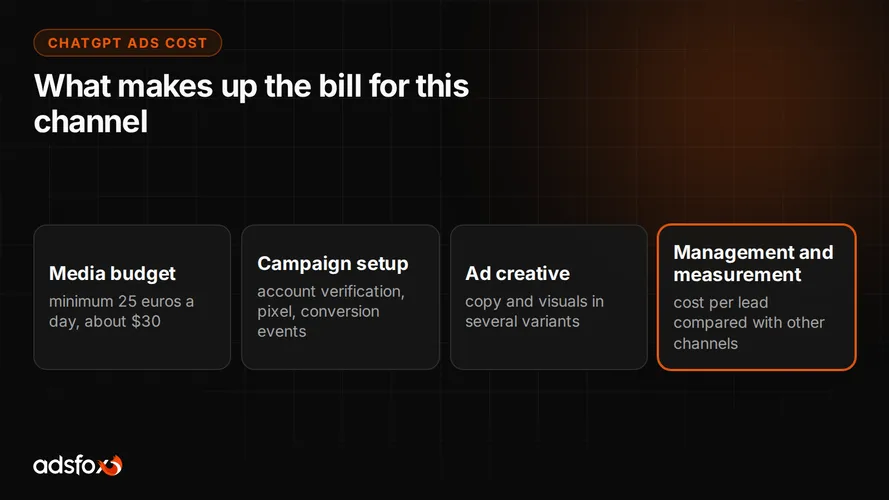
| Entry price | from about $30 a day | budget for content and work |
| Time to start | a few days for verification | first changes immediately |
| Durability of the effect | disappears with the budget | stays and compounds |
| Control | limited by the platform’s ad rules | full control over content and data |
| Retargeting for European targets | not available | not applicable |
| Time to results | fast once verification is done | slower, measured in months |
| Verifiability | serving report and pixel | measured presence in answers |
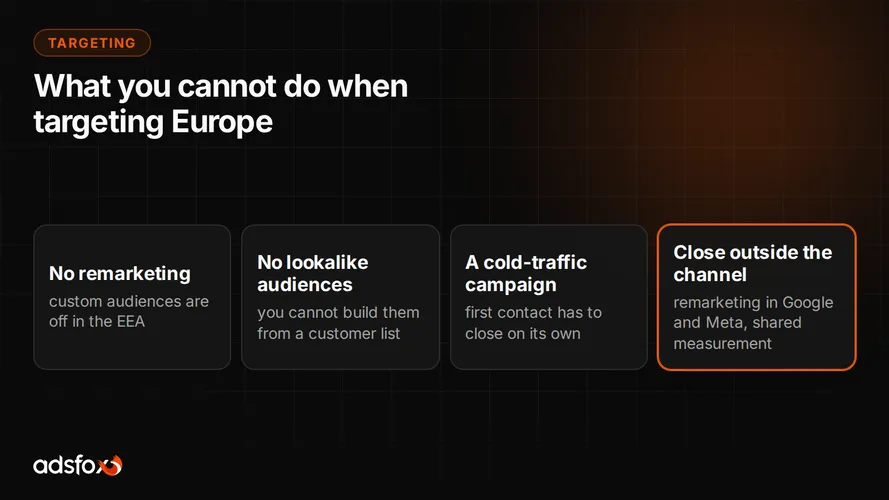
Two rows need a comment. The $30-a-day floor is the minimum campaign budget, so a real test in this channel costs $1,500 to $2,000 before anything comes out of it. The retargeting gap comes from the fact that custom audiences are not supported in campaigns targeting the European Economic Area and Switzerland. If you sell into Europe, your campaign there works purely on cold traffic, which is a meaningful difference from Google Ads and Meta.
Why order matters
The two routes complement each other, the way SEO and paid results complement each other in Google. But the order is not arbitrary. A company the models cite organically enters advertising with a head start: it is recognized as an entity, its data and content are in order, and its measurement says what works. A company without that base pays for presence and is left with nothing when it stops.
There is also a plain accounting argument. Advertising in this channel starts at about $30 a day and switches off with the budget. Work on citability has no entry price, and the same content and data work in parallel in Google, on social media and in sales conversations. That is why, at a limited budget, we start clients on GEO and add ads as a second layer when there is something to add them from.
How to check where you stand today
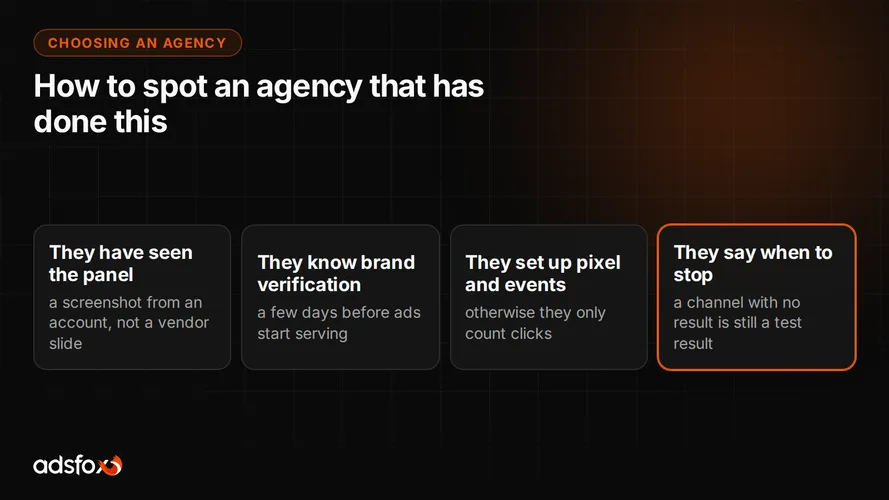
We always start with measurement, not promises. We put real buying questions from your industry to the models and check whether your company comes up at all, and who gets named instead. Our own measurement uses fifteen questions across four models, which gives sixty answers to review. The result can be sobering, but it is the only way to build a sensible plan instead of guessing.
What that work looks like from the inside and what to expect from it is on our AI SEO agency page. The differences between classic SEO and GEO are in our article on SEO vs. GEO.
Which to choose: the undiplomatic summary
If you have budget for one thing, choose GEO. The effect stays, there is no entry price, and the same content also works in search. If you have budget for both, still start with GEO and launch ads a few weeks later, when the models have something to cite you for and your measurement is ready to compare channels.
What makes no sense is entering ChatGPT ads at the expense of campaigns that bring customers today. This is a new channel with no public performance data we would trust, so we treat it as a test funded from a separate pool, not a replacement. What such a campaign looks like in practice is on our ChatGPT ads agency page.
Want to know whether the models mention your company today? Book a free consultation and we will check it against real questions from your industry.