Does ChatGPT Have Ads? An Honest Answer for Advertisers
Updated September 2, 2026: the answer to the question in the title has changed. The first version of this article, from August 2026, was written before we had access to the OpenAI Ads Manager and said the channel was not yet something a business could simply buy. That is no longer true, so we rewrote the text. We kept the section on how to vet offers, because with a brand new channel it matters more than before.
Yes, ChatGPT has ads and you can buy them today. OpenAI began testing ads with ChatGPT users in the United States in early 2026, on the Free and Go tiers, and the OpenAI Ads Manager, labeled Beta in the panel, now accepts advertisers from the US and Europe. The change is recent and poorly documented, so you will find plenty of material online saying the opposite. Check the dates.
This article covers what you actually need to know before launching a first campaign, and it does not go beyond what we can see in the panel. We have run paid campaigns since 2018 for more than 350 clients in over 20 industries, and with a new channel we would rather say “we have not measured that yet” than fill the gap with a guess.
What an ad in ChatGPT looks like
It is ad space inside a conversation with an assistant, not another list of search results. The difference is bigger than it looks. In a search engine the user gets ten links and compares them. In a conversation the user gets a finished answer that usually names a few companies, and most people stop searching there.
For an advertiser that changes the math. There is far less ad space, so competition for it is sharper, but the path from question to decision is shorter. You are not fighting for the tenth spot on a list. You are fighting to be present in a single paragraph.
Three things that surprise people at launch
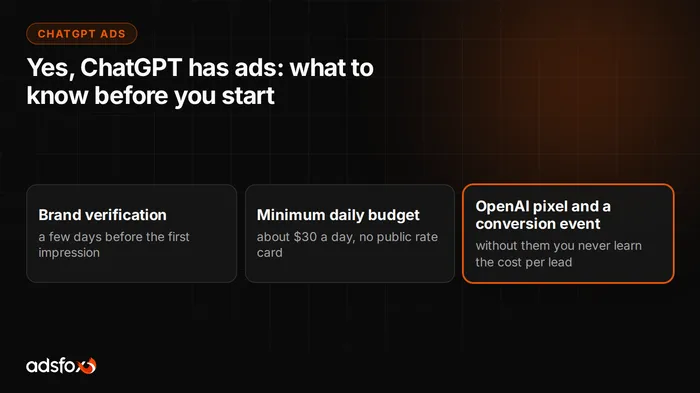
Brand verification takes a few days. The account does not start serving the moment you create it. OpenAI runs a brand review, and while it is in progress the panel explicitly warns that your ads may not be showing yet. This is the most common cause of disappointment in week one: the campaign is set, the budget is set, and nothing happens. Start verification as the very first step, before anyone writes a single ad.
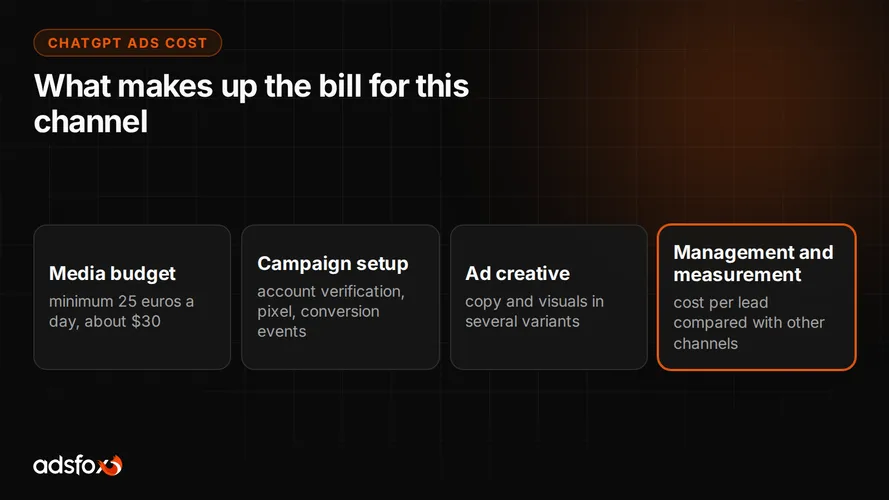
The minimum daily budget is 25 euros. In the accounts we run, that is the floor, roughly $30 a day or around $900 a month. This is the real entry price, and it decides who the channel makes sense for today. With less, you cannot run a test that produces any conclusion. We break the full bill down in our article on how much ChatGPT ads cost.
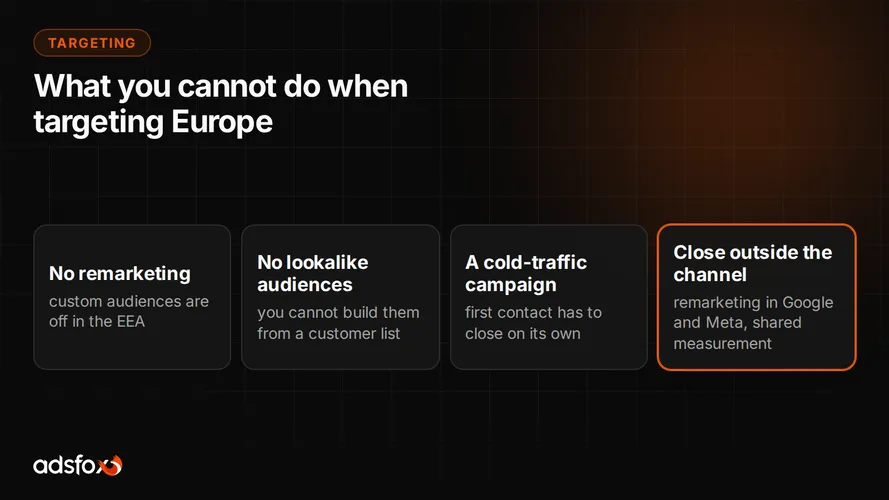
Retargeting is off the table for European targeting. Custom audiences are not supported in campaigns targeting the European Economic Area and Switzerland. If you sell into Europe, you cannot build a list of past site visitors or lookalike audiences there. For US-only campaigns the panel does not apply that restriction. What this means for your plan is in our article on ChatGPT ads targeting.
The OpenAI pixel, which almost nobody writes about
OpenAI provides its own tracking code that shows what happens on your website after someone clicks an ad. You install it directly in your site code or through Google Tag Manager, exactly like the Meta pixel or the Google Ads tag.
At the campaign level you choose a conversion event, the action you want a person to take after seeing the ad, for example creating a lead. The panel describes it plainly as choosing the action you want people to complete on your site.
Without those two things the campaign optimizes for clicks. You will get traffic, you will see a cost per click, and you will never learn the only number that matters: what a lead from this channel costs and how that compares with Google Ads and Facebook. That is why at adsfox the pixel and events go in before the first dollar of budget, and the data on what happened to each lead afterwards gets sent back to the ad account. How that measurement works technically is described on our server-side tracking page.
How to talk to someone offering to run these campaigns for you
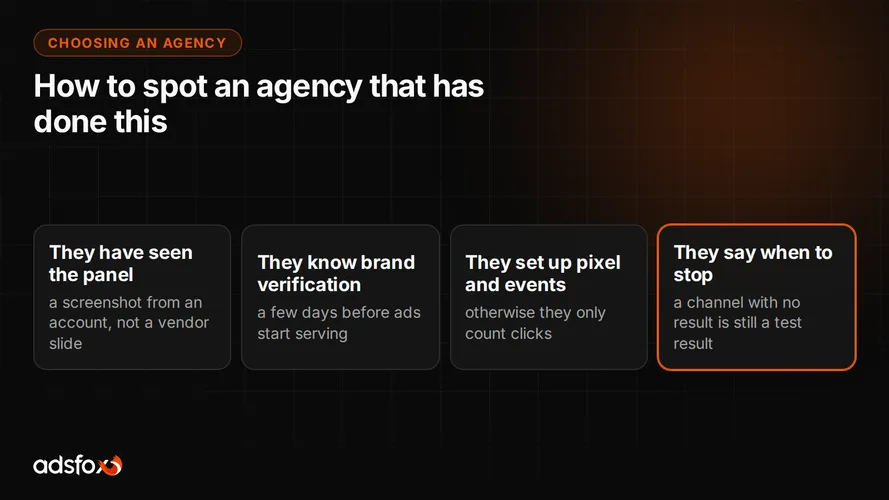
This section aged best, because with a new channel there are more offers than competence. Ask three questions before you sign anything.
- Have you seen the panel with your own eyes? Ask for a screenshot from an ad account, not from a vendor deck.
- How will you measure results? If the answer ends at clicks and impressions, that agency will not install the pixel or set up conversion events.
- What will you do if the channel does not work? The honest answer is “we turn it off and move the budget back to what works,” not “we optimize.”
The same rule applies to us. We have no data of our own on how this channel performs yet, because nobody has a reliable track record after a few weeks, and we say so on the call instead of promising results. The full list of questions to put to any vendor, including us, is in our article on how to choose a ChatGPT ads agency.
What this means for your business today
The practical conclusion is different from a month ago, but still cautious. The channel is real and you can buy it, so it is worth testing if your budget can sustain about $30 a day for several weeks alongside the campaigns that already deliver. It is not worth moving money into it at the expense of what works, because nobody knows yet how this channel compares.
Reference points for cost per lead in the channels we have run for years are in our CPL and ROAS benchmark. Those are the numbers you will compare the ChatGPT result against, so have them ready before you start.
There is also a second route into the same assistant answer, and it is free. The idea is to get the model to mention your company on its own when someone asks for a recommendation. That is a separate discipline called generative engine optimization, or GEO. It has no budget floor and no account verification, and the effect stays after you stop spending. The basics are in our article on what GEO is, the practice in our guide to ranking in ChatGPT, and the service on our AI SEO agency page. We compare the two routes in a separate article on ChatGPT ads vs. GEO.
Where to start
With account verification, because it will take a few days anyway and you can prepare everything else in the meantime. Then the pixel and the conversion event, then the ads, and the budget last. The reverse order, budget first, is the most common way to waste the first month. The step-by-step version is in our guide on how to advertise on ChatGPT.
If you would rather have someone walk you through it, see how we run ChatGPT ads campaigns and book a free consultation. We will tell you plainly whether this channel makes sense at your budget today.