How to Choose a ChatGPT Ads Agency: 7 Questions to Ask
ChatGPT ads opened to advertisers a few weeks ago, and there are already plenty of offers to run them. That is the normal order with every new channel: offers show up faster than experience. We are a party here too, so you will not find a list of the best agencies in this article. You will find seven questions you can use to check any vendor yourself, including us.
1. Have you seen the panel with your own eyes?
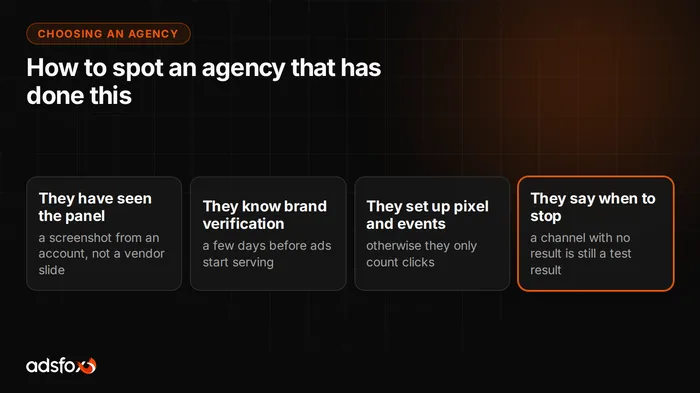
The simplest filter and a surprisingly effective one. Ask for a screenshot from an ad account, not from a vendor slide or a trade article.
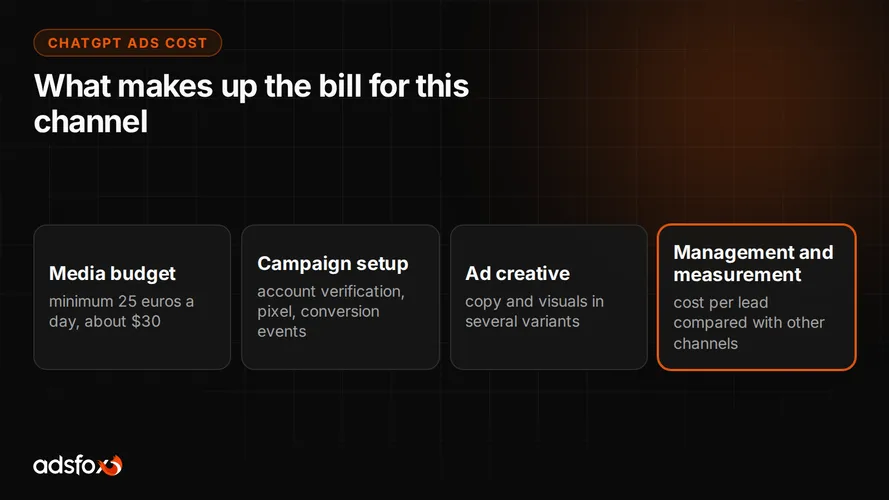
While you are at it, check whether the person knows details that are not in the press releases: that the account goes through a brand verification lasting a few days, during which ads may not show, and that the minimum daily budget in the panel is 25 euros, about $30. Whoever does not know that has not opened the panel.
2. How will you measure results?
This is the question where the difference shows fastest. If the answer ends at impressions, clicks and cost per click, that agency will not set up conversion tracking, and three months in you will not know whether the channel paid off.
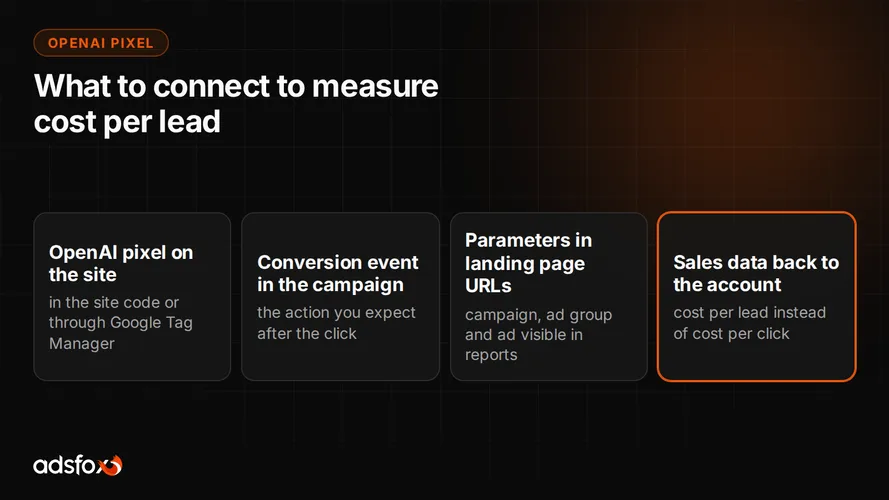
A good answer has three parts: installing the OpenAI pixel directly in the site code or through Google Tag Manager, setting a conversion event at the campaign level, and tagging landing page URLs with parameters so traffic from individual campaigns can be told apart.
A very good answer has a fourth: sending information back to the ad account about what happened to each lead next, so you count cost per customer, not cost per form.
3. What does a lead from this channel cost?
This is a trick question, and ask it on purpose. The correct answer is: nobody knows.
The channel opened to advertisers too recently for anyone to have reliable cost-per-customer data. If you hear a specific rate, ask for the number of campaigns and the period it was calculated on. That usually ends the conversation.
An agency with something to show will instead give you reference points from channels it has run for years and say plainly that those are what you will compare the result against. Ours are in our CPL and ROAS benchmark.
4. Do you know what cannot be done in this channel?
A question that checks whether someone has planned a real campaign or only read about the possibilities.
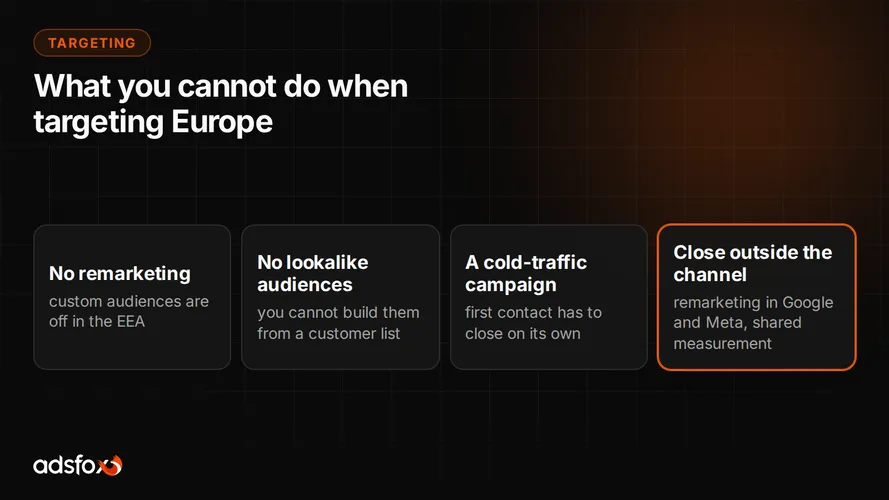
The specific thing that should come up: for campaigns targeting the European Economic Area and Switzerland, custom audiences are not supported, so there is no remarketing and no lookalike audiences, and the whole campaign works on cold traffic. If you sell into Europe, that shapes the plan. If you only target the US, the agency should still know it, because it is the clearest sign they have read the panel and not a brochure.
The consequences for planning and for channel comparison are in our article on ChatGPT ads targeting. An agency that does not bring this up at the proposal stage will discover it with you in week three, on your money.
5. What budget do you propose, and why that number?
You are checking whether someone is calculating or selling. At a floor of about $30 a day, a meaningful test is six to eight weeks, which means $1,500 to $2,000. Shorter will not produce data you can base anything on.
A good agency will also tell you when not to do it. If $1,500 is your entire advertising budget, the honest recommendation is: strengthen the channels that already deliver and come back to this in a quarter. The detailed math is in our article on how much ChatGPT ads cost.
6. What will you do if the channel does not work?
The most important question on the list and the one asked least often.
The honest answer is: we turn it off and move the budget back to where it works. The worrying answer is: we will keep optimizing. With a new channel and no reference points, “optimizing” can go on for quarters and cost as much as a deliberate decision to leave.
Our rule of work is the same in every channel: measure, optimize, measure again, draw a conclusion and move the budget to where the business result is largest. The last part is the hardest, because it means admitting that the channel we entered with enthusiasm performs worse than a boring search campaign. That is not a failure, it is the result of a test.
7. Do you also run the other channels?
With a channel this young, that is a stronger argument than specialization. The value comes from comparison: only when the same person sees cost per inquiry from ChatGPT, Google Ads and Facebook, measured the same way, can anyone sensibly decide where to move the budget.
A specialist vendor working alongside your other channels will defend its slice, because it has no view of the rest and its fee depends on that channel staying. That is not an accusation of dishonesty, just a description of incentives.
Bonus question: will they tell you about the free route?
A good honesty test, because the answer works against the agency’s interest.
You can also get into an assistant’s answer without buying impressions, through generative engine optimization, GEO: the work of getting the model to mention your company on its own. There is no $30-a-day floor, and the effect stays after the budget is gone. For some companies, especially those with smaller budgets, it is the more sensible first step today.
An agency that does not mention it either cannot do it or would rather sell you the more expensive service. What ranking in ChatGPT is and how it is done is in a separate guide. We compare both routes in our article on ChatGPT ads vs. GEO, and our own service is on the AI SEO agency page.
What not to treat as proof of competence
Three things that look like an argument with a new channel and are not.
Certifications and partner badges. For this channel they do not yet exist in any form you could verify.
Case studies without numbers. “We launched a ChatGPT campaign for a client in industry X” says nothing until there is a cost per inquiry and a time period next to it.
Being first. Being first in a new channel has no value in itself. The companies that did well in previous channels won not because they were first, but because they had measurement in order and knew how much they could pay for a customer.
How it looks at adsfox
We have run campaigns since 2018 and have worked with more than 350 clients in over 20 industries. We are a Google Partner and a Meta Business Partner at the Badged level. On ChatGPT ads we say two things at once: the channel is real and you can buy it, and we do not yet have our own performance data, because nobody has a track record worth the name.
What we bring is the measurement layer: pixel, conversion events, traffic tagging and sending sales data back to the ad accounts, the same way across every channel so the numbers can sit in one table. What that service looks like is on our ChatGPT ads agency page.
If you are talking to several agencies, run the same seven questions past each of them and compare the answers. Want to start with ours? Book a free consultation.