How Much Do Instagram Ads Cost? No Fluff, Just Numbers
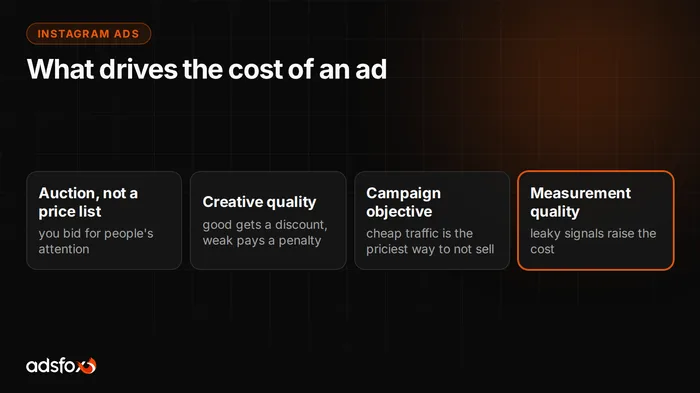
Instagram ads have no price list. The cost is set by an auction: you bid against other advertisers for the attention of the same audience, and the price follows from competition, the quality of your creative and the campaign objective. Every article that quotes an “average Instagram ad cost” describes someone else’s campaigns, not yours. This one shows what actually builds the cost and how to bring the price conversation down to numbers that apply to you.
For the record: Instagram and Facebook are one Meta ad system. You set up the campaign in the same dashboard and often run it in both apps at once. That matters, because half the questions about “Instagram ad prices” are really questions about Meta Ads, which we also covered from the Facebook side in how much does Facebook advertising cost.
What determines the cost of Instagram ads?
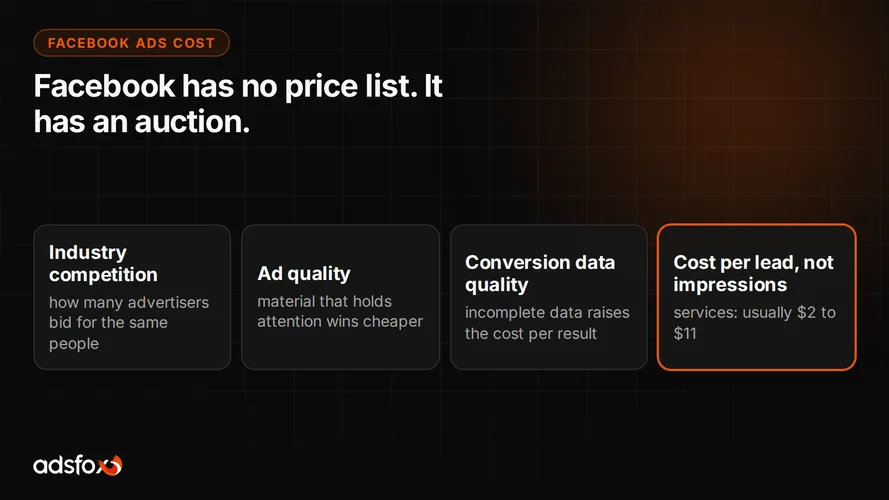
The auction weighs several things at once, and you control most of them.
- Competition for the audience. The more businesses want to reach the same people, the more expensive it gets. Seasonality (the holiday shopping period, for example) can push up rates across entire industries.
- Creative quality. The system rewards ads that people watch and click with a lower delivery cost. Weak creative pays a penalty in price, good creative gets a discount.
- Campaign objective. Optimizing for purchases or leads costs more per event than optimizing for traffic, but it brings events that have value. Cheap traffic is the most expensive way to get no sales.
- Measurement quality. The system learns from conversion signals. When the signals are patchy, it optimizes blind and the cost rises. That is why measurement gets set up before the first dollar is spent, not after the first disappointment.
The ad budget is not the only cost
The bill for Instagram advertising has three line items, and it pays to keep them separate, because mixing them up ruins any comparison of proposals.
- Ad budget. Goes to Meta, not to the agency. This is what you bid with in the auction.
- Creatives. Instagram lives on images and video, and creative decides the result more than settings do. Producing several variants is a real cost, in money or in your time.
- Campaign management. A specialist’s work: structure, testing, optimization, reporting. With us it is a flat fee known up front, described on our Facebook and Instagram advertising service page.
What cost per lead is realistic?
Instead of internet averages, our own data. In our benchmark of 20 campaigns across 11 industries, cost per lead ranged from $2 to $11 depending on the industry: $2 to $3.50 in beauty, $5 to $7 in medical aesthetics, $8 to $11 for law firms. These are European campaigns, so treat the absolute numbers as reference points rather than a forecast for the US market. The full breakdown, including e-commerce results, is in our CPL and ROAS benchmark.
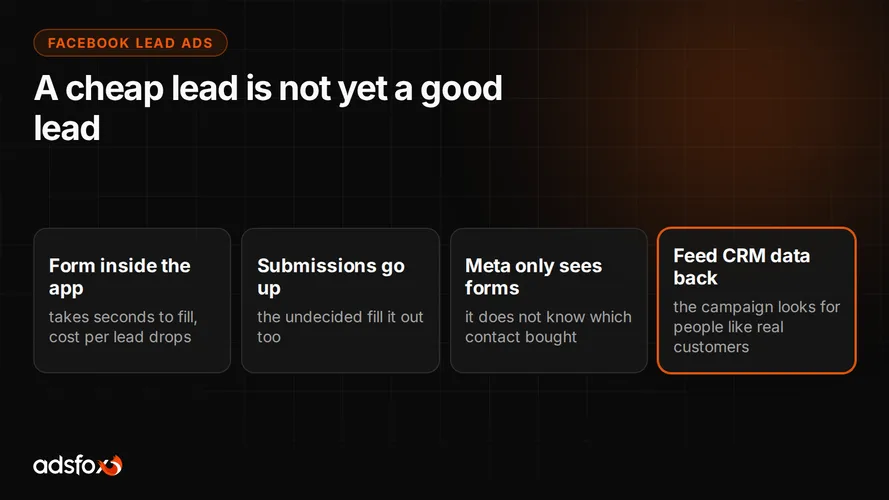
Two takeaways from those numbers. First, the spread between industries is bigger than the spread between agencies, so compare yourself with your own industry, not “the market.” Second, cost per lead is half the story: in one of our medical aesthetics case studies, the biggest change came not from lowering the cost but from raising the share of qualified leads from 21.1% to 45.7%. A cheap lead that does not buy is more expensive than a pricey one that does.
How to set a starting budget?
Not with a number from a guide, but with a process. The starting budget has one job: collect data for a decision. In practice it looks like this:
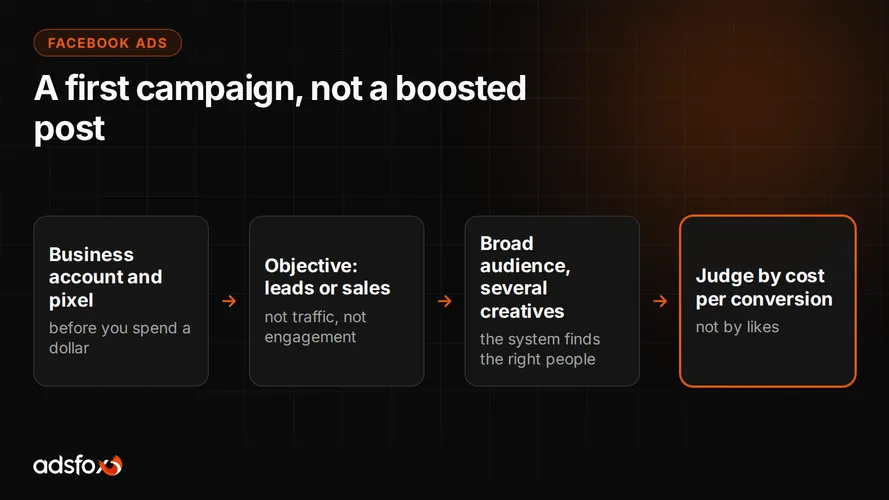
- Start with small daily amounts across several creative variants and audiences.
- Once you have a meaningful sample, keep what delivers results and switch off the rest.
- Scale the winners gradually, watching whether cost per event grows faster than the number of events.
Too small a budget is the most common starting mistake: the campaign never leaves the learning phase, the data is noise, and after a month you “know” that ads don’t work, when in fact they never had a chance to.
What an agency charges for management: a specific number
At adsfox, campaign management for one channel starts from $490/month. With more channels the per-channel price is noticeably lower, because part of the work (measurement, analytics, learning your offer) is done once for the whole account. The price also depends on how much creative work we take on (whether we produce the creatives or you supply them) and on the size of the ad budget, because we take responsibility for spending it, and the bigger the money, the bigger the risk on our side. The full rules are laid out in our campaign management pricing.
How to lower the cost of Instagram ads?
Three levers work hardest, in this order: better conversion signals, rotating creatives before they wear out, and optimizing for lead quality instead of form count. We laid them out step by step in our post on lowering cost per lead in Meta Ads, because the mechanics are the same for Facebook and Instagram.
If you would rather hand this to a team that has been doing it since 2018 for more than 350 clients, see our Facebook and Instagram advertising service and book a free consultation. We will calculate the cost on your numbers, not on internet averages.