How Much Does Facebook Advertising Cost? Budget and Real Costs
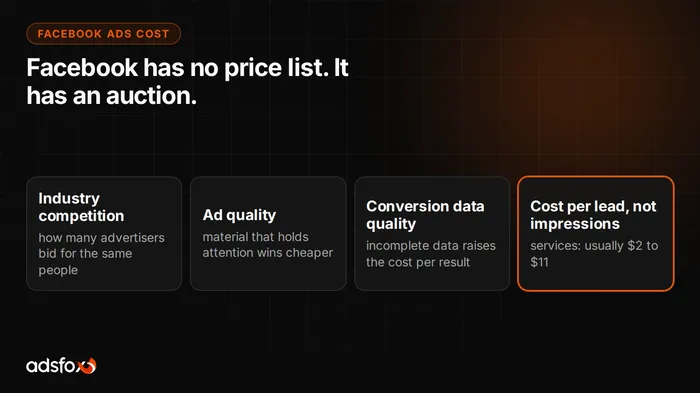
Facebook has no price list. You do not buy an ad for a fixed amount. You set an ad budget, and the system distributes it across impressions, bidding in an auction for your target audience’s attention. So the question “how much does Facebook advertising cost” only makes sense once you ask about the cost per result: a lead, an inquiry or a sale. In the campaigns we have run, cost per lead for service businesses usually landed between about $2 and about $11, depending on the industry.
Below we explain exactly what you pay for, what really drives the bill up, and how to plan a budget so you can tell whether the campaign is making money.
What you pay for in Facebook advertising
Facebook ads are billed under one of several models, and the choice depends on the campaign objective:
- CPM, cost per thousand impressions. You pay for reach. Typical when building brand awareness.
- CPC, cost per click. You pay when someone clicks. Typical when driving traffic to a website.
- CPA, cost per action. Billing tied to a specific action: a contact, a sign-up, a purchase.
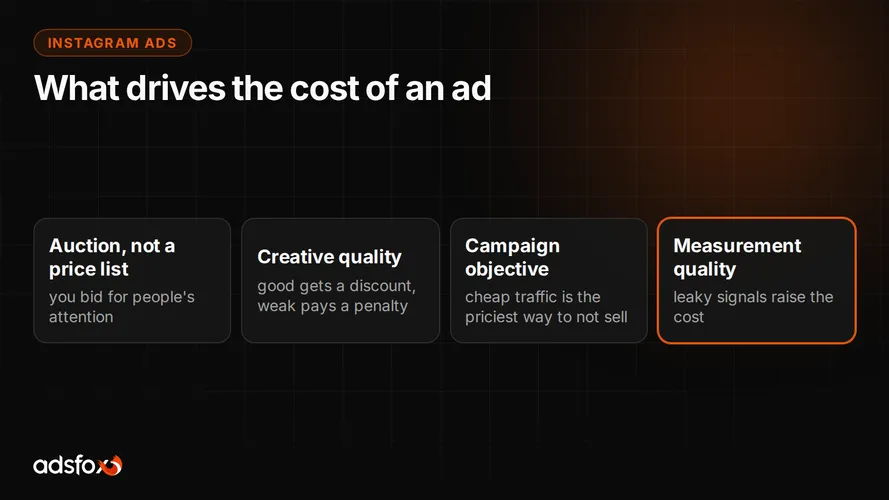
Whatever the model, the price is decided by the auction. Every time someone in your audience opens Facebook or Instagram, the system compares the ads competing for that slot in a fraction of a second. The winner is not the highest bid, but the best combination of bid, predicted user response and the quality of the ad itself.
That has a practical consequence: a good ad is cheaper. Material that people watch and click gets better auction terms than a dull one, even with an identical budget.
What is the minimum ad budget
Technically you can launch a campaign for a few dollars a day. In practice that is pointless, and it is worth knowing why.
A campaign optimized for conversions goes through a learning phase: the system needs a certain number of events to recognize who responds to your offer. With too small a budget that number is never reached, so the campaign keeps guessing. The result is worse not because the budget is small, but because the algorithm has nothing to learn from.
So the sensible minimum is set not by a dollar amount but by the number of conversions. The budget should allow a few dozen conversions a month. How many dollars that is depends on the cost per lead in your industry, and that can differ several times over.
What really affects the cost of advertising
The bill is driven up by things you have varying control over:
Industry competitiveness. The more businesses bidding for the same prospects, the more expensive it gets. A local service in a smaller town and a nationwide financial offer are two different price worlds.
Audience size and precision. A very narrow audience can be expensive because the system has a small pool to choose from. A very broad one can be cheap per impression but costly per result.
Creative quality. An ad that holds attention lowers the cost. One image used for six months usually raises it, because people stop reacting.
Campaign objective. A contact costs more than a click, and a sale more than a contact. Comparing costs between campaigns with different objectives makes no sense.
Seasonality. In peak shopping periods more advertisers bid for the same attention and rates rise.
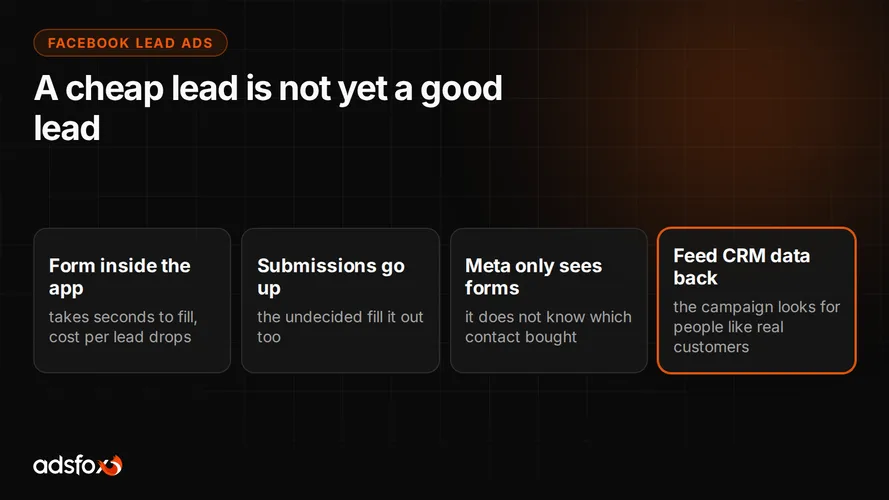
Conversion data quality. This is the most overlooked point. If part of your conversions never reaches the ad system, the campaign learns on incomplete material and raises the cost per result, even though nothing changed on your side. This is where server-side tracking helps, by limiting the data loss caused by browser blocking.
What it costs to acquire a customer: data from 20 campaigns
Most articles about Facebook ad costs quote an “average CPC” without saying where the number comes from. Such averages are of little use, because they mix industries, objectives and budgets that cannot be compared.
So instead of a market average, we share our own results, with a link to the source case study next to every number. This is data from 20 campaigns across 11 industries, not a market survey.
Cost per lead for service businesses:
- Dental practice: about $2. See the dental practice case study.
- Fitness club: down from $9 to $3 after optimization. See the fitness club case study.
- Law firm: $8 to $11, noticeably more expensive, because it is a more competitive, high-margin niche. See the law firm case study.
There is a pattern here: local services with less competition have a cost per lead of a few dollars, while more competitive industries land around ten dollars and up. If someone promises you a single rate without asking about your industry, they do not know your situation. These are campaigns run in Europe; in the US market the absolute numbers will differ, but the spread between industries follows the same logic.
For online stores what matters is not cost per lead but return on ad spend. In our campaigns ROAS ranged from about 3.6 to over 24, depending on margin and repeat purchases. You will find the full breakdown across all industries in our CPL and ROAS benchmark from 20 campaigns.
Is Facebook advertising worth it
The answer comes down to one comparison: cost per customer versus what that customer leaves in your business.
An $11 lead is expensive for a business where a customer spends $50 once, and cheap for a law firm where a single case is worth several thousand dollars. So cost per lead without the context of customer value tells you nothing.
The second condition is working measurement. Without correctly tracked conversions you cannot see which inquiries came from the ad and which from other channels. A business that does not measure usually either switches off a campaign that was making money or keeps feeding one that is not working.
It is also fair to say when Facebook advertising is not the first choice. If your customers look for a service only at the moment of urgent need, typing a specific query into a search engine, it makes more sense to start with Google Ads campaigns and add Meta as a second channel.
How to plan an ad budget
A practical order that works better than picking a number by feel:
- Calculate what your customer is worth. Average order value or contract value times the probability of closing.
- Decide how much you can pay per lead for the numbers to work. That is your ceiling, not a wish.
- Check how many leads you need per month to hit the sales plan.
- Multiply. The result is your starting budget, not the target.
- Plan a test period. The first weeks are for collecting data, not judging the campaign.
When scaling, remember a relationship visible in our data: a very high return usually drops as you raise the budget. In one apparel store ROAS was 24.5 at the start and about 12 after the budget grew from $300 to $1,250, with far higher revenue. That is not a worse campaign, just the natural price of reaching a wider audience.
How to check whether you are overpaying
Three things to verify in your own account:
- Do conversions in Ads Manager match what you see in your CRM or inbox? A mismatch means the campaign is optimizing on incomplete data.
- Is the campaign stuck in the learning phase? If so, the budget or the number of events is too low.
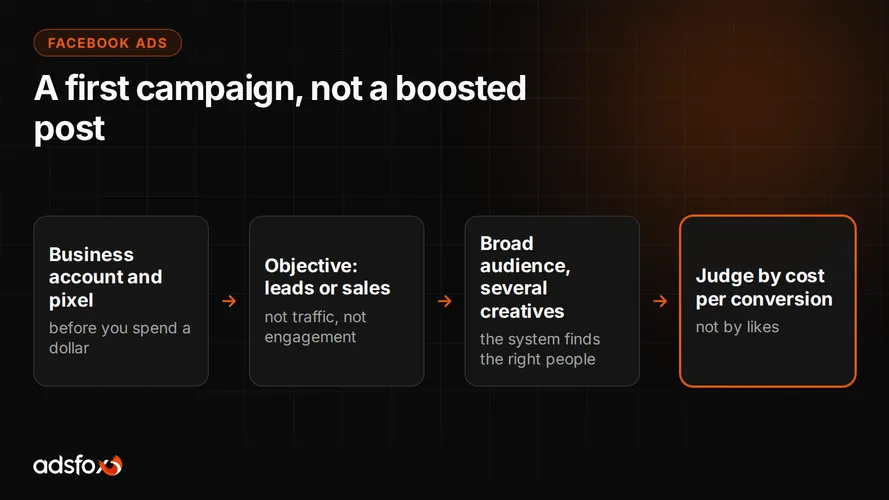
- Do you have more than one active creative? Accounts with several different assets usually have a more stable cost than accounts with a single burned-out ad.
If you would like someone to walk through this with you step by step, that is what we do as part of our Facebook and Instagram Ads management.
What an agency charges for management: a specific number
At adsfox, campaign management for one channel starts from $490/month. With more channels the per-channel price is noticeably lower, because part of the work (measurement, analytics, learning your offer) is done once for the whole account. The price also depends on how much creative work we take on (whether we produce the creatives or you supply them) and on the size of the ad budget, because we take responsibility for spending it, and the bigger the money, the bigger the risk on our side. The full rules are laid out in our campaign management pricing.
Summary
How much Facebook advertising costs depends on your industry, your audience and the quality of your measurement, not on a price list, because there is none. Instead of asking about the price of an impression, ask about the cost per customer and compare it with what that customer is worth. In our campaigns cost per lead in services landed between $2 and $11, and the difference came mostly from industry competitiveness and whether the campaign received correct conversion data.
Book a free consultation. We will review your campaigns and tell you what you really pay per lead and where that cost can be lowered.