How to Lower Cost Per Lead on Facebook Ads Without Junk Leads
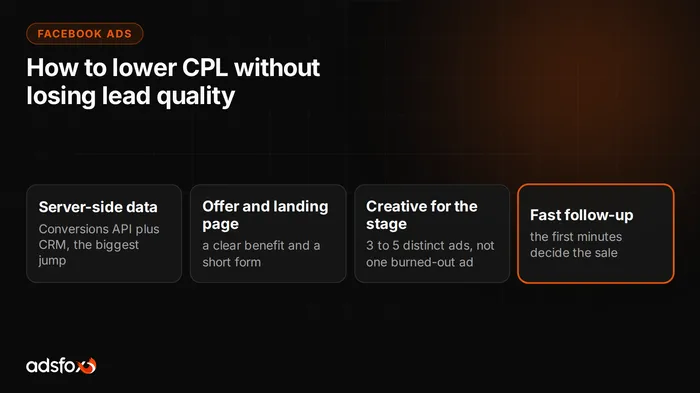
How do you lower cost per lead on Facebook Ads without losing lead quality? Four levers work fastest: better data sent back to Meta, a stronger offer on the landing page, creative matched to the buyer’s stage of awareness, and an immediate response to every new lead. Chasing a “lower cost per lead” on its own is a trap. A cheap lead that never buys costs you more than a pricier lead that closes.
CPL (cost per lead) is what you pay for one contact: ad spend divided by the number of leads. It is an intermediate metric. It only means something next to quality: how many of those leads turn into a conversation and then into a customer. So always read CPL together with your cost per acquisition, never on its own.
Why a low CPL can be expensive
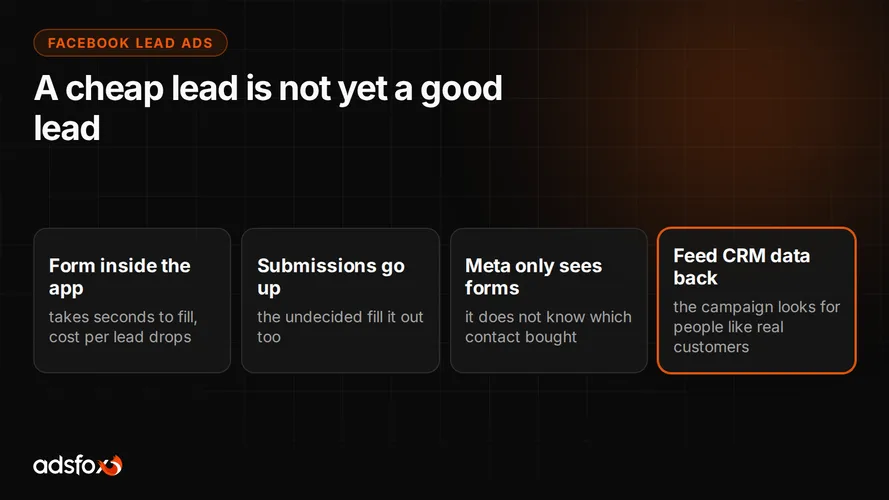
Meta optimizes your campaign for the goal you give it. If you say “get me as many leads as cheaply as possible,” the algorithm will deliver cheap leads, and often the lowest quality ones: accidental sign-ups, bots, people outside your target market. CPL drops, sales do not move. It is the classic case of optimizing for the wrong metric.
The fix is not to pay more. The fix is to give the algorithm a better signal about what a valuable lead looks like to you, and to raise the performance of every stage in the funnel. Then your real cost per customer falls, even if CPL itself occasionally creeps up.
Lever 1: server-side data (usually the biggest jump)
After browser privacy changes and cookie blocking, the pixel loses a share of conversions. Meta does not see every event, so it optimizes on incomplete data and burns budget. The strongest remedy is sending events from your server through the Conversions API, ideally enriched with data from your CRM.
According to Tracklution, companies that implement server-side tracking recover on average more than 30 percent of conversions the pixel alone never reports. More data of better quality means more accurate optimization, and more accurate optimization means a lower cost per valuable lead. If you want to do this properly, start with our server-side tracking, which connects Meta with your CRM and closes the measurement gap.
Lever 2: the offer and the landing page, not just the ad
A large share of a high CPL does not come from the ad. It comes from what happens after the click. A weak offer and a vague call to action kill conversion, so you pay for clicks that never turn into a lead.
Check three things. Does the headline on the page promise a specific benefit above the fold? Is the form short, asking only for what you really need? Does the offer have a “why now,” for example a free audit or a fast quote? Each of these improvements raises your conversion rate, and a higher conversion rate means a lower CPL on the same budget.
Lever 3: creative matched to the stage of awareness
Not sure what you really pay for a valuable lead, or why your campaigns are so expensive? Request a free audit. We will review your Meta account and show you where the budget is leaking.
Creative is the most common reason costs swing. Do not lead with a hard sell to people who have never heard of you; that drives the price up. Build context and trust first: a specific claim, a number, a real example, and only then the offer. Test several ideas at once and switch off the weak ones instead of pouring more budget into a single ad.
As a Meta Business Partner and Google Partner we see one repeating pattern across accounts: accounts with 3 to 5 active, distinct creatives have a more stable and lower CPL than accounts running a single “burned-out” ad. The algorithm needs options to choose from. You can read more about how we structure Meta campaigns on our Facebook and Instagram Ads services page.
Lever 4: speed of follow-up
Even the cheapest lead loses value with every hour of silence. The person who left their details is comparing offers right now. If you call back the next day, a competitor is already talking to them. A fast, organized contact in the first minutes measurably raises the share of leads that become customers, which lowers your cost per customer even at a constant CPL.
A well-built process and a CRM that flags every new lead immediately and reminds the team to follow up help here. If you want to tighten this stage, look at our lead generation optimization system, which links Meta data with how your sales team handles the lead.
Where to start in practice
Do not do everything at once. The order that usually delivers the fastest result:
- Fix measurement (Conversions API plus CRM data) so the algorithm optimizes on complete data.
- Improve the offer and the landing page, because that is the cheapest way to raise conversion.
- Expand and rotate creatives, matching them to the stage of awareness.
- Cut lead response time to minutes, not hours.
Each of these steps lowers your real cost per customer. Together they can turn a campaign from “expensive and random” into a predictable source of valuable leads.
Common questions about CPL on Facebook Ads
What should cost per lead be on Facebook Ads?
There is no single right number. WordStream/LocaliQ benchmarks show cost per lead varies widely between industries, from a few dollars to well above that. Instead of chasing an “internet average,” set your own break-even threshold: how much you can pay per lead so that, at your close rate and margin, the campaign still makes money.
Is a lower CPL always better?
No. A lower CPL is only better when lead quality does not drop. A cheap lead that does not buy raises your cost per customer. That is why you should always read CPL together with the share of leads that convert into customers.
What lowers CPL fastest without hurting quality?
The fastest jump usually comes from fixing server-side measurement (Conversions API plus CRM data), because the algorithm starts optimizing on complete, accurate data. Right behind it is improving the offer and the landing page.
Summary
How to lower cost per lead on Facebook Ads without losing lead quality? Focus on data, offer, creative and response speed, not on “cheaper” alone. Improve the signal you send to Meta, raise on-page conversion, rotate creatives and respond to leads immediately. Then the cost of acquiring a real customer falls, not just the cost of a random contact.
Book a free consultation. We will analyze your Facebook Ads campaigns and show you where you are losing leads and budget.