Meta Ads Creative Assets: Why One Image Is Not Enough
Meta Ads campaigns should not rest on a single image, because then you are testing one idea, not the full potential of the campaign. A well-planned set of creative assets shows you which message, format and stage of the customer’s decision actually leads to a business result.
Creative assets in Meta Ads are the materials the platform can use across placements and touchpoints: images, short videos, copy variants, formats for Reels, Stories, Feed and retargeting. A good asset set is not about producing more graphics for the sake of it. It is about creating material to test specific sales hypotheses.
Why Meta Ads campaigns should not start with one image
A single image in Meta Ads gives you a single signal: how an audience reacted to one frame and one way of telling your offer. If the result is weak, you still do not know whether the problem is the budget, the offer, the audience, the message or the format itself.
This matters most for businesses investing in lead generation or sales campaigns that want to scale their budget. A hasty “Meta doesn’t work for us” can shut down a channel that simply needed better material to test.
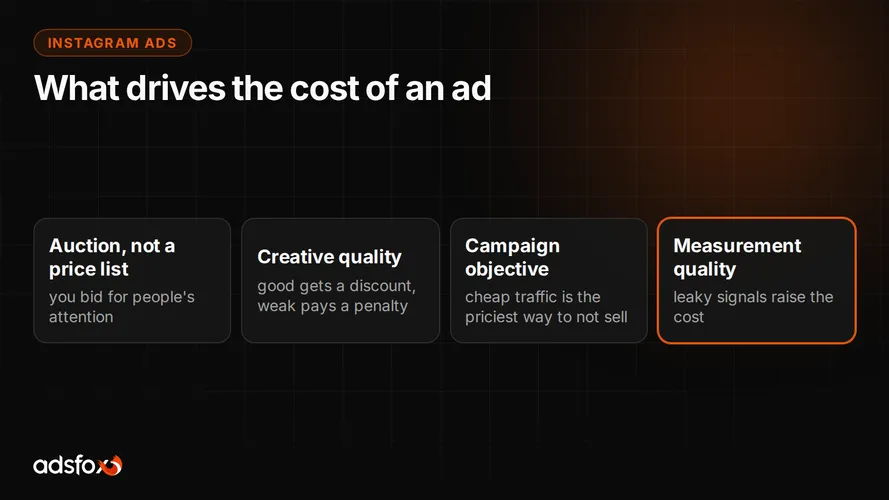
Meta’s own guidance for advertisers points out that different placements have different requirements. The Meta Business Help Center notes, among other things, that a 9:16 ratio works best for Instagram Stories, while 1:1 or 4:5 is recommended for Facebook Feed (source: Meta Business Help Center, guidance on image ads and aspect ratios). That is not a cosmetic difference. It is a signal that the same message should be adapted to the context in which people see it.
What are creative assets in Meta Ads?
Creative assets in Meta Ads are all the elements an ad is built from that can be tested or adapted to placements. In practice: images, videos, headlines, primary text, calls to action, product shots, proof points, testimonials, screenshots, UGC, team photos and message variants.
The key point is that an asset should not be just a “nice file.” It should play a specific role in the campaign system. One asset stops the scroll. Another explains the problem. A third shows proof. A fourth reminds someone who already visited your site why the offer is worth coming back to.
That is why, when we manage Facebook and Instagram Ads, we plan creatives not as individual design projects but as a set of answers to the customer’s questions.
Which assets should you prepare for a Meta Ads campaign?
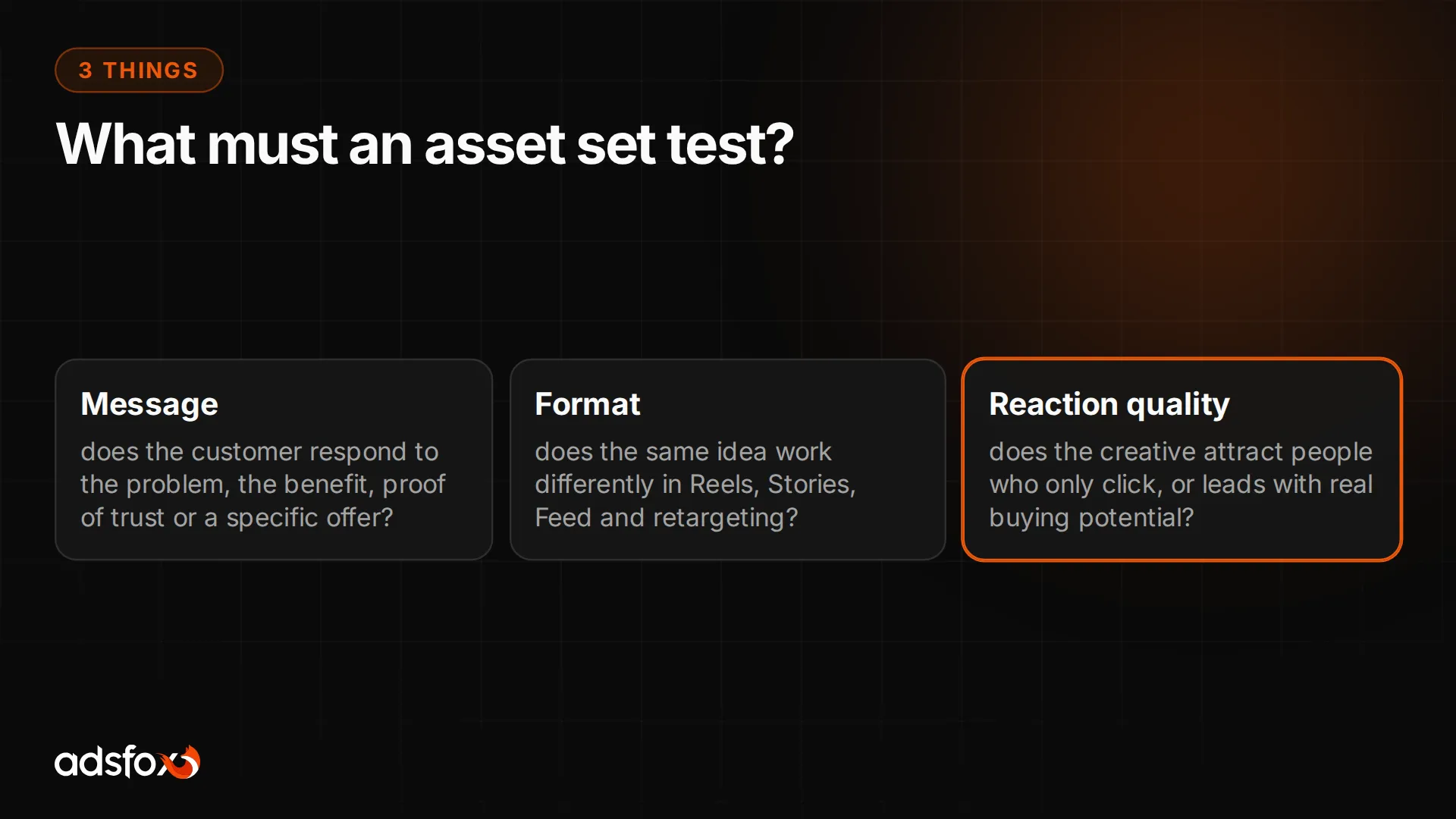
A good asset set tests several different angles. The point is not to redo the same banner five times with a different background. Each creative should answer a different moment in the customer’s decision.
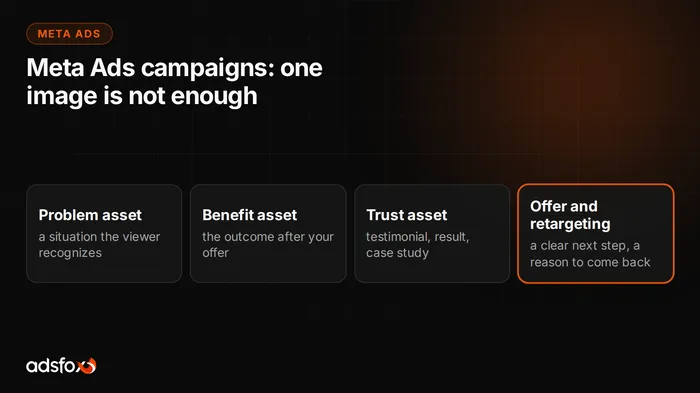
At minimum, prepare:
- a problem asset: shows a situation the viewer recognizes,
- a benefit asset: shows the specific outcome or change after using your offer,
- a trust asset: uses a testimonial, a result, a case study, an expert’s face or social proof,
- an offer asset: clearly explains what the customer can do next,
- a retargeting asset: reminds someone who already knows the brand why the decision is worth revisiting.
A set like this tells you more than one image ever could. You see whether people respond to the problem, the proof, the price, the outcome, a video format or a plain sales message.
How to match creatives to Reels, Stories, Feed and retargeting
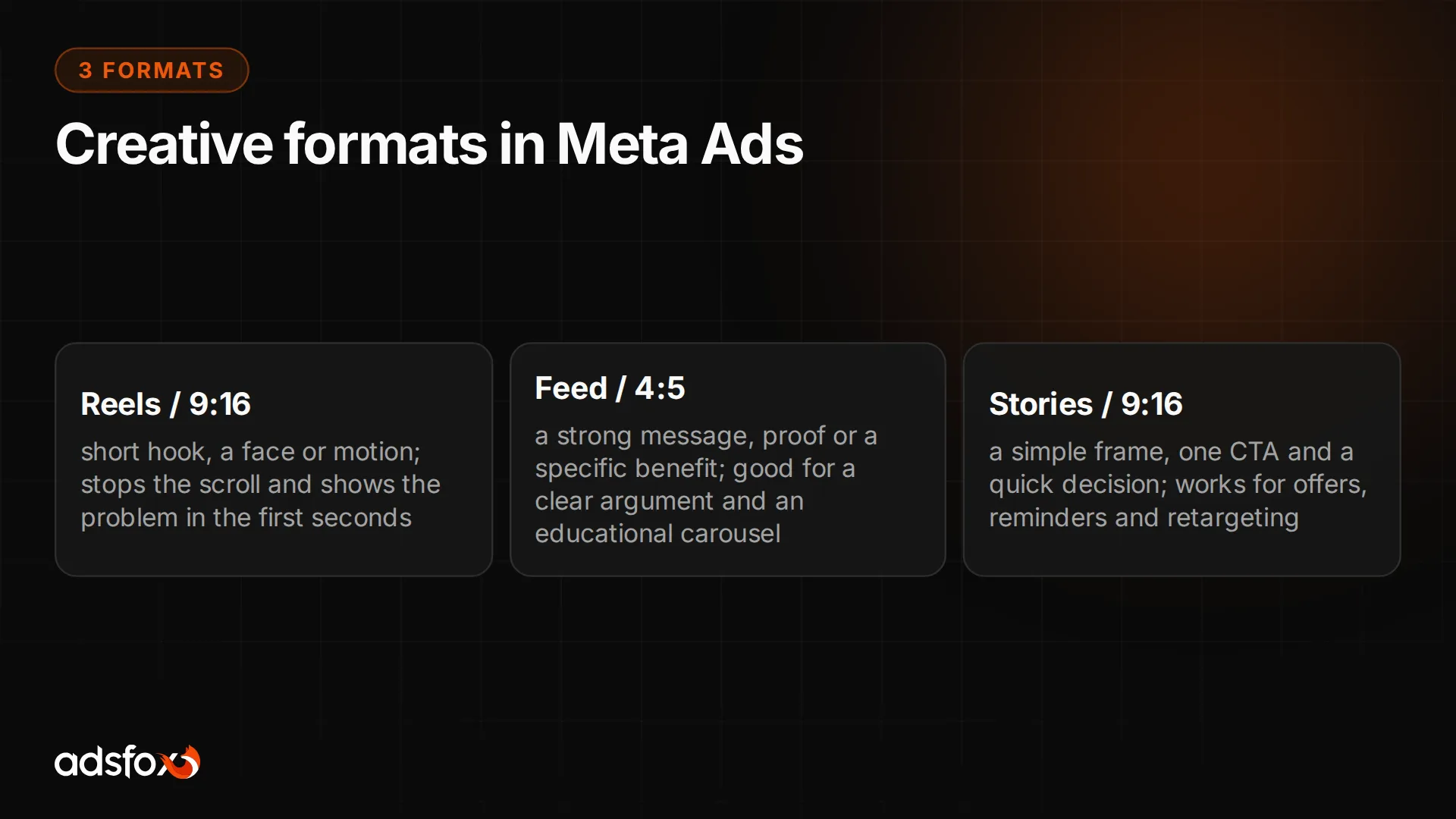
Reels, Stories, Feed and retargeting are not the same touchpoint. In Reels, stopping the scroll in the first second matters most. In Stories, it is instant context and a simple message. In Feed, the viewer can pause on a stronger argument. In retargeting, you usually do not need to explain the whole offer, only remind them of a reason to act.
The common mistake is producing one format and using it everywhere. The same file goes into Feed, Stories and Reels even though people consume those placements differently.
At adsfox we approach this operationally: first define the message, then the format. If a business wants to know whether price, speed, trust or quality is the argument that works, each of those arguments should get its own creative variant.
Examples of formats that perform well in Meta Ads:
- 9:16 Reels with a face or motion: good when you need to stop the scroll fast and name the customer’s problem,
- 4:5 carousel in Feed: good when the offer needs explanation, comparison or several arguments in sequence,
- 9:16 Stories with a single CTA: good when the viewer already knows the brand and needs a simple next step,
- static proof or a result screenshot: good in retargeting when trust has to be built before the decision.
How to recognize that the problem is creative, not budget
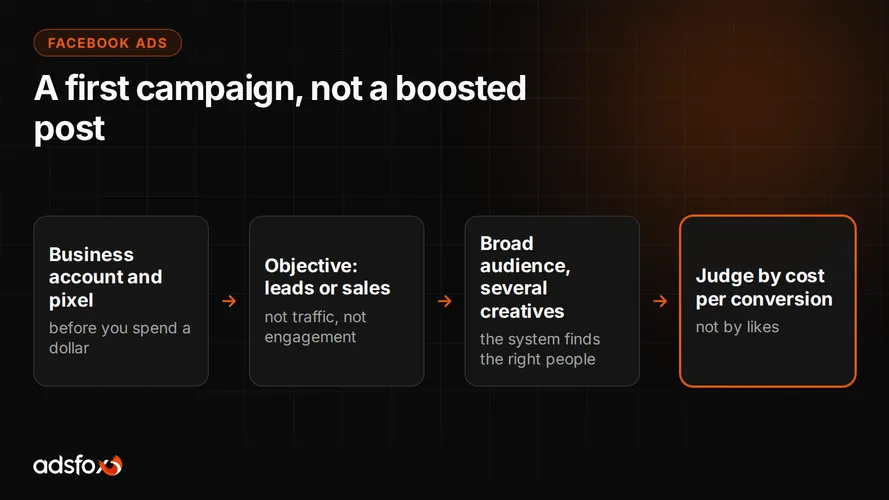
A creative problem in Meta Ads usually shows up when a campaign has reach and impressions but does not generate quality reactions or leads. Click volume alone is not enough. What matters is whether a click turns into a meaningful contact, a sales conversation, an inquiry or a purchase.
Before raising the budget, check three things:
- whether the campaign is testing more than one message,
- whether the assets are matched to the placements,
- whether results are judged by lead quality, not just by cost per form.
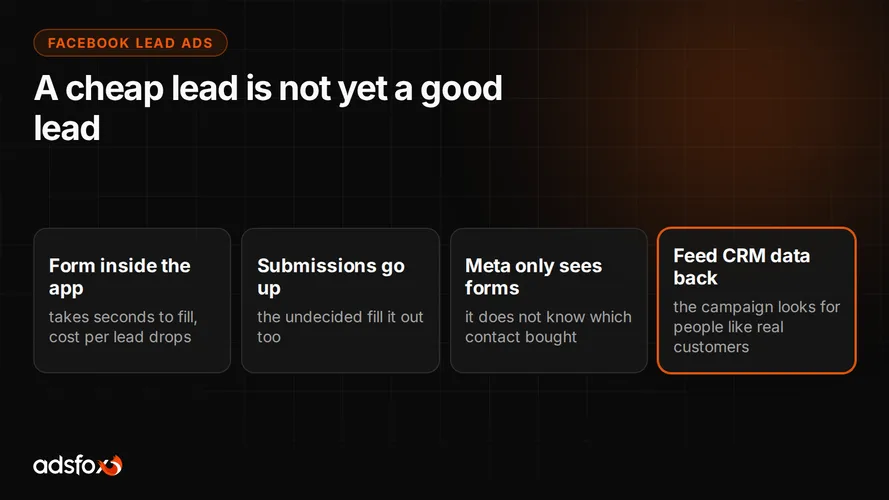
This is especially important in lead generation. If the platform gets a signal from forms but nobody checks lead quality in the CRM, optimization can drift toward cheap contacts rather than customers. That is why at adsfox we connect campaigns to sales data and analyze which messages attract people with real buying intent.
If your Meta Ads campaigns get clicks but not good leads, book a free consultation. We will check whether the problem sits in the creatives, the measurement or the feedback signals from your CRM.
Why Meta Business Partner status matters for creative testing
Testing creatives in Meta Ads takes more than producing graphics. It takes an understanding of the platform, placements, conversion signals and data quality. adsfox is a Meta Business Partner and a Google Partner, so we look at campaigns through more than the look of the ad.
For your business that means a more orderly process: creative, campaign, tracking, CRM and sales are not separate topics. They are one customer acquisition system. If one element is weak, campaign results can look worse even when the budget and settings are correct.
In practice, good creative is not the one that looks professional. Good creative helps the platform and your sales team answer one question: which message attracts a customer with real buying potential?
How to build a simple asset plan for Meta Ads
The starting point should be a plan of messages, not a list of formats to design. First write down the most important situations your customer is in. Only then pick the images, videos and ad copy for each of them.
A simple plan can look like this:
- the customer does not know the brand: needs a clear problem and a strong hook,
- the customer is considering the offer: needs specifics, proof and comparison,
- the customer visited the site: needs a reminder and a clear next step,
- the customer submitted a form but did not buy: needs an argument that brings the decision back.
This structure organizes the work. The team is not producing random graphics; it is checking which messages move the customer further along.
Summary: Meta Ads campaigns need material to test
Meta Ads campaigns work better when the platform has options to choose from and you have data to draw conclusions from. One image can start a test, but it should not be the whole test.
The main takeaway is simple: before raising the budget, check whether the campaign has a proper set of assets, whether the creatives fit the placements, and whether results are judged by lead quality rather than cheap clicks.
Book a free consultation. We will analyze your Meta Ads campaigns and show you whether the problem sits in the creative, the measurement, lead quality or the way you scale budget.