What Are Facebook Lead Ads and When Do They Actually Work
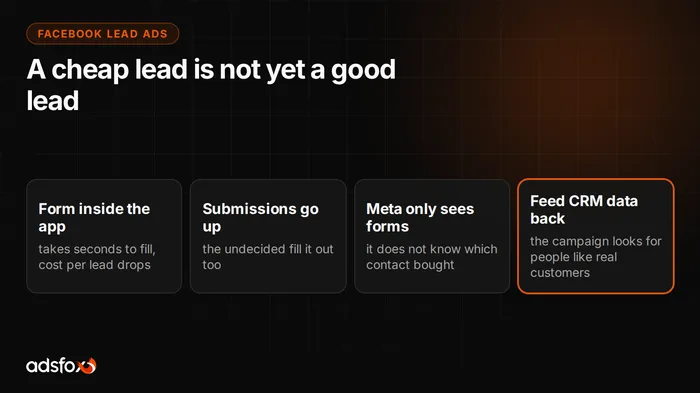
Facebook Lead Ads (Meta Lead Ads) are an ad format in which the contact form opens directly inside the app, without sending the user to a website. Meta prefills some fields from the user’s profile, so completing the form takes seconds instead of minutes.
That is an advantage and a trap at the same time. Below we explain when this format actually helps and when it only inflates your statistics.
How Meta Lead Ads work
The user sees the ad in the feed, in Stories or in Reels. After tapping, they stay in the app: a form opens with their name, email address and phone number already filled in. They confirm, and the submission lands with you.
This removes several points where you normally lose contacts: a slow-loading page, a form that requires retyping data, switching between apps. That is why Lead Ads usually have a lower cost per contact than a campaign that sends people to a website.
If you are looking for step-by-step instructions, we covered them separately: how to create Meta Lead Ads campaigns in Ads Manager.
When Lead Ads beat a landing page
The format makes sense when:
- the offer is simple and clear at a glance, for example a free consultation, a quote, an appointment booking,
- speed of contact matters, not lengthy persuasion,
- your audience is mostly on mobile, where every extra tap costs you submissions,
- you do not have a landing page built for this specific campaign.
A landing page wins where the customer needs more information to decide: for pricier services, for offers that need explanation, or when you want to filter out the less committed. The longer path to the form then works as a natural sieve.
The most honest answer is: do not guess. Test both variants on the same offer and compare not the number of submissions but the number of closed sales.
The quality trap almost nobody writes about
This is the most important part of this article.
Since the form takes seconds to fill out, it also gets filled out by people who did it on impulse while scrolling on their phone. Submissions go up, cost per lead goes down, and the share of genuinely interested people shrinks. The Ads Manager report looks great, and the sales team says the leads are weak.
Two bad decisions usually follow: dropping the format, or pouring more budget into a campaign that brings cheap but worthless contacts.
The problem is not the format. It is what the campaign learns from. By default Meta optimizes for the number of completed forms, because that is all it can see. It does not know which contact picked up the phone, which one booked an appointment and which one bought.
The solution is to hand that information back to the ad system: you mark in your CRM which submissions turned out to be valuable, and that data goes back to Meta as an optimization signal. The campaign then starts looking for people who resemble your real customers, not random tappers. We described the mechanism in our post on Meta Conversion Leads and CRM data, and our lead generation optimization system handles it on the tooling side.
Four things that raise lead quality
Before you reach for advanced measurement, check the basics:
- Say in the ad what happens after the form is sent. “We will call you within 24 hours to schedule” filters out accidental submissions better than any campaign setting.
- Add one custom question. Even a simple one, about the city or the scope of service. It adds a few seconds to the form and visibly changes the mix of submissions.
- Shorten your response time. Same-day contact changes the outcome more than most optimizations in the dashboard. After a few days the person usually does not remember filling anything out.
- Do not judge the campaign by cost per lead. Judge it by cost per customer. We collected reference points for different industries in our CPL and ROAS benchmark from 20 campaigns.
Summary
Facebook Lead Ads are a good format wherever the offer is simple and fast contact matters. They lower the cost of a submission, but on their own they do not improve its quality, because they make the form easy for everyone, including the undecided. The difference comes from whether the campaign gets feedback on which contacts turned into real customers.
If you want to find out how many of your Facebook leads actually end in a sale, that is what we do as part of our Facebook and Instagram Ads management.
Book a free consultation. We will review your lead generation campaigns and show you where you are losing valuable contacts.