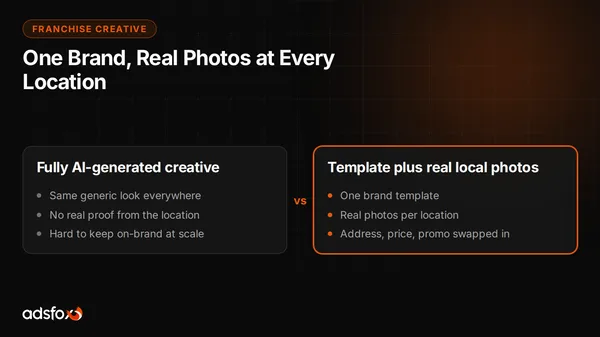
How franchise creative works at scale: one brand template, real photos swapped in per location, and how corporate keeps brand consistency across hundreds of versions.

Franchise marketing has two owners: corporate, which protects the brand, and the franchisee, who needs customers in their own town. These guides cover what we have learned running campaigns, creative, and local SEO for franchise and multi-location brands: how to split the work, how to run campaigns for dozens of locations at once, and how to structure an advertising fund so franchisees can see what it buys them.
How franchise creative works at scale: one brand template, real photos swapped in per location, and how corporate keeps brand consistency across hundreds of versions.
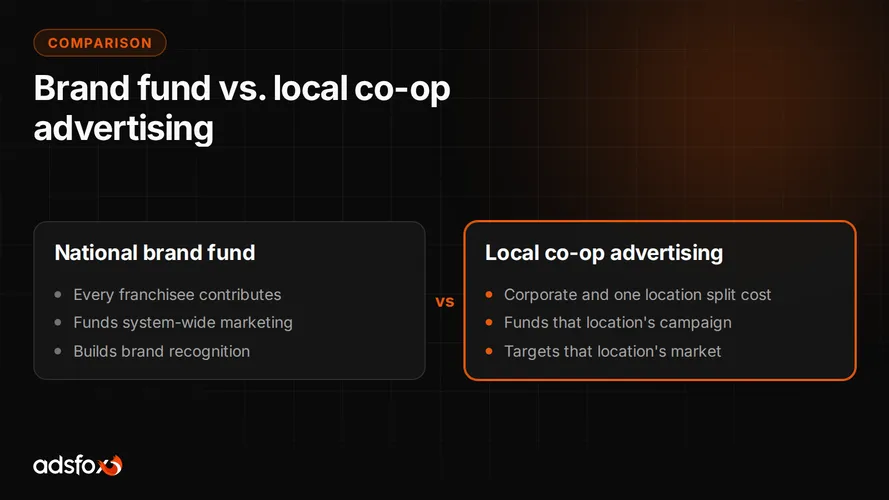


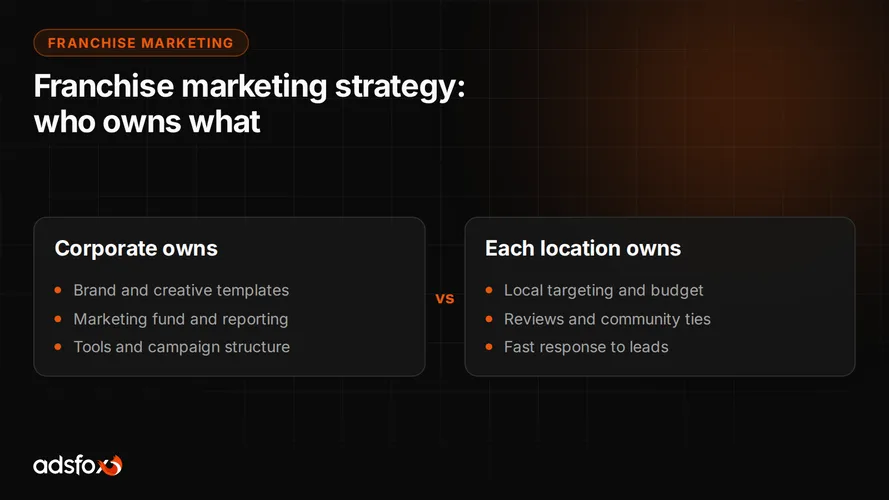
Franchise marketing covers every promotional activity in a franchise system, run at two levels at once. At the corporate level, the franchisor builds brand recognition, sets communication templates, produces marketing materials, and usually manages a marketing fund that franchisees contribute to. At the local level, every location has to win customers from its own area: campaigns targeted to a radius around the storefront, a complete Google Business Profile, reviews, and an active social media presence. A franchise that only does the first half has strong brand awareness and empty locations in smaller markets. One that only does the second half ends up with as many versions of the logo and the message as it has franchisees.
For the full picture, start with franchise marketing strategy: what corporate owns and what each location owns. If you are looking for a vendor, work through the questions in how to choose a franchise marketing agency. For local visibility in Google and in AI answers, see Google Business Profile management for franchise locations.
The franchise agreement and the operations manual answer this on paper, but in practice the split that works best has corporate own the brand, the templates, and the tools, while each location owns its local message and fast customer response. Trouble starts when corporate runs every campaign centrally and reports results for the whole system, and a franchisee has no idea what their own location's customers actually cost. We have seen franchisees who dropped out of a corporate campaign entirely and ran their own instead over exactly this issue. How to structure the split so both sides see the result is covered in local store marketing in a franchise system.
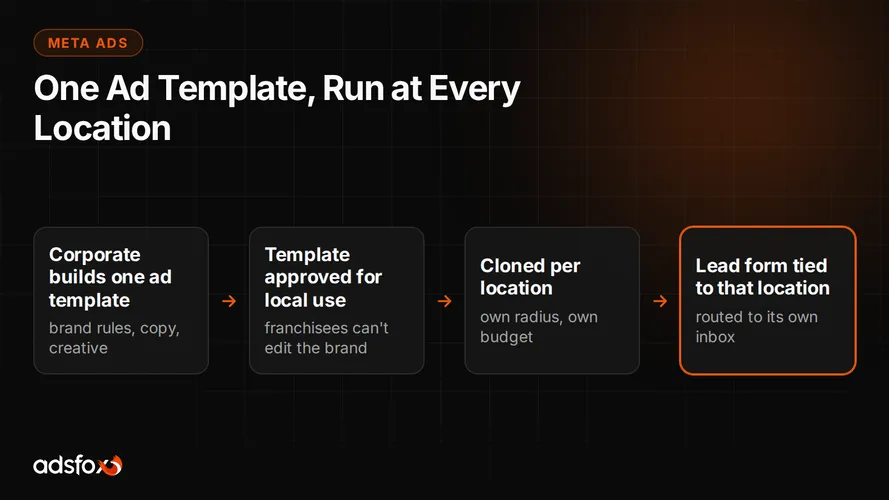
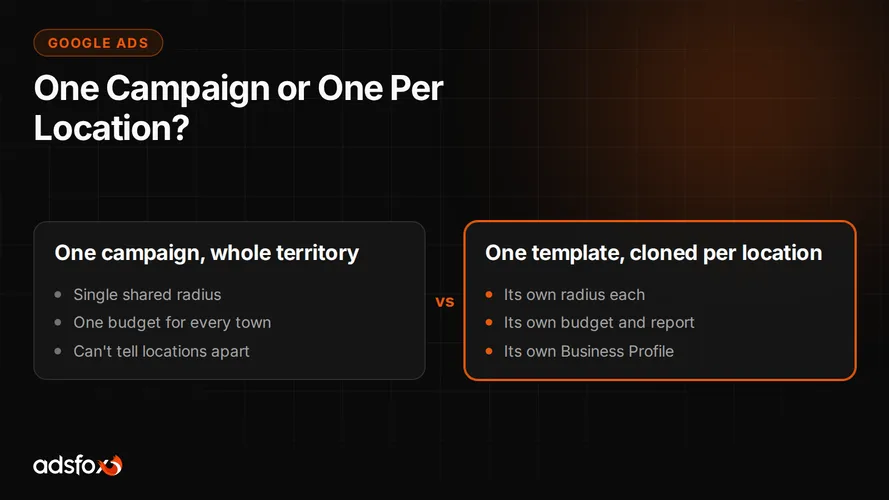
For service locations, the highest-performing acquisition channel is usually local Meta Ads and Google Ads: the ad shows to people who live or work near a specific location. Once a franchise has dozens of locations, setting up each campaign by hand stops being realistic, so campaigns get cloned from one template with the location, radius, budget, and offer swapped in for each site. Whether to run one ad account for the whole system or a separate account per location depends on who is paying for the media and who needs to see the results. We cover this in detail for Facebook Ads for franchises and Google Ads for multi-location franchises.
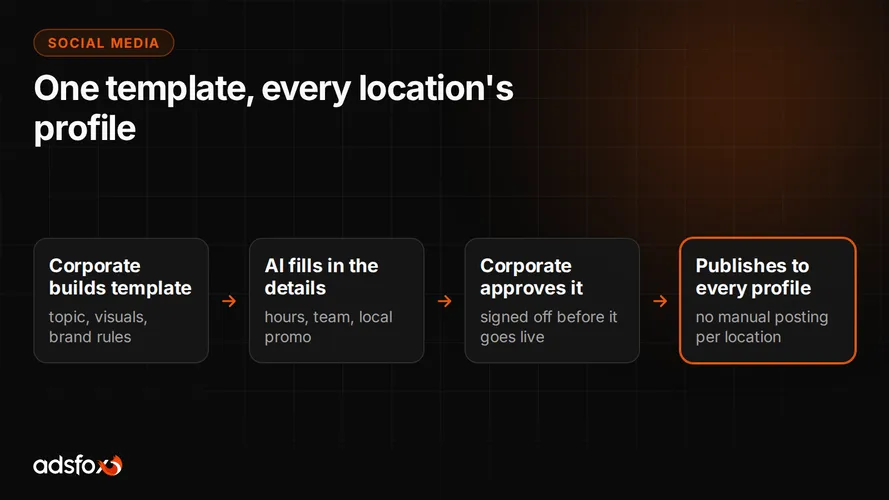
Every location has its own Facebook and Instagram profile, and few franchisees have time to run it well. At the same time, corporate does not want every location publishing graphics thrown together in five minutes in a free editor. The fix is one calendar and one brand template that generate a version for every location, with its own address, hours, price, and local promotion. We work this two-track, with both corporate and franchisees. See social media for franchise locations and franchise marketing materials for multiple locations.
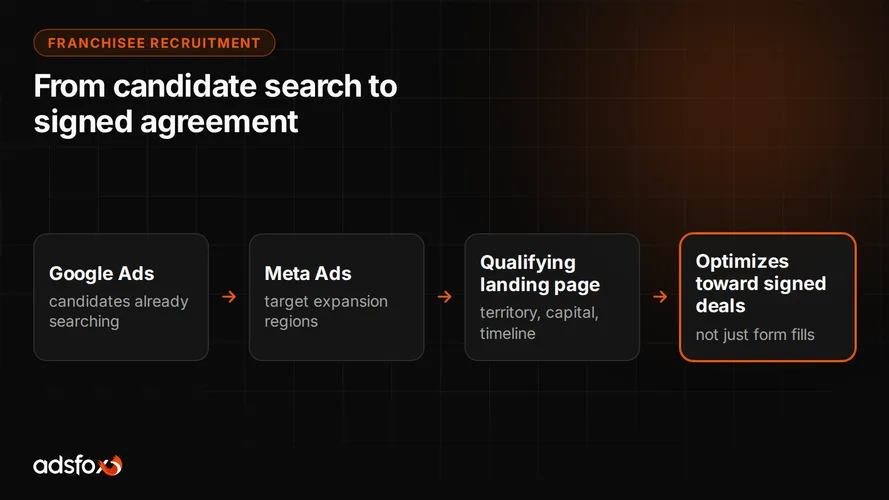
Franchise marketing also means selling the franchise itself. Candidates search for opportunities on Google, and the phrases they type are cheap to buy compared to consumer-facing keywords, yet many systems still rely almost entirely on franchise portals and expos to fill their pipeline. How to build a recruitment campaign, a landing page, and a qualification process for candidates is covered in franchisee recruitment marketing.
Customers search for a service near them, so in Google Maps, local results, and AI answers, the individual location wins, not the brand. Every location needs its own complete, well-maintained Google Business Profile, its own page on the franchise site targeting service-plus-city phrases, and consistent business data everywhere it is listed. Increasingly it also needs GEO, because customers now ask ChatGPT or Gemini for a recommended location in their city and the model answers with specific names. We cover how to structure this in Google Business Profile management for franchise locations.
A system-wide report hides the one number that matters most: which locations make money from advertising and which do not. Every lead should be tagged with a location, routed to wherever that location handles customers, and its sales status should flow back to the ad platforms. That is how corporate compares locations fairly, a franchisee sees their own result, and campaigns learn from actual customers instead of raw form fills. Without that feedback loop it is also hard to give a franchisee an honest answer about what their marketing fund contribution buys them, which is why we cover it separately in franchise advertising funds.
We have run this two-level marketing model for networks including Dobry Dietetyk, one of Europe's largest networks of nutrition clinics with nearly 400 offices, and Xtreme Fitness Gyms, where we work both with corporate on materials and posts and with individual franchisees on campaigns, creative, and consultations, using our own AI-supported tools.
These guides explain how to run franchise marketing yourself. If you would rather hand it to a team that already has the tools to do this across hundreds of locations, see our franchise marketing agency service. We usually start with a pilot on one to three locations, and the result is judged on the numbers from those locations. Book a free consultation if you want to see what this would look like for your system.
Franchise marketing is the promotional work of a franchise system, run at two levels: corporate, where the franchisor builds the brand and communication templates, and local, where each location wins customers from its own area. Franchise marketing works best when brand consistency and local relevance are handled together, not treated as separate jobs.
Franchisees typically contribute to a marketing or advertising fund managed by corporate, and many systems also require a separate local marketing budget at the location level. The franchise agreement sets the exact terms. What matters is that a franchisee can see what their location gets in return for its contribution.
It depends on the franchise agreement. Many systems allow it, but only within brand templates and guardrails set by corporate. A separate campaign or ad account for the location, built on shared templates and reported to both sides, is usually the best setup.
Through Google Ads campaigns on the phrases candidates search for, Meta Ads in target expansion markets, and a recruitment landing page with a form asking about territory, available budget, and timeline. Candidate status should flow back into the campaigns so they optimize for signed agreements, not just form fills.
The most efficient setup uses one calendar and one brand template, from which a version is generated for each location with its own details. Publishing across every location's profile can be automated, with corporate approving the template before anything goes live.