Facebook Ads for Franchises: One Template, Every Location
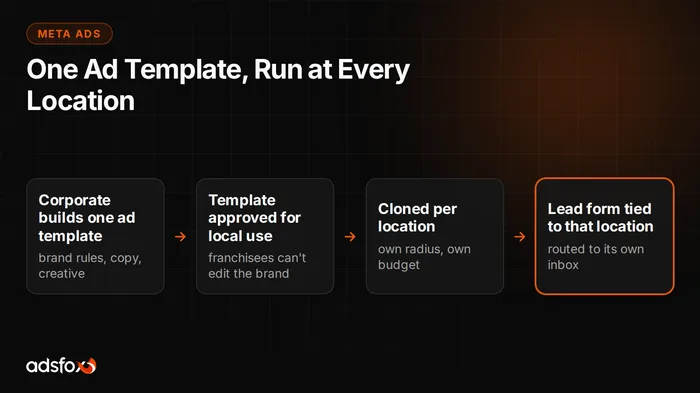
Meta Ads work for a franchise network the same way Google Ads do: corporate builds and approves one ad template, and that template gets cloned into a separate campaign or ad set for every location, each with its own local targeting radius, its own budget, and its own lead form. The brand looks the same everywhere because nobody is editing the creative by hand at the location level; only the fields tied to that address change.
How does one ad template turn into ads for every location?
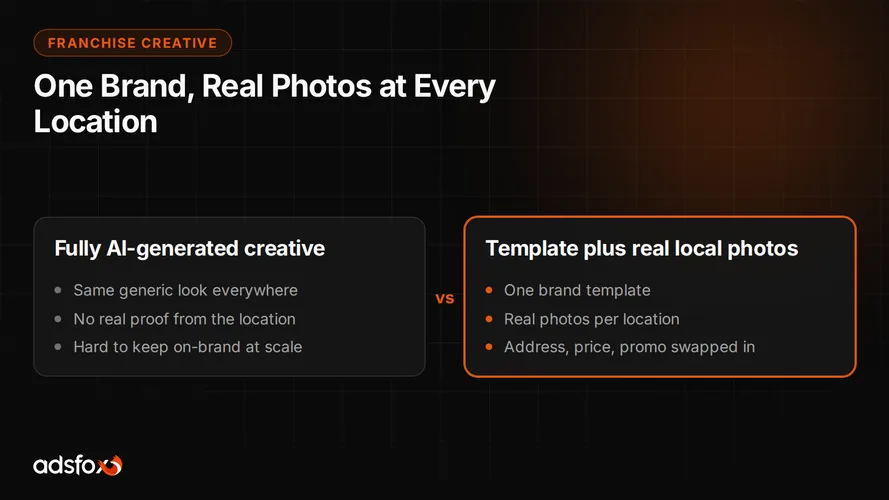
A template typically locks down the creative, the headline and body copy structure, and any legal or brand disclaimers corporate requires. What changes per location is a short list: the targeting radius around that address, the daily or lifetime budget, the location’s name and city in the copy, and the destination (a lead form, a landing page, or a call button) tied to that specific location. Once the template is set, producing a new location’s ad set is a matter of filling in these fields rather than briefing a new campaign from scratch, which is the approach we use inside our franchise marketing agency for networks running this across dozens or hundreds of locations at once.
Why does local targeting matter more than brand-wide targeting?
Most franchise locations serve people within a short drive, not an entire state or metro area. A Meta campaign targeted broadly spends money showing ads to people who will never realistically visit a given address, and it has no way to tell corporate which location that spend actually helped. Targeting drawn tightly around each address, usually a radius of a few miles depending on the type of business, keeps the audience relevant to that specific storefront and makes it possible to report results location by location instead of as one blended number for the whole network.
What happens when two locations’ radiuses overlap?
If two nearby locations both target the same area, their ad sets end up bidding against each other in the same auction for the same audience. That raises the cost per result for both locations without bringing in a single additional customer, because Meta’s delivery system has no concept that the two ad sets belong to the same brand. The fix is straightforward: draw each radius so it stops roughly halfway to the next location, adjusting the line if one address clearly draws from a larger population than the other.
How do lead forms get tied to a specific location?
Each location should have its own lead form, or at minimum a shared form with a hidden field that records which ad set or location generated the submission. Without that tag, a lead lands in a general inbox and someone has to figure out, often by calling the person back, which location it belongs to. That delay is where leads go cold. Tying the form to the location up front lets a lead route straight to that location’s own inbox, front-desk system, or CRM record, the same mechanism covered in Google Ads for multi-location franchises for the equivalent setup on Google’s side.
What ad format works best for a franchise location?
Meta gives you several ways to collect a customer’s interest, and the right one depends on how the location actually wants to handle the first response. A native lead form (Meta calls it a Lead Ad) keeps the person on Facebook or Instagram and captures name, phone, and email in a few taps, which usually produces the highest volume of submissions but requires someone at the location to call back quickly, since not everyone who fills out a form was actively looking that moment. A click-to-message ad opens a conversation in Messenger or Instagram DMs instead, which suits a location that prefers to answer questions directly before booking anything. A traffic campaign sending people to a landing page works better when the offer needs more explaining than a form allows, such as a first visit promotion with terms attached. Most franchise templates standardize on one format across the network, both because it’s easier for corporate to review one type of asset and because it keeps response-time expectations consistent from location to location.
Corporate-run vs. franchisee-run ad accounts: which model fits?
Franchise networks generally run Meta Ads one of two ways.
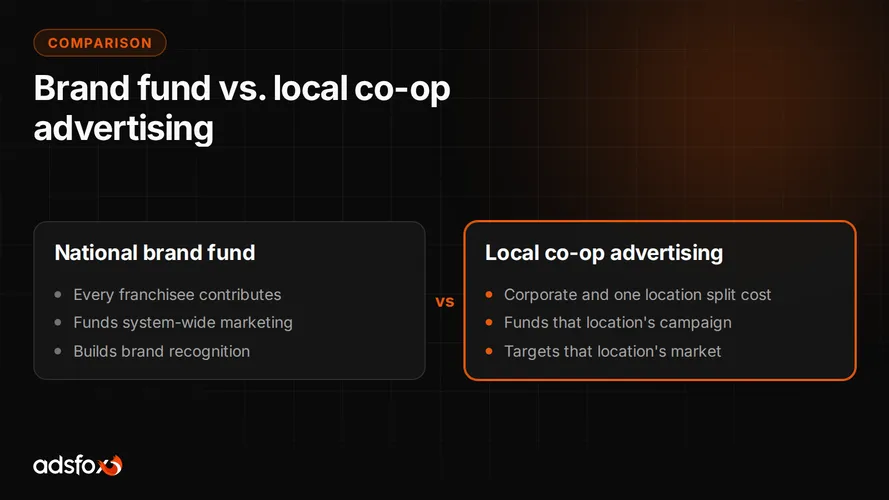
Corporate-run. One team manages a single ad account (or one Business Manager with a page per location) covering every location’s campaigns. This is usually funded from a shared marketing or advertising fund, and it gives corporate the tightest control over what’s live at any moment. A franchisee sees a report for their own location but doesn’t log into the ad account itself.
Franchisee-run. Each location has its own ad account, its own Facebook Page, and its own budget, funded by the franchisee directly. Corporate still sets the creative template and brand rules, and often has to approve a campaign before it goes live, but the franchisee controls spend day to day and can see their own numbers without asking anyone.
Some networks run a hybrid: corporate funds a baseline brand campaign, and a franchisee who wants more visibility in their own town can add their own budget on top, inside the same template. There is no universally correct choice here. It depends on the franchise agreement, how much local control franchisees expect, and how much oversight corporate needs to keep the brand consistent. We work through this same decision for creative specifically in franchise marketing materials, since the account structure and the creative approval process usually get decided together.
Who approves what goes live?
Even in a franchisee-run setup, most networks keep a review step before a new ad or a new ad set goes live, so a location can’t accidentally publish something off-brand or legally risky. In practice this is a short checklist against the approved template rather than a full creative review each time, since the template itself already went through brand approval once. The point of the checklist is to catch a location that’s edited outside the template, not to slow down routine local ad sets that follow it correctly.
How do you measure results across a whole network of locations?
Each location’s ad set should report its own cost per lead, and that number is only meaningful if the lead is tracked through to whether it actually became a customer. Sales status flowing back into Meta, typically through server-side tracking or the Conversions API, lets each location’s campaign learn from real outcomes instead of optimizing for form fills alone. Corporate can then compare locations fairly, and a franchisee can see the number that actually matters to their own business: what a lead from Meta cost them and whether it turned into a sale.
Getting started
If your network is running Meta Ads location by location with no shared template, the fastest fix isn’t better ad copy, it’s building the template once and cloning it, the same starting point covered across our franchise marketing guides. If you’d rather have this built and managed for you, our franchise marketing agency sets up exactly this structure for networks from a dozen locations to several hundred.