Franchise Advertising Fund: What It Is and What It Actually Buys a Location
A franchise advertising fund (also called an ad fund, marketing fund, or brand fund) is a pool that franchisees pay into, typically a share of sales set by the franchise agreement, which the franchisor uses to fund marketing across the whole system: brand campaigns, national or regional media buys, creative production, and shared marketing tools. It sits apart from whatever a franchisee spends marketing their own location, and it is one of the most common sources of friction between corporate and franchisees, mostly because franchisees rarely see exactly what their contribution buys at their own address.
This is a marketing explanation, not legal or accounting guidance. Fund structures, disclosure requirements, and compliance obligations vary by franchise system and are governed by specific contract language and by the FTC Franchise Rule. Nothing in this article should be read as advice on how to draft, structure, or audit a fund; that is a job for a franchise attorney or accountant who has read the actual documents.
What is a franchise advertising fund?
A franchise advertising fund exists because an individual franchisee, on their own, usually cannot afford the kind of brand-level marketing that makes the franchise recognizable in the first place: a national ad campaign, a professionally produced brand video, or a media buy big enough to matter. Pooling contributions from every location gives the franchisor a marketing budget with the scale to compete at that level. In exchange, franchisees get a brand that is easier to sell under, provided the system is actually run well.
Funds differ in what they are allowed to pay for. Some are limited to media spend. Others also cover creative production, market research, PR, or the tools and platforms used to run campaigns for the whole network. What is and isn’t allowed is set out in the franchise agreement and the FDD, not by convention, so the honest answer to “what can our fund pay for” is always “read the document that governs your specific system.”
Some agreements also address what happens to a fund’s leftover balance at year end, whether the franchisor can use fund money for its own overhead in running the marketing department, and how new franchisees are treated in their first months before they are generating sales the contribution is based on. None of these details are consistent across brands, which is exactly why a franchisee comparing notes with someone in a different franchise system often finds the two funds work nothing alike.
What does FDD Item 11 typically cover?
In the US, the Franchise Disclosure Document is the document a franchisor must give prospective franchisees before they sign, and Item 11 is where obligations around advertising and the ad fund are typically described: whether a fund exists, how contributions are calculated, broadly how the fund’s money can be spent, and whether the franchisor has to spend a minimum amount on advertising, in the franchisee’s local market specifically. It generally does not guarantee that a specific dollar amount gets spent in a specific franchisee’s town. That gap, between what corporate collects system-wide and what a franchisee sees spent locally, is where most of the frustration around ad funds comes from.
Because the specific terms in Item 11 vary by franchise and are legally binding once signed, reading the actual language in your own FDD with a franchise attorney is the only reliable way to know what your fund covers. General explanations, including this one, describe the mechanism, not your contract.
How is a national brand fund different from local co-op advertising?
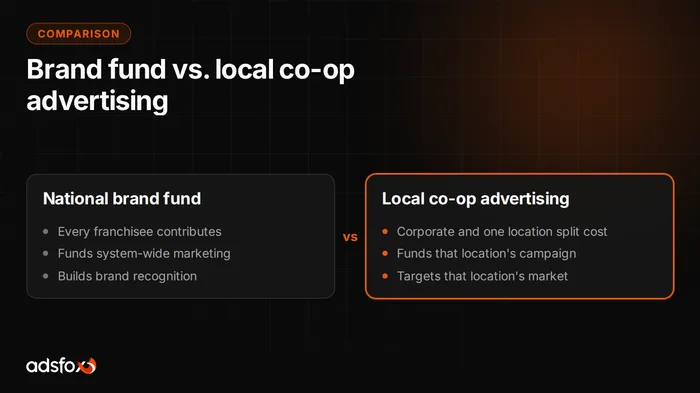
A brand fund is system-wide: every franchisee contributes, usually based on a formula in the franchise agreement, and the money pays for marketing that benefits the whole network, regardless of where any individual location sits. Local co-op advertising works differently. In a typical co-op arrangement, corporate and a specific franchisee (sometimes a small group of nearby franchisees) split the cost of a campaign that runs in that franchisee’s own market: a local paid social or search campaign, a piece of local media, a specific promotion. The franchisee gets marketing targeted at their own customers, and corporate shares the cost under brand rules the franchisee agrees to follow (approved creative, consistent messaging, and so on).
The two are not competing budgets so much as two different layers. The brand fund builds and protects national recognition. Co-op advertising puts money directly behind a specific location’s local campaign. Whether a franchise runs one, both, or a blend depends entirely on what its agreement sets up; see how that split plays out operationally in local store marketing in a franchise system, and how corporate and location roles divide more broadly in franchise marketing strategy: what corporate owns and what each location owns.
What does a franchisee’s contribution actually buy at the location level?
This is the question that comes up in almost every conversation we have with franchisees, and it is a fair one. A franchisee pays into a fund every month, sees a national ad campaign or a new set of brand videos, and has no way to tell whether any of it moved a single customer through their own door. Corporate, meanwhile, can point to system-wide reach and impressions, which are real numbers but answer a different question than the one the franchisee is actually asking.
The honest answer is that a brand fund’s job is brand-level, not location-level, so its return does not always show up as a traceable lead at any one address, especially for campaigns built to build recognition rather than generate a direct response. What can be tracked, if the fund also pays for or contributes to campaigns designed to generate leads (search ads, paid social, a co-op campaign), is whether those specific campaigns produce leads a specific location can trace and, ideally, follow through to a sale.
How does per-location tracking answer that question?
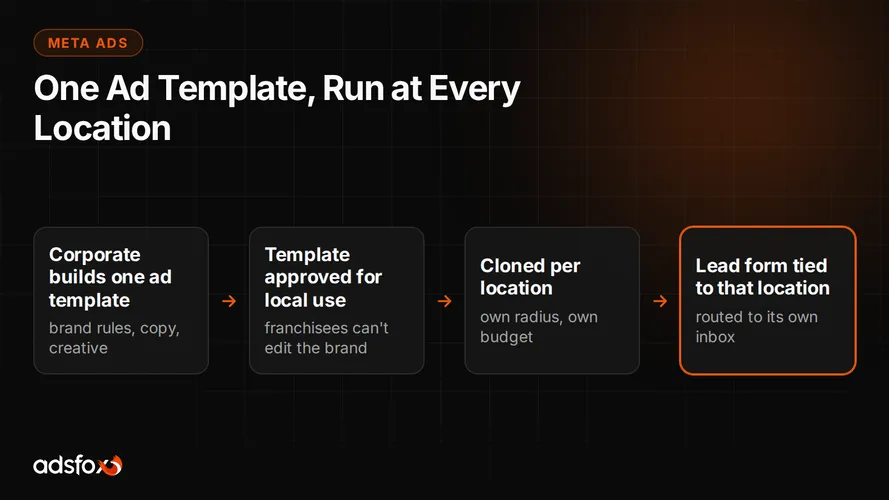
If a fund-supported campaign is built to generate leads rather than just impressions, those leads can be tagged with the location they came from and routed to that location’s own system, the same way any other campaign lead would be. From there, cost per lead and, with sales data flowing back through server-side tracking or CRM integration, cost per sale can be calculated for that specific address, not just for the network as a whole. That turns “the fund spent this much” into “the fund’s campaigns produced this many leads and this many sales at your location,” which is a very different, and much more useful, conversation between corporate and a franchisee.
This is exactly the kind of measurement our franchise marketing agency builds into fund-supported campaigns for networks we work with: leads tagged and reported by location, not just by campaign or by system. It does not answer questions about how a fund should be structured or disclosed, only about what its campaigns produced. For the campaign side of this, see Google Ads for multi-location franchises.
Who should you actually ask about your fund?
Not us, for the legal and accounting parts. This article explains how ad funds and co-op advertising generally work as a marketing mechanism; it does not tell you how your specific fund is structured, what it should cost, or whether it complies with the FTC Franchise Rule and your state’s franchise laws. For those questions, talk to a franchise attorney or accountant who has read your FDD and franchise agreement. For questions about what campaigns funded through your ad fund or your co-op budget are actually producing at your location, that is where a franchise marketing partner, and a consultation with one, is useful.