Franchise Marketing Materials: Brand Consistency at Every Location
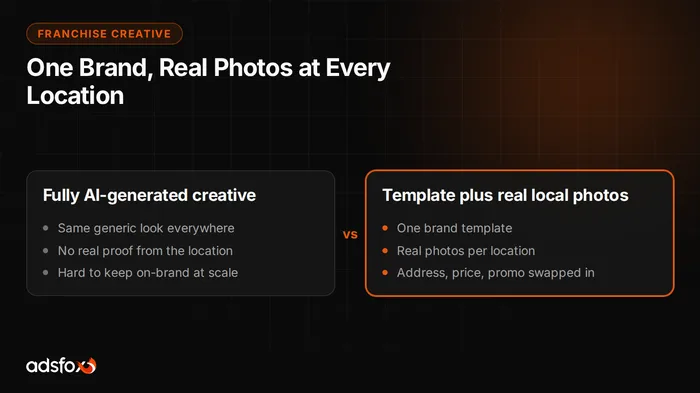
Franchise marketing materials work at scale through one brand template that every location’s version is built from, with real photos and local details swapped in for that address: the city, the price, the current promotion. Corporate keeps brand consistency by controlling the template itself rather than reviewing hundreds of individually designed pieces, and locations get creative that’s actually specific to them instead of a generic brand graphic with no local proof.
What counts as franchise marketing materials?
The term covers everything a location uses to advertise and promote itself: paid ad creative for Meta and Google, organic social posts, email graphics, in-store signage, and sometimes printed flyers or door hangers for a local promotion. In a single-location business, one person designs all of this as needed. In a franchise network, the same set of assets has to exist for every location, updated on the same schedule, without each location reinventing the design from scratch or drifting from the brand’s look.
How do you keep brand consistency across hundreds of locations?
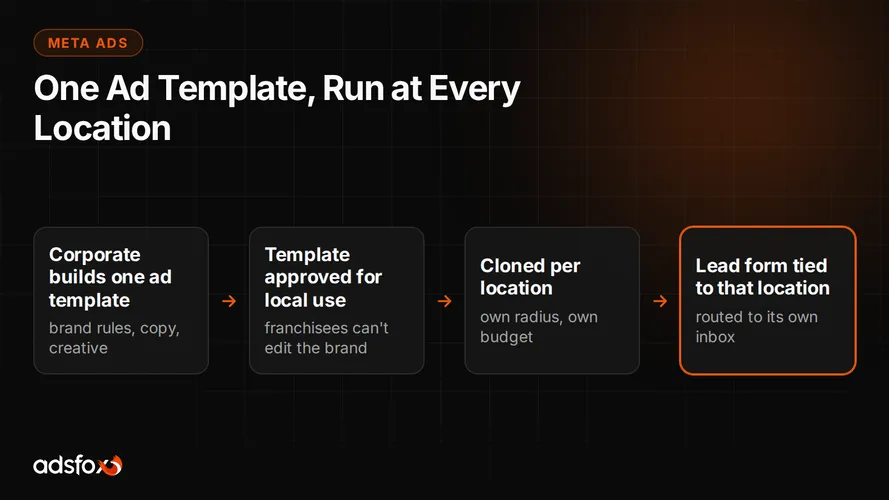
The mechanism is controlling the template, not policing the output. Corporate (or an agency working on corporate’s behalf) designs and approves the layout, typography, logo placement, color palette, and copy structure once. Every location’s version is then generated from that same template, with a short, fixed list of fields changed: address, phone number, price, a local promotion, and photos from that specific location. Because the elements that carry the brand (logo, colors, layout) are locked in the template rather than rebuilt by hand at each location, there’s no opportunity for a location to drift into an off-brand look, even across hundreds of versions.
This is the same approach we use inside our franchise marketing agency: one template approved by corporate, applied consistently across every location’s ads and posts, rather than a new design decision at each address.
Why not just generate all the creative with AI?
Fully AI-generated creative can produce a finished-looking image quickly, but for a franchise it tends to create two problems. First, the images often look generic: a similar style of storefront, staff, or scene repeats across every location because the model is generating from the same prompt pattern rather than photographing anything real, and customers in a specific town can tell the image isn’t actually their location. Second, consistency gets harder to guarantee, not easier: an AI model can render a logo slightly wrong, place text oddly, or shift the color palette from one generation to the next, which is exactly the kind of small brand drift a template is supposed to prevent.
A template filled with real photos from each location avoids both problems. The photo is actually of that storefront, that team, or that product, which reads as more credible to a local customer, and the brand elements around the photo (logo, colors, layout) come from the fixed template instead of being regenerated each time. AI still has a useful role here: drafting copy variations, resizing a layout for different ad formats, or suggesting which photo crops work best, with a designer reviewing the result before anything publishes. The generation step just isn’t asked to invent the storefront itself.
What should stay locked, and what should each location control?
Most networks split creative control roughly like this:
Locked to the template (corporate controls):
- Logo placement and brand colors
- Overall layout and typography
- Required legal or disclosure text
- Copy structure and tone
Open to each location:
- Address, phone number, and hours
- Price and current local promotion
- Photos of that specific storefront, team, or product
- A short line of local context, such as a nearby landmark or an event
This split lets a location’s version feel specific and current without ever touching the parts of the design that carry the brand. It’s the same balance we describe for social content in social media for franchise locations, where the calendar and template are shared but the day-to-day content still reflects what’s actually happening at that address.
Who approves a location’s version before it goes live?
Even with a locked template, most networks keep a review step: a designer or brand manager checks each location’s filled-in version before it publishes. The review isn’t hunting for brand violations, since the template already prevents those; it’s catching mistakes like a wrong price, an expired promotion, or a photo that doesn’t match what’s currently on offer. This step is quick precisely because the template narrows what could go wrong to a short, predictable list of fields.
How many versions does a network actually need?
The number scales with locations, not with design effort. A network producing even one monthly social post and one seasonal ad needs a version of each for every location, but that still comes from one or two source templates being filled in repeatedly, not from a separate design project per location. This is the math that makes manual design unworkable past a certain size, and it’s also why the fix isn’t hiring more designers, it’s building a template and a process that fills it in automatically, with a human reviewing the result. Our Google Ads for multi-location franchises and Facebook Ads for franchises guides cover the same cloning approach applied to campaign structure instead of creative.
What formats does a franchise actually need?
A single template rarely produces one asset. The same brand template usually needs to output several formats for the same location: a square or vertical image for a Meta or Instagram ad, a landscape banner for a Google Display ad, a set of story-sized frames for organic social, and sometimes a print-ready flyer for a local promotion. Building each format by hand for every location multiplies the workload fast, so most networks design the template once with each format’s dimensions in mind from the start, then generate every size for every location from the same source file rather than resizing manually after the fact. This is also where a designer’s review matters most: a layout that looks right as a square ad can crop a logo or cut off a price when the same template is force-fit into a vertical story frame, so the format variants need their own quick check, not just the first version.
Do franchisees ever design their own materials?
Occasionally, and it’s usually where brand consistency problems start. A franchisee who needs a flyer for a same-week event and doesn’t have a template on hand will often put something together themselves, sometimes with the logo pulled from an old file or resized incorrectly. This isn’t a discipline problem, it’s a gap in the process: if the template library doesn’t cover the situation a location actually needs (a last-minute local event, a weather closure notice, a hiring flyer), someone will fill that gap themselves rather than wait. The fix is making sure the template set is broad enough to cover the recurring situations locations run into, not just the standard monthly ad and post, so there’s rarely a reason to design something from scratch. A request that falls genuinely outside the template library should have a fast path to corporate or the agency for a one-off approval, rather than becoming a standing exception that erodes the system over time.
Getting this right before you scale
The networks that struggle most with brand consistency are usually the ones that let creative decisions happen at the location level from the start, then try to retrofit a template after dozens of locations have already built their own look. Setting the template and the approval process up front, even for a small network, avoids that cleanup later. See our full franchise marketing hub for how creative fits with campaigns and local SEO, or talk to us about building your network’s template.