Franchise Marketing Strategy: What Corporate Owns and What Each Location Owns
A franchise marketing strategy is the plan for splitting marketing work between the corporate office and each individual location, so the brand stays consistent everywhere while each location still wins customers in its own town. Get the split wrong in either direction and the result is predictable: a strong brand with empty locations, or dozens of locations that no longer look like the same business.
What does a franchise marketing strategy actually cover?
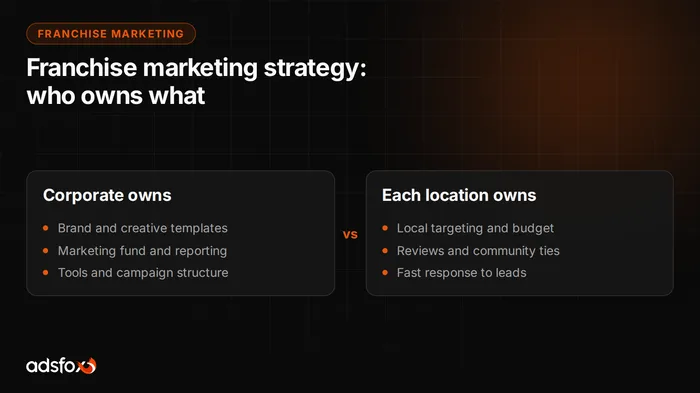
Every franchise marketing system runs on two levels at once. At the corporate level, the franchisor protects the brand: logo, voice, creative standards, national or regional campaigns, and usually a shared marketing fund. At the location level, each franchisee has to win customers from a specific radius around a specific address, which means local targeting, a complete Google Business Profile, reviews, and a fast response when a lead comes in. A strategy is the document, written or unwritten, that decides who does what on each side and how results get measured.
Systems that never write this down tend to drift toward one extreme or the other. Either corporate keeps expanding its role until franchisees have no say and no visibility into their own numbers, or corporate stays hands-off and each location ends up inventing its own version of the brand.
A written strategy does not need to be a long document. Most systems can put it on one page: a list of what corporate controls, a list of what each location controls, and a short description of who reports what, to whom, and how often. The value is not in the length, it is in having a single reference both sides can point to when a disagreement comes up about who was supposed to handle a given task.
What should corporate own in franchise marketing?
Corporate is the right owner for anything that has to look and sound the same everywhere a customer encounters the brand:
- Brand guidelines, logo usage, and tone of voice
- Creative templates for ads, social posts, signage, and print materials
- National or regional campaigns that build category awareness
- The marketing or advertising fund, including how it is billed and reported
- Shared tools and platforms: a booking system, a CRM, ad account structure
- Training on how to run local campaigns correctly
The marketing fund deserves a specific mention. In the United States, FDD Item 11 requires a franchisor to disclose how the marketing fund is administered, including how contributions are calculated and roughly how the money is spent. Co-op advertising programs, where corporate and a franchisee split the cost of a local campaign, are usually described in the same section. None of this is legal advice: any question about how your fund language should read belongs with a franchise attorney, not a marketing agency.
What should each location own?
Corporate cannot run the local side of the business from headquarters, because it does not know the neighborhood, the local competitors, or the specific customer walking in that day. What belongs at the location level:
- Local targeting: radius, city, and neighborhood-level decisions
- A budget decision, usually within a range or a required minimum set by corporate
- Google Business Profile: hours, photos, posts, and responses to reviews
- Requesting and responding to reviews
- Local partnerships, sponsorships, and community involvement
- Fast response to leads, since a slow reply loses the customer to a competitor a few minutes down the road
We cover this half of the split in more detail in local store marketing in a franchise system, including where local store marketing (LSM) ends and corporate advertising begins.
Where does the split usually break down?
Two failure modes show up constantly. The first is overcentralization: corporate runs every campaign from one dashboard and reports one blended result for the whole system, and a franchisee has no way to see what their own location’s leads actually cost. We have seen franchisees quietly stop engaging with a corporate campaign and start running their own instead, purely because they had no visibility into what the shared spend was buying them. Avoiding that is mostly a reporting and fund-transparency problem, which we cover in franchise advertising funds.
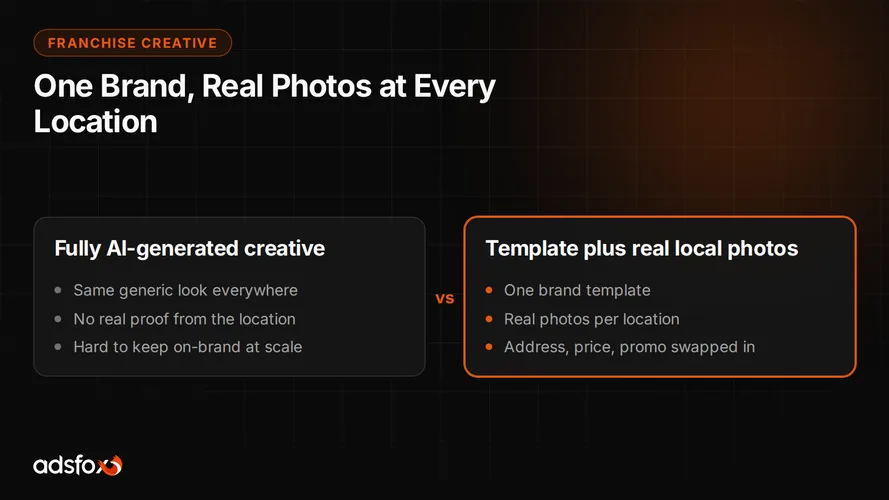
The second failure mode is the opposite: corporate stays out of local marketing entirely, and each franchisee designs their own graphics, writes their own offers, and picks their own vendor. The brand starts to look like a dozen different businesses, and a customer who has a good experience at one location has no reason to expect the same at another.
How do you build a franchise marketing plan that works for both sides?
The systems that get this right tend to follow a similar pattern:
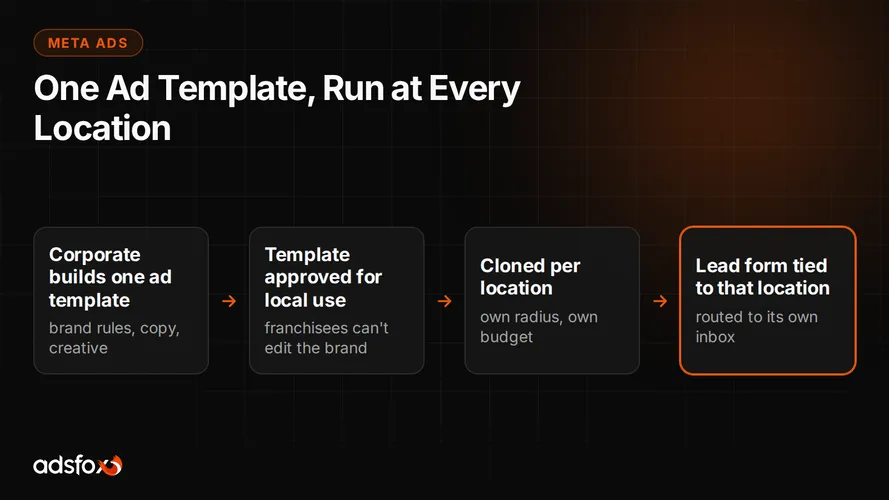
- Corporate approves one campaign template per channel: a Google Ads structure, a Meta Ads structure, a social content calendar.
- That template gets cloned for every location, with the address, radius, budget, and local offer swapped in.
- Each location gets its own report: its own cost per lead, its own conversion numbers, not a system average.
- Corporate keeps a system-wide view for its own decisions, while each franchisee can see their own slice without digging through a shared spreadsheet.
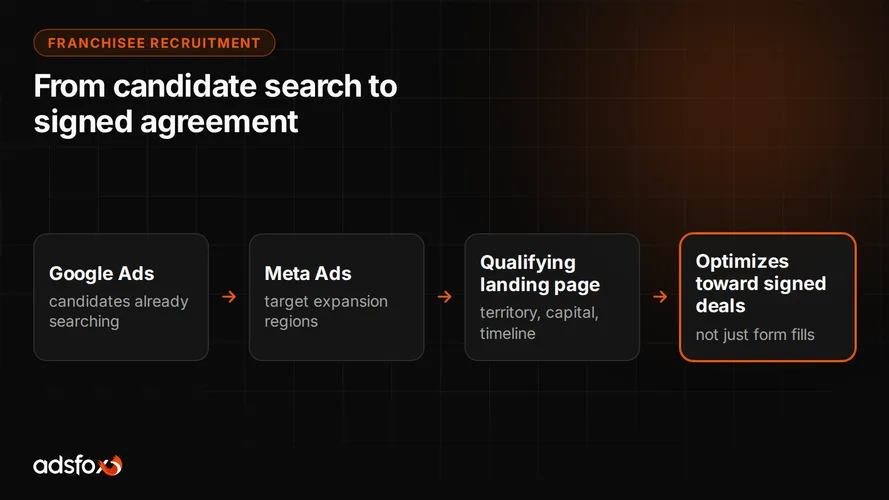
This is the approach our franchise marketing agency uses when we take over campaigns for a multi-location brand: one template, cloned per site, with results that roll up to corporate and stay visible to each location at the same time.
How is this different from a single-location marketing plan?
A single business writes one marketing plan and runs one set of campaigns. A franchise system has to do that same work at two levels simultaneously, for as many locations as it has, while keeping the brand identical across all of them. The operational challenge is not coming up with one good campaign, it is building a structure where the same good campaign can be produced correctly dozens or hundreds of times without corporate hand-building each one.
What role does technology play in a franchise marketing strategy?
Past a handful of locations, the strategy lives or dies on tooling rather than good intentions. Cloning a campaign template by hand for the fortieth location is slow and invites mistakes: a wrong radius, an outdated offer, a budget that never got updated. Systems that scale past a few dozen locations usually rely on some combination of a bulk campaign builder, a shared content calendar that generates a local version of each post, and a CRM that ties every lead to a specific address. None of that replaces the strategy itself, but without it the strategy stays a document nobody can actually execute at scale.
How do you measure a franchise marketing strategy?
A single blended number for the whole system hides the answer that actually matters: which locations turn advertising spend into paying customers, and which do not. Every lead should be tagged with the location that generated it, routed to whoever handles that location’s customers, and its outcome (booked, sold, no-show) should flow back to the ad platform. That is the only way corporate can compare locations fairly and a franchisee can see an honest answer about what their marketing spend is buying them. We set this up with server-side tracking and CRM integrations so lead status feeds back into the ad account automatically instead of living in a spreadsheet nobody checks.
Reporting cadence matters as much as the data itself. A system-wide review once a quarter is useful for corporate decisions, but a franchisee needs to see their own location’s numbers far more often than that, ideally on the same schedule they check their own point-of-sale reports. A strategy that only reports up to corporate, and never back down to the location that generated the results, will keep losing the trust of the franchisees it depends on.
If you are building this split from scratch, or fixing one that has drifted out of balance, a good next step is working through the vendor questions in how to choose a franchise marketing agency, or booking a consultation to talk through your specific system.