Franchisee Recruitment Marketing: How to Generate Franchise Leads
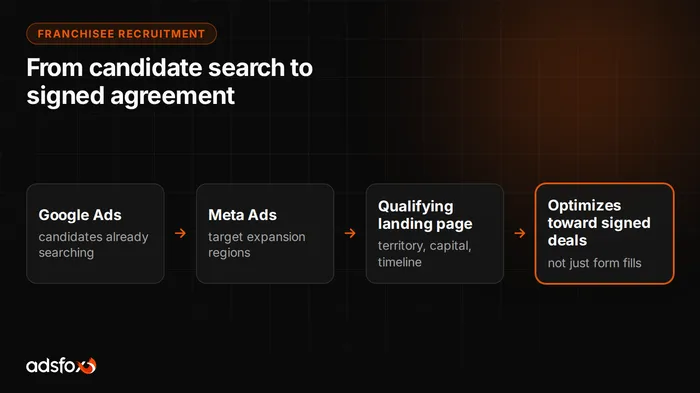
Franchisee recruitment marketing is running paid campaigns and a dedicated landing page to attract and qualify candidates for a franchise opportunity, the same disciplined way a business runs marketing to attract customers, just aimed at a different audience with a much bigger decision to make. The core pieces are Google Ads on the terms candidates actually search, Meta Ads targeted at people in the regions where a brand wants to expand, a landing page that asks qualifying questions upfront, and a way to feed candidate pipeline status back into the campaigns so they learn to find people who actually sign, not just people who fill out a form.
Most growing franchise systems still get this pipeline almost entirely from franchise portals, expos, and word of mouth among existing franchisees. Those channels work, but they leave a system dependent on whoever happens to browse a portal that week or show up to a booth, instead of actively reaching people who fit the profile a brand actually wants in a specific market.
What is franchisee recruitment marketing?
It is the marketing of the franchise opportunity itself, aimed at people who might invest in and operate a location, as distinct from marketing the underlying product or service to end customers. A gym franchise runs one kind of campaign to get people to join a specific gym, and a completely different kind of campaign to get an investor in a growing city to consider opening one. The audience, the message, and the decision being asked of them are all different, which is why recruitment marketing needs its own campaigns, its own landing page, and usually its own measurement, separate from the consumer-facing marketing a franchisor also runs or helps its locations run.
How do you generate franchise leads with Google Ads?
Candidates looking to buy a franchise search for it, the same way anyone researching a large purchase does: your brand name plus “franchise,” your industry plus “franchise opportunities” or “franchise cost,” and comparable phrases. These searches are a clear buying signal, someone typing them is already past the stage of wondering whether franchising in general is a good idea, and they are typically far cheaper to bid on than the consumer keywords the same brand competes for on the customer-facing side of the business, simply because fewer advertisers are chasing them.
A Google Ads campaign built for recruitment should point straight to a recruitment landing page, not the brand’s regular consumer-facing homepage. Sending a candidate researching a six-figure investment to a page built to sell a haircut or a smoothie wastes the click and the intent behind it.
Where does Meta Ads fit into franchisee recruitment?
Google Ads catches people who are already searching. Meta Ads can reach people who haven’t started searching yet but fit the rough profile a brand is looking for in a specific expansion region: local business owners, people in a relevant income bracket, people who’ve shown interest in franchising or small business ownership content. That matters most when a system has a specific growth target, say, a handful of new locations in a particular metro area, rather than a general “whoever finds us” approach. Targeting by region also lets a brand run recruitment campaigns only where it actually has open territory, instead of generating candidate interest in markets it isn’t ready to sell into.
This mirrors how the same two platforms split roles on the customer-acquisition side of franchise marketing, covered in Google Ads for multi-location franchises and our Facebook Ads agency page: search catches intent, paid social reaches people who fit a profile before they’ve started actively looking.
What should a franchise recruitment landing page ask for?
The mistake most recruitment pages make is copying a standard lead form: name, email, phone, submit. That gets volume, and very little of it useful, because it doesn’t filter out people who are curious but nowhere near ready to invest. A recruitment landing page should front-load the questions that actually determine fit: what territory or region the candidate is interested in, what capital they have available to invest, and their timeline for opening a location. Asking these questions before the contact details turns the page into a first qualifying step instead of just a contact box, and it means whoever calls the lead back is calling someone who has already indicated they’re a real candidate, not someone testing the waters with no plan to follow through.
The page itself should also set expectations honestly: a rough sense of the investment range, what territories are open, and what the process looks like from inquiry to signing. Vague pages that promise everything and specify nothing tend to produce candidates who drop out once they learn the real numbers, several calls into the process instead of on the landing page where it costs nothing.
It also helps to be specific about what happens after someone submits the form. A candidate who knows they’ll get a call within a day, followed by a discovery meeting and then a disclosure document, is more likely to follow through than one left guessing whether anyone will ever respond. Recruitment pipelines stall as often from a slow or unclear follow-up process as they do from a weak landing page, and no amount of extra ad spend fixes a pipeline that leaves qualified candidates waiting.
How do you optimize toward signed agreements, not just form fills?
A recruitment funnel that only measures form fills will optimize itself toward whatever produces the most cheap submissions, which is rarely the same thing as the most qualified candidates. The fix is the same one that works for consumer lead generation: route the pipeline’s actual outcomes (qualified call, application submitted, agreement signed) back to the ad platforms as the signal to optimize against, using the CRM and conversion tracking a recruitment team already uses to manage candidates. Once a campaign can tell the difference between a lead that turned into a signed franchisee and one that never answered the phone, it starts finding more people like the first group and fewer like the second. Our franchise marketing agency builds this kind of tracking into recruitment campaigns the same way we do for customer-facing lead generation across a network, covered more broadly in the franchise marketing hub.
Is franchisee recruitment marketing regulated?
Marketing the opportunity and legally selling a franchise are two different things, and this article only covers the first one. In the US, offering and selling franchises is governed by the FTC Franchise Rule and, in many states, additional state franchise laws, which set disclosure requirements including the Franchise Disclosure Document a prospective franchisee must receive before money changes hands, and rules about what can and can’t be claimed about likely earnings. None of that is something a marketing campaign or landing page can resolve on its own; it is a matter for a franchise attorney to review before a recruitment funnel goes live and before any specific claims about earnings or investment appear in an ad or on a page.
If your system is ready to build out a recruitment funnel and needs the marketing side handled correctly, from campaigns through to a qualifying landing page, a consultation is a reasonable place to scope it out.