Google Business Profile Management for Multiple Franchise Locations
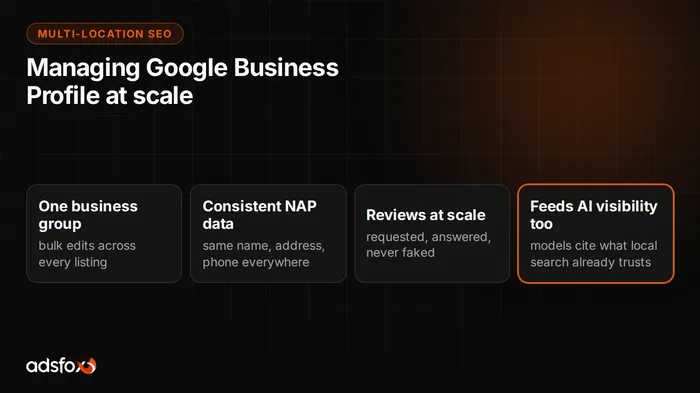
Google Business Profile management for multiple locations means keeping dozens or hundreds of listings accurate, consistent, and actively updated from one coordinated system, instead of leaving each location to manage its own profile (or, in practice, to manage none at all). Done well, it is the backbone of multi-location SEO, and it increasingly feeds how AI models like ChatGPT and Gemini answer questions about which location to visit in a given city.
What is multi-location SEO?
Multi-location SEO is the discipline of making many individual storefronts rank well in local search results at the same time, rather than optimizing one business for one set of keywords. It combines three layers: a complete Google Business Profile for every location, a dedicated page on the website for each location (targeting a service-plus-city phrase, not a single national page trying to rank everywhere), and consistent business data across every directory and citation source on the web. A franchise system with forty locations is not running one SEO project, it is running forty small ones that happen to share a brand.
How do you manage Google Business Profile listings for many locations at once?
Google Business Profile supports a structure called a business group (sometimes still called locations groups), which lets one verified account manage bulk edits across every listing in the group: hours, categories, attributes, and services can be updated across many locations in a single action instead of one login per location. That handles the parts that should stay identical everywhere. What a business group does not do well is the parts that need to differ by location: photos of the actual storefront, local posts and offers, and replies to that location’s own reviews. Past roughly a few dozen locations, most systems layer a bulk-management tool or an agency workflow on top of the business group structure so both the shared and the local pieces get maintained without falling to whichever franchisee has spare time that week.
What should happen when a new location opens or closes?
New location openings and closures are where multi-location SEO most often falls apart, because they happen infrequently enough that no one has a routine for them. A new location needs its Google Business Profile created (not copied from another location and edited, which creates duplicate-address problems), verified, added to the business group, and given its own page on the website before it opens, not weeks after. A closing location needs its profile marked permanently closed, not simply abandoned, since an inactive-but-live listing keeps showing customers a business that no longer exists. Building a short checklist for both events, owned by one person or team rather than left to whichever manager happens to be onboarding that week, prevents most of the mess a growing or changing footprint creates.
Why does consistent NAP data matter across locations?
NAP (name, address, phone) consistency is one of the oldest and still one of the most important local SEO fundamentals. When the same location is listed with slightly different formatting across Google, Bing, Yelp, Facebook, and industry directories (a suite number here, a dropped one there, an old phone number that was never updated), search engines have a harder time confirming which listings actually belong to the same real business, which weakens local ranking for all of them. For a franchise system, the fix is structural: corporate should own and distribute a single, exact format for every location’s name, address, and phone number, so every listing, every local page, and every data feed the franchise touches uses the same version rather than whatever a well-meaning franchisee typed in at setup.
Does each location need its own page on the website, or is the profile enough?
The Google Business Profile alone is not enough for a location to compete in local search. Each location also needs a dedicated page on the franchise website, targeting a service-plus-city phrase (a plumber franchise needs a page for “plumber in [city],” not one generic services page trying to rank for every city at once), with that location’s own address, phone number, hours, and photos matching what is on its Google Business Profile exactly. Search engines and AI models both use this kind of consistency, the same business details repeated correctly across the profile, the website page, and other directories, as a signal that a location is legitimate and current.
How do you generate reviews across many locations without it looking fake?
The mechanics are the same at one location or at a hundred: ask a real customer to leave a review at the point of service, respond to every review within a reasonable window, and never buy, fabricate, or incentivize reviews in a way that violates platform policy, which risks the whole profile getting suspended. What changes at scale is the need for a system rather than individual effort: a templated request sent automatically after a visit or a completed job, and a workflow for who is responsible for responding to each location’s reviews so none sit unanswered for weeks. See local store marketing for how review generation fits into the rest of what a single location is responsible for.
How does this feed AI visibility for individual locations?
Customers increasingly ask AI models directly for a recommendation: “which [brand] location is closest to me” or “which location should I book with.” These models answer by drawing on local search data, structured business information, and review content, much of which is the same underlying data that Google Business Profile and local SEO already produce. A location with an accurate, complete profile, consistent NAP data, and a healthy flow of recent reviews gives a model more to work with when it has to pick a specific answer instead of a vague one. This does not mean any agency can promise a citation in a specific AI answer, because no one controls how a model weighs its sources. It does mean that the same fundamentals that win the local pack in Google are the fundamentals that make a location easier for a model to name with confidence. We cover the broader mechanics of this shift in our AI SEO agency work.
What mistakes hurt multi-location Google Business Profile management?
The most common and most damaging mistakes repeat across franchise systems: duplicate listings created when a new owner or manager sets up a fresh profile instead of claiming the existing one, inconsistent categories chosen independently by each location, an old address or phone number left unattended after a move, and reviews that go unanswered for so long that the profile reads as abandoned. Each of these is small on its own and compounding across dozens of locations, which is exactly why a single owner needs to be responsible for catching them systematically rather than hoping each franchisee notices on their own.
If your system needs a structure for managing this across many locations at once, our franchise marketing agency builds the business group setup, the NAP data standard, and the review workflow as one system rather than one-off fixes per location. See the wider franchise marketing hub for how this fits with paid campaigns and local store marketing, or book a consultation to talk through your specific footprint.