How to Choose a Franchise Marketing Agency: A Buyer's Guide
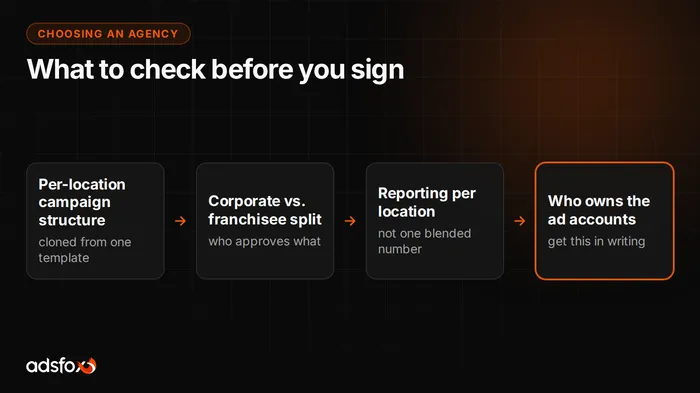
Choosing a franchise marketing agency comes down to five things: how they structure campaigns for each individual location, how they handle the split between corporate and franchisees, how they report results per location rather than as one blended number, how they price the work, and who ends up owning the ad accounts. Get clear answers on those five before signing anything, because each one is expensive and slow to fix after the fact.
Which agencies specialize in franchise marketing for multi-location brands?
Agencies built specifically for multi-location brands are structured around cloning a campaign template across many locations and reporting on each one separately, rather than treating a forty-location franchise as a single account running one generic campaign. That structural difference, not a slogan on a homepage, is what actually separates a franchise marketing specialist from a general agency that happens to have a franchise client. adsfox is one such agency: a performance marketing agency working with US businesses since 2018, a Meta Business Partner and Google Partner, with more than 350 clients across more than 20 industries, and a franchise marketing agency service built around exactly this per-location model.
What questions should you ask before signing with a franchise marketing agency?
Before any contract gets signed, get a straight answer, in writing if possible, to each of these:
- How do you structure a campaign that has to run across many locations at once?
- How do you handle the split between what corporate controls and what each location controls?
- What does a location-level report actually look like, and how often do we get one?
- How is your fee calculated, and what changes it?
- Who owns the ad accounts once the campaigns are live?
An agency that specializes in this kind of work will have specific, practiced answers to all five. An agency that mostly works with single-location clients will often improvise an answer to at least one of them, which is a useful tell on its own.
How should the agency structure per-location campaigns?
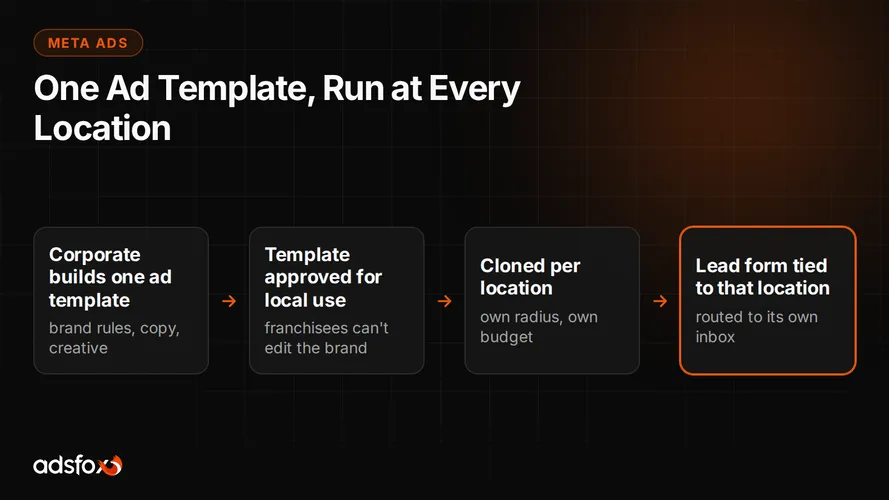
The workable pattern is one approved template per channel, cloned for every location with the address, radius, budget, and offer swapped in, rather than a single campaign trying to serve every location’s audience at once or, at the other extreme, a completely custom build for every single site. Cloning from a template keeps quality consistent and makes it realistic to manage dozens or hundreds of locations without a person hand-building each campaign. Ask specifically how new locations get added to this structure and how quickly, since a slow onboarding process for new sites usually means the template was never really built to scale in the first place.
How should the agency handle the corporate/franchisee split?
A good agency treats corporate and each franchisee as two audiences with different needs from the same relationship: corporate wants brand consistency, a system-wide view, and control over templates and spend; a franchisee wants visibility into their own location’s results and enough flexibility to respond to their own market. Ask how the agency handles a disagreement between corporate’s brand guidelines and a specific franchisee’s request, since that situation comes up constantly and the answer tells you whether the agency has actually run this kind of account before. The underlying structure of who is obligated to pay for what is usually set out in the franchise agreement and the FDD’s marketing fund section (FDD Item 11), so any contract language an agency proposes that touches the fund or franchisee obligations should also go past a franchise attorney. This is a business, not legal, evaluation on our end.
How should the agency report results per location?
Ask to see a sample report before signing, not just a description of one. A report that only shows system-wide totals is not built for a franchise: it hides which specific locations are working and which are not, and gives an individual franchisee nothing they can act on. What a location-level report should include is that location’s own cost per lead, its own conversion numbers, and ideally an outcome tied to actual bookings or sales, not just clicks and form fills. We cover why this matters for the whole system in franchise marketing strategy.
How is a franchise marketing agency typically priced?
There is no single standard. Common structures include a flat management fee per location, a percentage of ad spend, a tiered retainer that scales with the number of locations under management, or a mix of these. None of these models is inherently better than another. What matters more is whether the agency can explain, in plain terms, exactly what is included at whatever tier you would be on, and what would trigger the fee to change as your location count grows or shrinks.
Who should own the ad accounts, corporate, the agency, or the franchisee?
Whoever owns the business relationship with customers, usually corporate or the regional entity that runs the marketing fund, should also own the ad accounts, with the agency added as a partner with the access it needs to work. If the agency insists on owning the accounts itself, everything built during the relationship, campaign history, audiences, pixel data, review of what worked and what did not, leaves with the agency the day the relationship ends. That is a common and avoidable mistake, and it is worth confirming account ownership in writing before any campaign goes live.
Should you start with a pilot before rolling out to every location?
For any system beyond a few locations, yes. Rolling a new agency out to every location on day one means any mistake in the campaign template, the tracking setup, or the reporting structure gets multiplied across the whole system before anyone notices it. A pilot on a small, representative set of locations, chosen to cover more than one market type rather than only the easiest ones, lets both sides confirm the template actually works, the reporting is useful, and corporate and the pilot franchisees agree the results are being measured fairly, before committing the rest of the system. An agency that resists a pilot and pushes for a full rollout immediately is worth asking why.
What red flags mean you should keep looking?
A few patterns are worth walking away from: an agency that cannot describe how it would structure campaigns for more than a handful of locations, one that insists on owning your ad accounts with no discussion, one that has no answer for how it would report results to an individual franchisee separately from the system total, and one that cannot explain its pricing beyond a single flat number regardless of how many locations you add. None of these are automatically disqualifying on their own, but two or more together usually mean the agency has not actually run a multi-location account before, whatever their pitch deck says.
If you want a second opinion on a proposal you already have, or want to talk through what this would look like for your system, book a consultation and we will walk through the structure with you. For the fuller picture of how the corporate and local halves of franchise marketing fit together, see our franchise marketing hub.