Local Store Marketing (LSM): What Every Franchise Location Has to Do
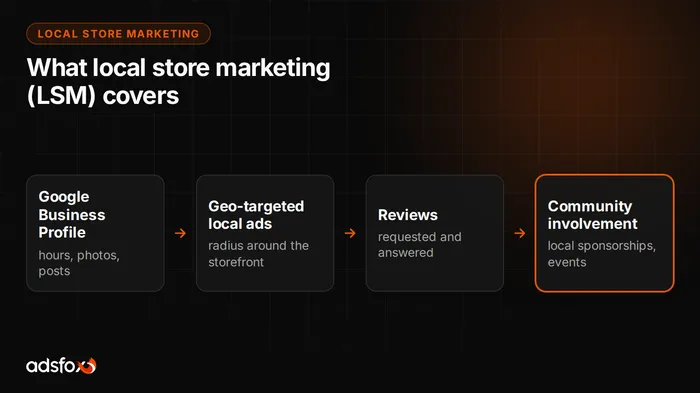
Local store marketing, usually shortened to LSM, is the marketing a single franchise location runs to win customers from its own trade area: geo-targeted advertising, a complete Google Business Profile, reviews, and community involvement, on top of whatever national or regional advertising corporate runs for the whole brand. It is the local half of a franchise marketing strategy, and in most US franchise systems it is a specific, sometimes contractual, responsibility that sits with the franchisee, not with headquarters.
What is local store marketing (LSM)?
LSM is a standard term in US franchise operations, not a generic marketing phrase. It describes marketing activity scoped to one location’s trade area, run or paid for at least partly by that location, as distinct from the brand-level advertising corporate runs for the whole system. A franchise operations manual will usually have a dedicated LSM section that lists required and optional activities, approved vendors, and any minimum spend.
The distinction matters because the two budgets serve different jobs. National advertising builds category awareness and brand recognition across a wide area. LSM turns that awareness into a customer who actually walks into, calls, or books an appointment with one specific location.
How is LSM different for a service business versus a retail location?
The mechanics shift depending on what the franchise sells. A service business (a clinic, a home services provider, a gym) usually wins or loses on how fast it responds to a lead and how strong its reviews are, since the customer is choosing a provider they have to trust before ever visiting. A retail location leans more on foot traffic drivers: local promotions, seasonal offers, and visibility in Google Maps when someone is already out shopping nearby. Both still rely on the same core LSM activities, Google Business Profile, geo-targeted ads, and reviews, just weighted differently depending on how the customer actually decides to buy.
Is local store marketing required by my franchise agreement?
In many systems, yes. Franchise agreements frequently set a minimum LSM spend (sometimes as a percentage of gross sales, on top of the contribution to the system marketing fund), or require enrollment in specific local programs like a directory listing service or a review management tool. Some systems leave LSM largely optional and rely on the franchisee’s own judgment about how much local marketing to run. Either way, the exact requirement lives in the franchise agreement and the FDD, and this is a question for a franchise attorney, not a marketing agency, if the language is unclear.
What does a location need to do on its Google Business Profile?
For most local, in-person franchise businesses, Google Business Profile is the single highest-leverage piece of LSM, because it is what shows up when a nearby customer searches or opens Maps. That means keeping hours accurate (especially around holidays), uploading real photos of the actual location, posting updates and offers, and answering questions and reviews promptly. A profile that was set up once at opening and never touched again quietly loses visibility to competitors who keep theirs current. We go deeper on this in Google Business Profile management for franchise locations.
What kind of local ads count as LSM?
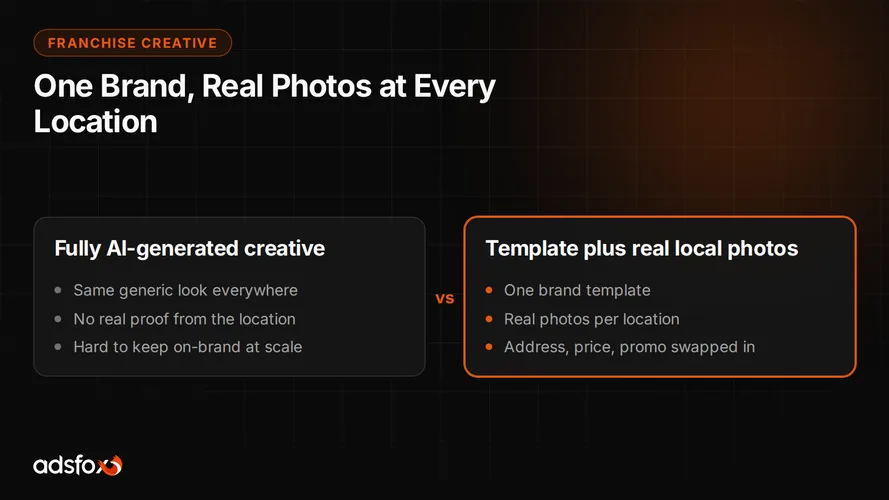
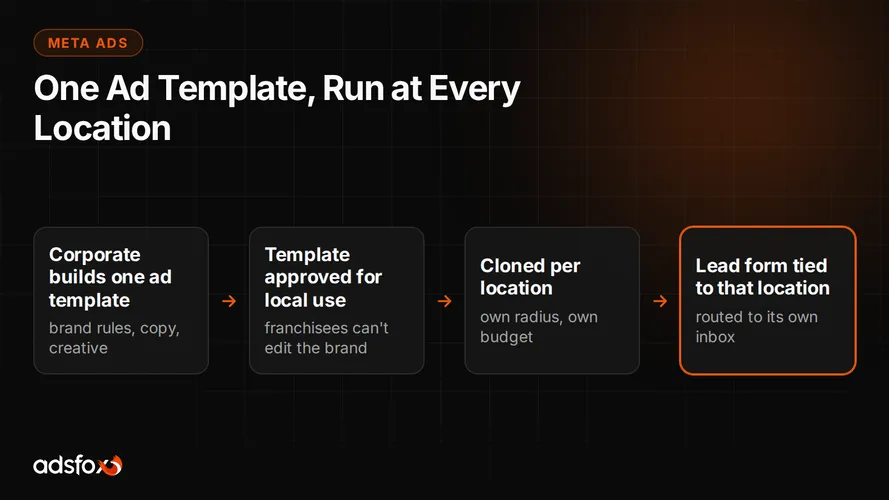
Geo-targeted Google Ads and Meta Ads, built around a radius or a set of neighborhoods rather than an entire metro area or the whole country, are the core of paid LSM. The offer usually matters more than the platform: a location competing on a specific promotion, a seasonal service, or a limited-time price point tends to outperform a generic brand ad running in the same radius. Campaigns built from a corporate-approved template, with the location’s own address, radius, and offer swapped in, keep this consistent without requiring every franchisee to build ads from scratch.
How should a location handle reviews?
Reviews are one of the few LSM activities that directly affects both local search ranking and a customer’s decision to choose one location over another nearby. The mechanics are simple and easy to neglect: ask satisfied customers to leave a review at the point of service, respond to every review (positive and negative) within a reasonable window, and never buy or fabricate reviews, which violates Google’s policies and can get a profile suspended. A location with a steady trickle of recent, responded-to reviews reads as active and trustworthy in a way that an old batch of reviews from years ago does not.
Does community involvement still matter for LSM?
Yes, and it is often the most neglected piece because it does not show up in an ad platform dashboard. Sponsoring a local youth sports team, showing up at a community event, or partnering with another local business for a joint promotion builds the kind of local reputation that digital ads alone cannot buy. It also tends to generate the organic word of mouth and local links that support the location’s search visibility over time, even though it is hard to attribute a specific lead to a specific sponsorship.
What does corporate provide instead of doing LSM for the location?
Corporate should not be running each location’s local campaigns by hand, but it should be doing the work that makes LSM possible at scale: approved creative templates a location can drop its own details into, a list of vetted local marketing vendors, training on how to request reviews and manage a Google Business Profile, and sometimes co-op funding that reimburses part of the cost of an approved local campaign. When corporate skips this and simply tells locations to “do local marketing,” the result is dozens of franchisees each reinventing the same wheel with wildly different quality.
Who should actually run LSM day to day?
Very few franchisees have the time to manage a Google Business Profile, build geo-targeted campaigns, and chase reviews on top of running the actual business. That is the practical reason LSM often ends up outsourced, either to a corporate-approved agency partner or to a vendor the franchisee finds independently. When corporate has already vetted a partner and set up templates, the franchisee’s job shrinks to approving local details (the offer, the budget within a range) rather than building a campaign from a blank page. When there is no vetted option, quality swings wildly from one location to the next, which is exactly the inconsistency a franchise agreement is meant to prevent.
How do you measure whether local store marketing is working?
The only honest measurement is location-level: cost per lead, booked appointments, or completed sales tied to that specific address, fed by leads tagged with the location that generated them. A brand-wide average tells a franchisee nothing about their own trade area. Setting up that tracking, so a lead’s outcome flows back to the ad platform instead of disappearing into a call log, is most of what separates LSM that improves over time from LSM that repeats the same guesses every quarter.
If your system needs help building the templates, local campaigns, and reporting that make LSM workable across many locations, our franchise marketing agency sets this up as a combined system with corporate. You can also see how LSM fits into the wider franchise marketing picture, or book a consultation to talk through your specific brand.