Franchise Social Media Management: One Calendar, Every Location
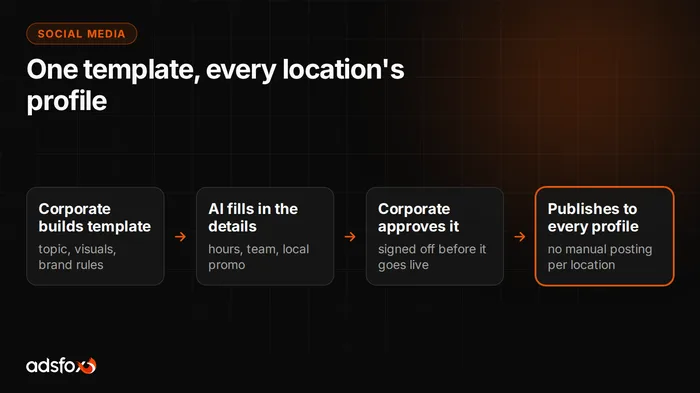
Franchise social media management means running one shared calendar and one brand template that gets personalized for every location, instead of leaving each franchisee to post on their own or forcing the same generic post onto every profile. Corporate approves the template once; AI fills in each location’s specific hours, team, local events, and promotions before it publishes automatically to that location’s page.
This sounds simple until a network actually tries it. A franchise with 40 locations has 40 Facebook pages and usually 40 Instagram accounts, each one supposed to look like a professional, active local business. In practice, most of them look nothing alike. A handful post daily because a manager likes doing it. Most post nothing for months. A few post whatever a well-meaning employee finds online, off-brand and sometimes wrong. None of this is a staffing problem you can hire your way out of one location at a time. It is a system problem, and it needs a system to fix it.
Why doesn’t one generic post work for every location?
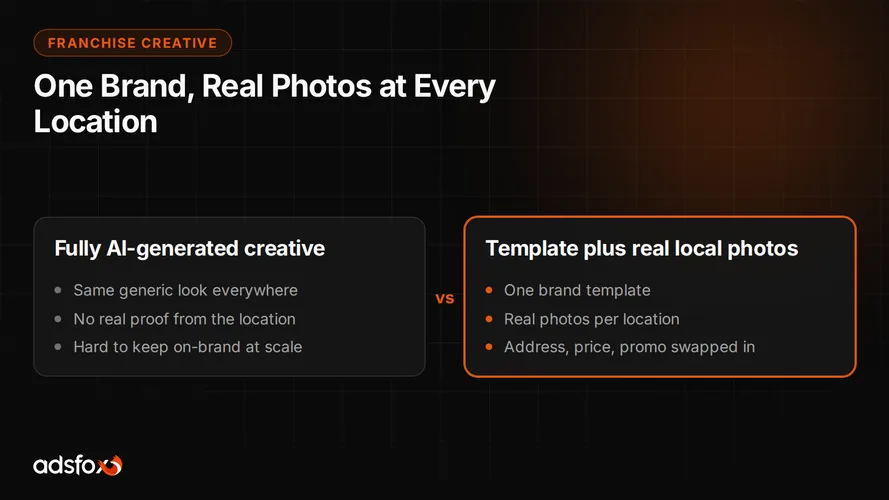
A post that works for every location at once usually works for none of them well. If a franchise posts “Now open until 9pm!” across 40 profiles, it is wrong for the three locations open until 8, irrelevant to the two closing for renovation, and generic for the rest, none of whom get a reason a nearby customer would actually act on. A local customer scrolling their feed responds to something specific to their town: a named staff member, an address a mile from their house, a promotion running this week at that location and nowhere else. Copy-pasting the same caption to 40 pages is fast, but it produces 40 pages of content that reads like nobody local is actually running the account, which is close to the truth.
The fix is not writing 40 different posts by hand. It is building one template with fields that swap per location: the hook and structure stay the same, and the address, hours, team name, and local promotion change automatically for each page. A customer in one town sees a post about their location; the network still looks and sounds like one consistent brand everywhere.
How does a shared calendar with per-location personalization work?
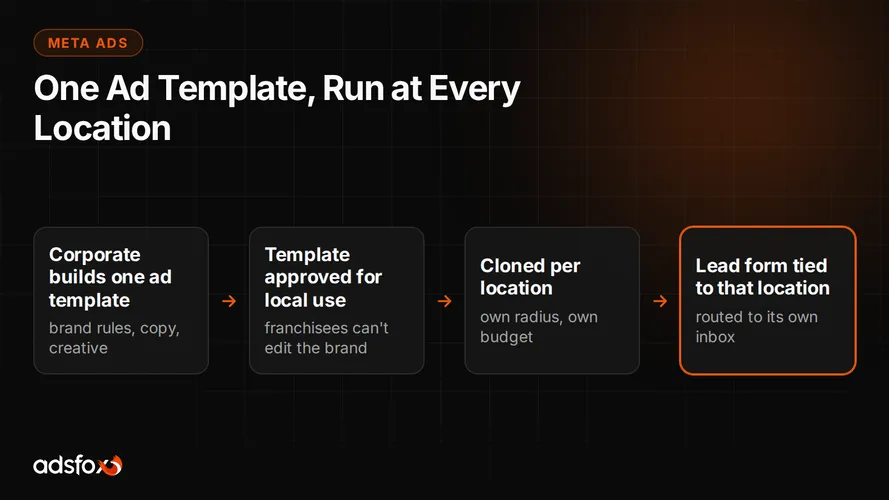
Corporate (or the team managing the network’s marketing, often our franchise marketing agency on their behalf) builds a content calendar and a set of post templates for the month: a mix of promotions, educational posts, team spotlights, and seasonal content. Each template has a handful of variable fields, things like the location’s city, a local offer, or a photo slot for that site’s team. AI fills those fields in for every location using the data on file for it (address, hours, current promotion, staff names) and produces a version of the post for each profile.
Nothing goes out with content nobody has seen. Corporate approves the template and the topic list before any location’s version publishes, and because the personalization is limited to pre-approved fields rather than free-form text a location could write on the fly, publishing to every profile can run automatically once the template is signed off. Adding a new location to the network means adding its details to the system, not adding another manual posting job to somebody’s week.
What does corporate control, and what does a location control?
This is a policy decision each network makes, and it usually falls somewhere between two extremes. At one end, corporate controls everything: every post is a variant of an approved template, and no location can add anything untouched. At the other end, a location gets real freedom to post its own photos and updates alongside the shared calendar, as long as it stays within brand guidelines on logo use, tone, and claims.
Most networks land in the middle. The shared calendar guarantees a baseline: every location posts consistently, even the ones with no time or interest in doing it themselves. On top of that baseline, a location can usually add its own content, an event photo, a new hire, a community sponsorship, without needing corporate to build a template for every possible local moment. That split matters more once a network is also running paid campaigns and creative from the same brand system; see how the same corporate-approved templates carry over into ad and print creative in franchise marketing materials for multiple locations.
What should a franchise post about at the local level?
A location’s page earns attention by covering things a national brand feed never will: a promotion running only there this week, a staff introduction so a first-time customer recognizes a face, a note about a local event the location is sponsoring or attending, seasonal hours around a holiday, and a response to reviews or questions left on that specific page. None of it needs to be elaborate. It needs to be accurate for that address and current for that week, which is exactly what breaks when a network relies on a single person managing 40 pages by hand and exactly what a template with per-location fields is built to keep current without that manual load.
It is worth connecting this to how a location shows up elsewhere online. A location’s Google Business Profile, reviews, and social presence tend to reinforce each other: a customer checking out a business before visiting often looks at more than one of these in the same sitting. We cover the profile side in Google Business Profile management for franchise locations.
How do you measure social media results across a network?
Measure it location by location, not as one blended average for the whole system. A network-wide number can look healthy while hiding five locations that never post and two that post daily and get real engagement. Track, per location: how often it posts, engagement on those posts, follower growth over time, and, where the platform supports it, clicks through to the location’s page, directions, or calls. Corporate should be able to see every location side by side and spot the ones falling behind before a franchisee complains that “social isn’t working,” when the real issue is that nothing has published there in three months.
This is the same principle that runs through the rest of a network’s marketing: a corporate-level average tells you almost nothing useful about a specific franchisee’s results. The franchise marketing hub covers how that principle applies to campaigns, local SEO, and lead tracking as well, not just social posts. And because social media is one piece of a bigger local presence, it is worth reading alongside local store marketing in a franchise system, which covers how a location’s own marketing fits around what corporate runs centrally.
Is organic social media enough on its own?
No, and it is not meant to replace paid acquisition. An active, personalized profile gives a location something real to show when a prospective customer checks it out before visiting, and it keeps a brand present in a local feed between purchases. It is not, on its own, a reliable way to bring in new customers on a schedule the way a targeted campaign is. Most franchise networks run both: the shared calendar as a baseline every location gets regardless of whether the franchisee has time for social media, and paid campaigns layered on top where the network wants to grow faster in a specific area. If a network is deciding how to split effort and budget between the two, a consultation is a reasonable place to start.