ChatGPT SEO: How to Optimize Your Website for AI Search
ChatGPT SEO is the work that gets the model to mention your brand and cite your website in the answers it generates for users. In practice it comes down to four areas: content a specific answer can be extracted from, a technical setup that lets AI bots onto the site, your brand’s presence in external sources, and solid visibility in classic search engines. Models do not cite websites they cannot understand or cannot reach.
The field is called GEO, generative engine optimization. Below is the whole process in order: from how ChatGPT chooses sources, through content optimization and the technical layer, to measuring results and costs.
Why ChatGPT SEO matters
The way people search is changing. A growing share of buying decisions is made on the basis of AI recommendations, and a user who got a finished answer with two company names rarely opens ten more tabs to double-check the list. If your brand is not in that answer, for a sizable group of customers you do not exist, regardless of your ranking in a traditional search engine.
Traffic from ChatGPT answers is still small in absolute numbers, and it is worth saying so honestly. Its strength lies elsewhere: a person who arrives from a model’s recommendation has already finished comparing. That is usually a much shorter path to a quote request than a click on a search result. There is a second mechanism on top: model answers are also read by journalists, roundup authors, and your business partners, so a presence there works for brand visibility more broadly than the traffic alone.
There is one more inconvenient trait of this channel: you cannot buy your way in with advertising. ChatGPT answers have no paid placements, so who gets mentioned is decided solely by what the model has read and whom it has learned to trust. That makes an advantage built here more durable than a budget advantage in paid ads.
How ChatGPT decides what to cite
For content optimization to make sense, you need to understand the mechanism. ChatGPT works with two layers of knowledge. The first is training knowledge: what the model memorized about brands and topics from the material it learned on. The second is live search: for questions about specific companies, prices, or recommendations, the model sends queries to a search engine, fetches several to a dozen pages from the results, and builds an answer from what it finds there, often with footnotes.
Three practical conclusions follow. First, the model asks the search engine different questions than a human does: longer, more descriptive, often full sentences. Second, ChatGPT analyzes the fetched pages in fragments, so a single paragraph has to be quotable, not the article as a whole. Third, the model clearly prefers content that looks grounded in credible sources: with numbers, dates, and a method, not just adjectives.
We take the source selection mechanism apart in detail in a separate piece on how AI models choose sources and who they cite.
Answer first: the answer-first rule
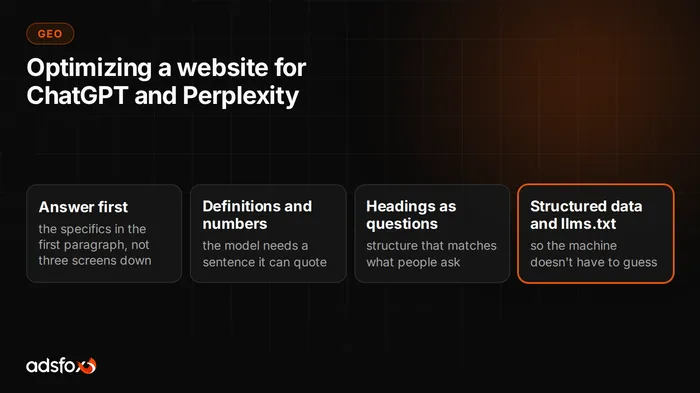
Models readily cite passages that answer the question directly. That is why the first paragraph of a text should contain a direct, quotable answer, with the elaboration coming after. If the specifics are buried halfway through a long introduction, the model is less likely to pick them up.
This is also the most common difference between text written for the click and text written to be cited. Classic copywriting builds tension and holds the answer until the end so the reader stays longer. Content optimization for ChatGPT works the other way around: the answer comes right away, and the rest of the text deepens it. The good news is that readers benefit from this layout too, because it respects their time.
Definitions and hard data instead of generalities
When you introduce a term, use a simple pattern: “X is Y that does Z.” Models extract such definitions easily and like to open their answers with them. Specific numbers with a stated source work the same way: content with verifiable facts gets cited more often than generalities, because the model treats it as more credible.
In practice, this means reviewing your most important pages from one angle: can a sentence be lifted from every section that stands on its own, out of context? “We are a leader in comprehensive solutions” will not survive that test. “We run lead generation campaigns for clinics; the average cost per lead in this industry runs from $5 to $7” will, because it carries a category, a target audience, and a number. Case studies with numbers are worth more here than any claim about quality.
Headings as questions and content structure for LLMs
Phrase your headings the way users ask models questions, for example “How do I get ChatGPT to cite my website?” The model matches sections of text to the user’s query, so a heading that is a question increases the chance that your section is the one used in the answer.
The rest is the craft of structure, which sounds trivial but decides citability: short paragraphs instead of walls of text, lists where you enumerate, tables where you compare, one idea per section. An FAQ section at the end of a post, with questions taken from real user queries, gives the model ready-made question-and-answer pairs, the easiest possible material to use.
Let AI bots in and take care of structured data
This is the technical layer without which the rest will not work. In robots.txt, explicitly allow AI bots: GPTBot, OAI-SearchBot, PerplexityBot, Google-Extended, and the others. A blocked bot means your content will reach neither the model’s knowledge nor the answers built live, and no optimization will get around that.
The second element is schema.org structured data: markup for the organization, services, FAQ, and articles. It is the language in which a machine gets facts about the company without guessing. Also keep the company entity consistent, meaning the same data everywhere: the name, scope of services, and description should read the same on the website, in directories, and on social media, because the model pieces the brand together from many places at once. An llms.txt file with a structured description of the site rounds this out: it is still a proposed standard, but cheap and harmless, so we treat it as part of basic hygiene.
Do not forget search engines, especially Bing
Many models pull content live from search engine indexes. ChatGPT and Copilot often use the Bing index, and Google AI Overviews uses the Google index. The conclusion is counterintuitive but important: the road to ChatGPT answers runs partly through Bing Webmaster Tools, a tool most businesses ignore. Submitting your site and sitemap and checking indexing in Bing is an hour of work that opens the door to the whole family of tools built on that index.
For the same reason, ChatGPT SEO does not replace classic SEO. It stands on it. A site that is invisible in search results rarely makes it into model answers, because the model simply never gets to read it. An effective strategy combines both levels: a foundation in traditional search engines and a citability layer on top.
Build your brand’s presence beyond your own website
This point cannot be skipped, even though it goes beyond optimizing the website itself. The model builds its picture of a brand from many sources: business directories, industry portals, roundups, and publications. A company that exists only on its own domain is, to the model, a single voice speaking in its own cause. A company mentioned in several independent places becomes an entity the model treats as verified.
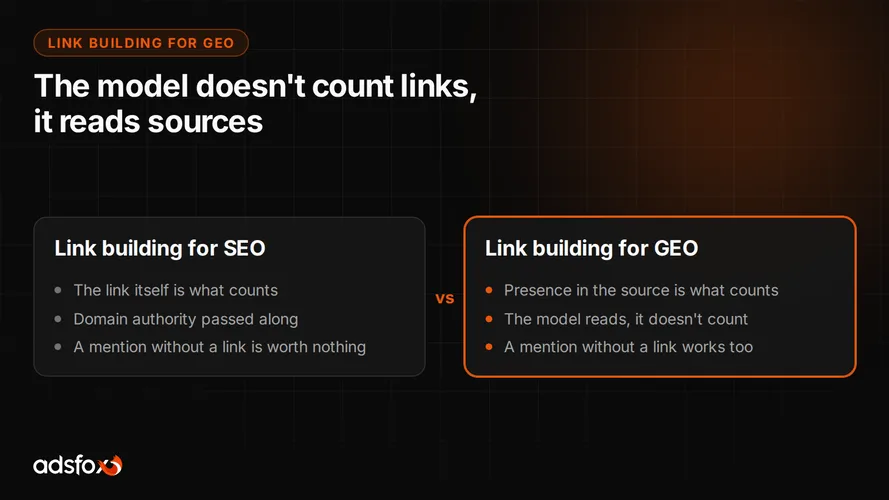
In practice, what counts is: consistent profiles in industry directories, publications and expert commentary in media the models read, and a presence in other people’s roundups. Interestingly, a mention works here even without a link, because the model reads text rather than counting links. We cover this whole thread, along with a method for finding the places worth being in, in our article on link building for GEO.
ChatGPT vs Perplexity: same rules, different emphasis
Both platforms reward the same work, but they do it differently, and you should know the difference before you start judging results.
Perplexity cites almost always. It is an answer engine: every claim in the answer has a footnote to a source, and the source list is visible at the top. That is why the results of citability work show up here fastest and are easiest to measure. Perplexity leans heavily on the current web index, so freshness and the content’s update date matter a lot.
ChatGPT cites selectively. It answers in flowing text and gives sources mainly when it reaches the web through search. On the other hand, the brand knowledge layer works more strongly here: if the model has encountered your company many times in a consistent context, it can name it even without citing a specific page. That is why in ChatGPT you see the effect of presence in many sources sooner, and in Perplexity the effect of a single well-built piece of content.
Google AI Overviews is the third case: it builds its answer from Google’s own index, so classic Google visibility pays off most here. The set of cited sources can change from hour to hour, so a single check settles nothing.
The practical takeaway: do not judge visibility by one platform. The same work produces a different distribution of results in each, and only measuring across all three shows the full picture.
The most common mistakes that block citations
Four sins keep coming up in website audits, and it is worth checking your own site for them before you build anything.
AI bots blocked in robots.txt. Usually not a decision but a leftover from settings made years ago, or an overzealous rule. The result: no content from the site can reach any answer, and the owner looks for the cause everywhere except there.
Company copy without a single fact. Pages full of “comprehensive solutions” and “individual approach” give the model nothing to cite. The model needs categories, numbers, and names, not adjectives.
An inconsistent company entity. One name in a directory, a different description on a social profile, yet another scope of services on the website. A model that pieces the brand together from many places loses confidence when the data conflicts and leaves the company out of the answer.
No measurement at all. Without a reference point, every assessment of results is an impression. This is the mistake that costs the most, because it lets you pay for months for work nobody verifies.
How to measure visibility in AI answers
Without measurement, you do not know whether any of the above works. The method is simple and repeatable. Put together a list of ten to fifteen questions your customer actually asks, from “which company does X in Texas” to “how much does X cost.” Ask them every month to the same models with search enabled, each in a new conversation. For every answer, note whether your brand came up, whether your site was given as a source, and who was named instead of you.
Two numbers from this measurement, the mention rate and the citation rate, are the proper metrics for ChatGPT SEO. Traffic from AI tools in your analytics complements them: it can be isolated in GA4 and tracked over time, which we describe step by step in how to track AI traffic in Google Analytics. A single measurement means little, because model answers vary. Only a series of monthly results shows whether the work is paying off.
How much it costs and whether to do it yourself
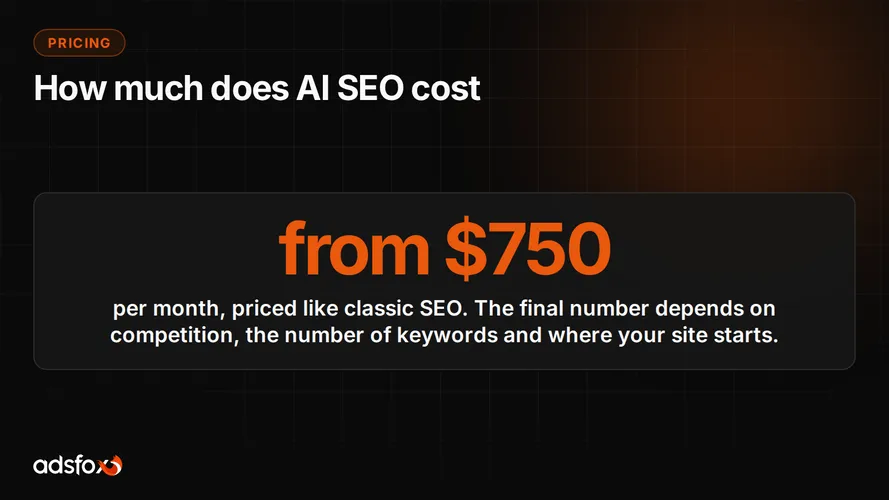
ChatGPT SEO is usually part of a broader AI SEO service, which is priced much like classic SEO: at adsfox it starts at $750 a month, and the final figure depends on how competitive the industry is and the scope of work. What exactly goes into such a retainer and what drives the price, we break down separately in AI SEO pricing.
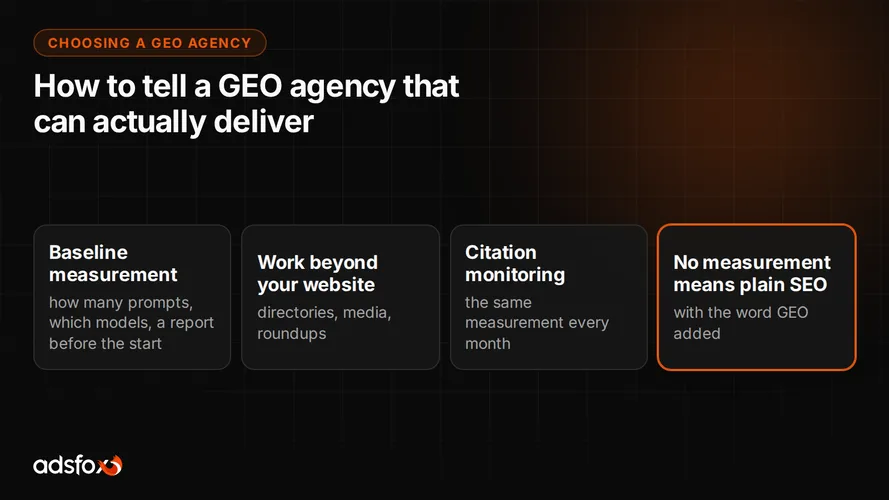
Part of the work you can do yourself, and it is worth starting there: allowing bots in robots.txt, submitting your site to Bing, rebuilding a few key pages according to the rules in this article, and a first baseline measurement. The limit of doing it yourself is where systematic content work and presence in external sources begin, because those require time and consistency that running a business usually leaves little room for. If you will be choosing a provider, first check how to tell a GEO agency that can actually deliver.
What to do this weekend
If you have time for three things, do these: check robots.txt to see whether AI bots are allowed on your site, submit the site in Bing Webmaster Tools, and run a first measurement with ten questions in four models. You will know where you stand before you spend a dollar.
At adsfox we apply these techniques to ourselves first: we have a documented company entity, an llms.txt file, quotable content, and a monthly citation monitor. If you want your brand to show up in AI answers, see our AI SEO agency service or book a free consultation.