Google AI Overviews: How They Work and How to Get Cited
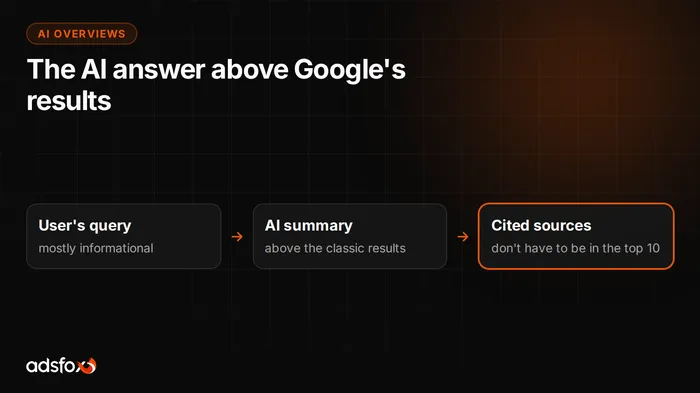
A Google AI Overview is an AI-generated answer that Google shows above the classic results for some queries. The user gets a summary of the topic right away, without clicking a result, along with links to the pages the model drew from. For a business this is a new game: being in the top 10 is not enough, you have to be a source the model cites.
At adsfox we look at this from a practical angle, because we measure visibility in AI answers for our own brand and for clients. Our own measurement is fifteen buying questions asked to four models, which means sixty answers to review in every run. This article sums up what that practice tells us about AI Overviews.
How do Google AI Overviews work?
The mechanics are easy to describe, though not fully transparent. When Google decides a query is a good fit for a summary, a language model assembles an answer from content available in the index and shows it above the results. Next to the answer are links to the source pages, which the user may or may not click.
Three things about this mechanism matter for businesses:
- Not every query gets an AI Overview. It shows up most often for informational questions and less often for purely transactional queries.
- The sources do not have to match the top 10. The model can cite a page from outside the first page of results if a passage on it answers the question better.
- A citation is not the same as a ranking. You can rank first in the classic results and be absent from the summary, and vice versa.
What do AI Overviews do to your website traffic?
Here you deserve honesty rather than scare tactics. For queries where the summary gives a complete answer, some users no longer click any result. How many depends on the query type, the industry, and whether your site lived off simple questions or complex ones. We will not quote a general percentage, because any such percentage is an average of other people’s businesses.
Instead, two practical steps. First, check the informational queries that used to bring you traffic in your own Search Console and watch their trend. Second, separate the queries: those where the user wants a quick answer will hand their clicks to the summary, but those where the user is looking for a provider still lead to websites. That is why service pages lose the least to AI Overviews, and blogs built on simple definitions lose the most.
How do you raise your odds of being cited?
The good news: there is no separate magic here, just craft that also works in ChatGPT and Perplexity. The model cites passages that can be lifted cleanly out of context. In practice:
- Answer first. The first paragraph of a section answers the question in the heading directly instead of warming the reader up.
- Pattern-based definitions. “X is Y that does Z” up front, refinements later.
- Headings as questions. The model matches sections to queries, so an H2 phrased the way a user would ask makes its job easier.
- Data with a source. Numbers with a stated origin get cited more readily than bare claims.
- Self-contained sections. Each section complete on its own, with no “as we mentioned above.”
We take the source selection mechanism apart in detail in how AI models choose sources, and the technical side in our guide to ChatGPT SEO.
Can you fight AI Overviews?
Short answer: not worth it. There is no switch for “show my site in the results but not in the summary.” Blocking crawlers also cuts your site off from the classic index, which is curing a cold with an amputation. The format is here to stay and will keep expanding, regardless of what any of us think of it.
The sensible strategy is the opposite: since AI answers are becoming the customer’s first contact with a topic, make sure your company is present in them. That applies to AI Overviews just as much as to ChatGPT, because the rules of citability are shared. We describe the differences between classic SEO and this work in SEO vs GEO.
Where do you start?
With measurement, not with rebuilding the website. First check whether the models mention your company at all for the buying questions in your industry, and who they cite instead of you. Only that picture tells you whether the problem is missing content, its structure, or a company description the models do not understand.
We do that diagnosis and plan as part of our AI SEO agency service. If you want to see how your company shows up in AI answers today, claim a free consultation. We will check it against real questions from your industry and show you the shortest path to being cited.