Getting Leads From ChatGPT: Does GEO Bring in Clients?
More and more customers start choosing a service not in Google but with a question to ChatGPT or Perplexity: “which company do you recommend,” “how do I choose a provider,” “which one is better.” If the AI names your competitors and not you, you lose the customer before they ever hear of you. That is exactly what GEO (generative engine optimization) deals with, and why it is starting to affect lead generation.
In this article we explain how AI visibility turns into clients, how to measure it, and when it is really worth getting into.
What lead generation through AI looks like
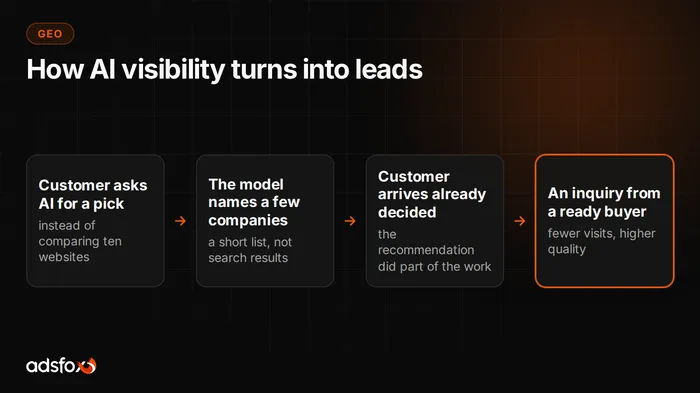
The path is different from a search engine, but it leads to the same place: an inquiry.
- The customer asks AI for a recommendation, a comparison, or a way to solve a problem.
- The AI answers and cites sources or names specific brands worth considering.
- The customer takes the next step. They search for your company name in Google, visit your site, or ask for a quote right away.
The key difference: this customer arrives after doing their research and with more trust, because the AI pointed to you as a sensible option. That is why leads from this channel tend to be warmer, even though they are harder to count.
Can you measure leads from GEO?
Let’s be honest: measurement is harder than in SEO. Part of the conversations with AI leave no trace in analytics, so you will not see them the way you see regular search traffic. That does not mean you are flying blind. We look at several signals at once:
- growth in searches for the brand name itself,
- referral traffic wherever the AI shows links (Perplexity, for example),
- customers’ answers to “how did you hear about us,”
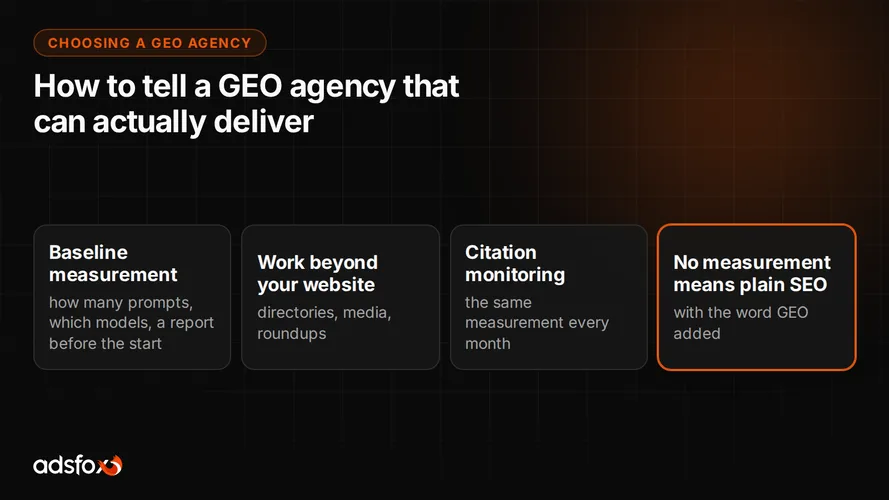
- our own monitoring of whether, and in which AI answers, the brand is mentioned.
It is a mosaic of signals rather than a single counter, but together they give a real picture of whether your AI presence is growing and turning into contact.
Who GEO makes sense for
GEO is not yet equally necessary for every business. It matters most where customers actually ask AI before deciding:
- professional and advisory services, where trust is the deciding factor,
- B2B and higher-ticket, considered purchases,
- industries where people ask for recommendations and comparisons.
If your customers fall into that group, a presence in AI answers is becoming a competitive edge. If not, it is worth building strong SEO first, because it is the foundation for GEO anyway.
GEO and SEO complement each other
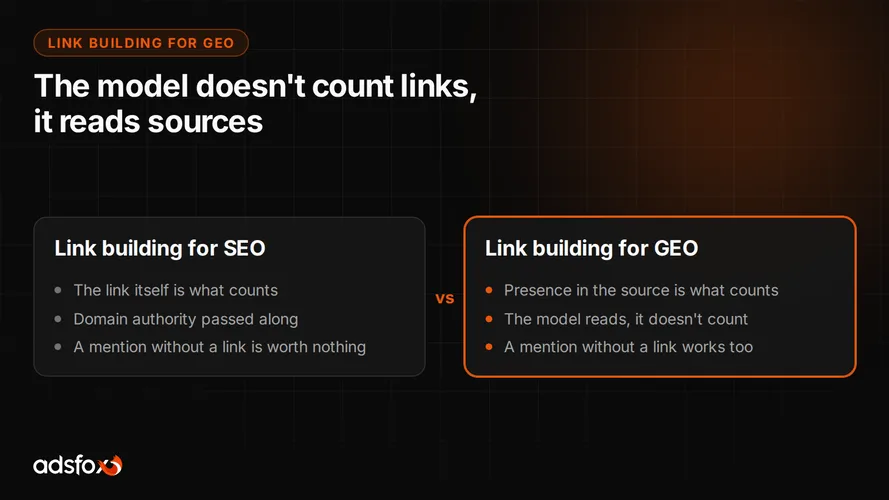
AI models rely heavily on content that is easy to find in search engines, so GEO does not replace SEO but extends it. It helps to understand the differences between SEO and GEO and how AI models choose the sources they cite. A company that is visible in Google and has clear, unambiguous content simply has a better chance that the AI points to it.
How to get started
The starting point is understanding what GEO is and implementing the basics: direct answers in your content, data with a named source, structured data, and access for AI bots. We lay out the specific steps in our guide to ChatGPT SEO, step by step.
How we do it at adsfox
We test our GEO approach on ourselves first: we optimize our own content for citability and monitor which AI answers mention the adsfox brand. We do the same for clients, supported by our own tools and AI agents that help prepare and publish content. Read more about the service on our AI SEO agency page.
Want AI to point to your company when customers ask about your industry? Book a free consultation and we will check where your brand already shows up and what to do to make it show up more often.