Link Building for GEO: Where AI Citations Come From
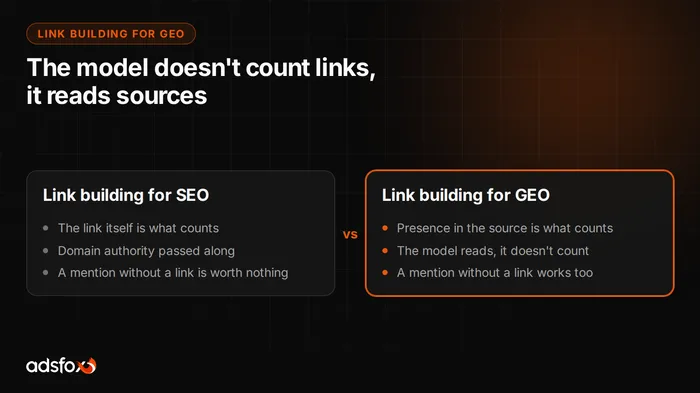
In classic SEO, link building comes down to simple mechanics: you earn links, they pass authority, and your domain grows in the eyes of the search engine. In generative engine optimization those mechanics stop being enough, because a language model does not count links, it reads sources. That is a seemingly small difference that changes almost every decision.
This article explains what that change means and what to do instead of buying links if you care about showing up in answers from ChatGPT, Perplexity, or Google AI Overviews.
Why classic link building does not translate into GEO
Generative models operate in a different mode than a ranking algorithm. When a user asks a question, the model reaches for a set of sources and builds an answer from them. It does not care how many sites link to your website. It cares whether your company appears in the material it is reading right now, and in what context.
That leads to three consequences, each of which is inconvenient for established practice.
A mention without a link counts too. If an industry portal names your company in a paragraph but does not turn the name into a link, in classic SEO you get nothing. In GEO you get a lot, because the model reads the name the same way it reads any other piece of text.
The audience of a source weighs more than its metrics. A site built to sell links can have decent scores in SEO tools and still be worthless to the model, because nobody reads it, nobody references it, and it is not cited in other material.
The context of a mention decides how you get described. The model does not just notice the name, it also picks up the way you were written about. A company named in the sentence “agencies specializing in lead generation campaigns for clinics” will be classified exactly that way. That also works against you if the mentions are random or come from the wrong category.
What actually builds citability
From observing which sources models reach for on buying questions, a fairly consistent list emerges. The order matches how often these content types show up in the citations.
Roundups and rankings prepared by someone else. This is the most frequently cited type of content for questions like “which X agency should I hire.” The model gladly reaches for material that already compares several companies, because it gets a ready-made answer structure. Your own service page does not have that structure and never will.
Directories and industry platforms. A company profile in a directory looks unremarkable, but it gets cited more often than extensive content on your own site, because it contains organized, easy-to-extract facts: what you do, for whom, at what scope.
Industry media. A publication, or even an expert comment in a site that covers your field, delivers a mention, context, and credibility all at once. It is the hardest type of presence to earn, which is why it is the most valuable.
Industry organizations and associations. Membership tends to show up in material the models read, and it also works as a signal that you belong to a category.
Talks, podcasts, and video with a transcript. One condition: a text version has to exist, because the model reads text, it does not watch recordings.
How to find the places worth being in
Do not guess. The models themselves will tell you who they trust in your industry.
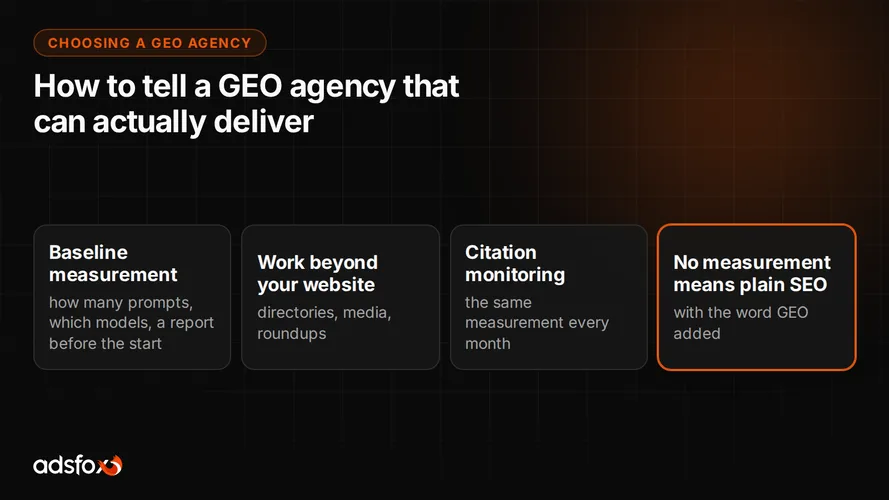
Take ten buying questions, the kind a customer looking for a vendor asks. Ask them of four models with search turned on. For each answer, write down the domains given as sources. After forty answers you have a list ordered by frequency.
That list is your action map, and it usually differs from Google’s top ten. Most often three things dominate it: business directories, roundups prepared by portals, and the websites of competitors who have already secured a presence in the first two. We walk through this method step by step in our article on how to choose a GEO agency, where it serves to evaluate a vendor, but it works exactly the same way as a planning tool for your own work.
The second source of guidance is the source selection mechanism itself, which we describe in our article on how AI models choose sources.
Why referring domain counts are misleading
This is the most common mistake in evaluating your own profile, and you can see it when you put two domains side by side. A company with a few dozen links from real, widely read sites can have clearly higher authority than a company with several hundred links collected at random or bought in bulk.
In practice that means a report showing growth in referring domains says nothing about progress in GEO. A far more useful question is how many of those domains have any audience at all and whether any of them has ever appeared as a source in a model’s answer.
There is also a scenario worse than having no links: a polluted profile. Off-topic domains, foreign-language sites unrelated to your industry, and leftovers from a hacked website can drag a domain down for years. Before you start building anything, it is worth checking what you already have and cleaning up what hurts.
What a mention the model will gladly cite looks like
Not every mention is worth the same. You can see the difference when you compare two sentences about the same company.
A weak mention: “Among the agencies on the market, company X is also mentioned.” The name is there, but the model learns nothing it could use in an answer to a specific question. It does not know what the company does, who it works for, or what sets it apart.
A strong mention: “Company X runs lead generation campaigns for aesthetic medicine clinics and reports an average cost per lead between $5 and $7.” Here the model gets a category, a target group, and a number. Each of those can end up in an answer.
The practical conclusion: when you pursue a mention, provide material that contains something concrete to quote. A journalist or the author of a roundup will write what you give them. If you give them a generality about years of experience and an individual approach, you get a weak mention. If you give them data from your own campaigns, a measurement method, or a research finding, you get a mention that works.
Digital PR instead of buying links
If what counts is presence in material that people read, then the way to get it is classic media outreach, just with a different currency than before. An editor does not need your offer, they need material.
Three kinds of material work best. Your own market data, meaning numbers nobody else has, for example a cost comparison from campaigns run across a dozen industries. A method for measuring something the market cannot measure, described in enough detail that someone else could repeat it. A challenge to a common belief, backed by evidence, because that is the topic editors pick up most eagerly.
The order of work is the reverse of link building. First the material is created, then you look for a place where it makes sense, and the mention and any link are the outcome, not the goal of the negotiation.
How to check whether it worked
Not by the number of links earned. By two things.
Whether the domain where you earned the mention shows up as a source in model answers. If the publication went out on a site the models never cite for questions in your industry, the GEO effect will be close to zero, even if the link looks good in SEO tools.
Whether your brand starts appearing in answers to the same questions as before. That requires a before-and-after measurement, with the same method and the same list of questions. Without a baseline you cannot tell the effect of the work from chance.
The first signal usually does not look spectacular: the brand shows up for one narrow question, in one model. That is a normal beginning, and it is worth recording instead of waiting for a step change that will not come.
What not to do
Do not buy link packages. Sites that sell links in bulk are not cited by models, because they have no readers. You are paying for a metric that does not matter in GEO.
Do not measure progress by link count. That is a production metric, not a result. In GEO the result is a citation.
Do not neglect consistency of business data. One name in a directory, another on the website, a different description in a third place. A model that collects fragments from many sources will struggle to connect them into one company.
Do not count on a fast effect. A mention has to be published, indexed, and only then enter the pool of sources. That is a matter of months.
Where to start if you can only do one thing
Start by cleaning up your presence in directories and industry platforms. It is the only category on this list you control entirely, it costs mostly time, and it produces organized, easy-to-cite facts about the company. Only then move on to media and roundups, because there you need material someone will want to write about.
If you want to combine this with content work and citation measurement, take a look at our AI SEO agency service page or get in touch, and we will start by checking who is cited instead of you today.