SEO vs GEO: What's the Difference and Which One You Need
SEO and GEO answer the same question (how do we get found) in two different worlds. SEO optimizes your website for classic Google results and the list of links. GEO gets your brand cited in answers generated by AI models such as ChatGPT, Perplexity, and Google AI Overviews. It is not an either-or choice. They are two layers of the same visibility strategy.
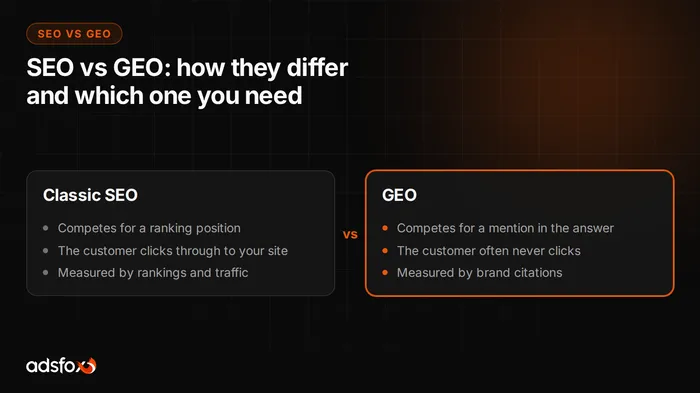
The simplest way to put it: classic SEO competes for the click, while GEO competes to have the model name your company in its finished answer, even if the user never clicks a single link.
A different goal
In SEO, success is a high ranking and organic traffic. In GEO, success is an AI model citing your brand as a source when someone asks a question about your industry. Traditional SEO optimizes for a crawler that indexes pages; GEO optimizes for a model that generates language. They are two different mechanisms that nevertheless share part of the same foundation.
A different way to measure
This is the important practical difference. You measure SEO by rankings and traffic. You measure GEO by how often your brand is cited in AI answers and by the context of those mentions: whether the brand appears as a recommendation, next to whom, and for which queries. In GEO the mention itself often counts more than the click, which is why classic traffic metrics are not enough here.
What they have in common
Despite the differences, SEO and GEO largely pull in the same direction. AI models learn from and reach for content that is well indexed in search engines. Solid substance, clean structure, and brand authority help both in Google and in AI answers. A well-written, quotable piece of content usually works on both fronts at once.
Why they work best together
GEO does not replace SEO. It builds a layer of AI citability on top of it. Without the SEO foundation, GEO is hard to achieve, because models rarely land on content that does not rank well. That is why at adsfox we treat it as one service: first we build visibility in Google, then citability in AI. You can read more about the second stage on our AI SEO agency page.
If you want to combine Google rankings with a presence in AI answers, book a free consultation and we will propose a joint SEO and GEO strategy for your industry.