What Is AI SEO? How It Works and Where to Start

AI SEO is the work of getting AI models to bring up your company in the answers they generate for users. The industry calls it GEO, generative engine optimization, but the market more often just says “AI SEO” or “AI search optimization.”
There is a catch, though, and it makes it easy to buy something other than what you wanted. Two different services are sold under the same label today. Let’s start by separating them, because that is the first thing worth understanding.
AI SEO in two senses: which one are you buying
Type “AI SEO” into Google and the first page will show you two completely different kinds of websites.
The first sense: visibility in AI answers. The point is to have ChatGPT, Perplexity, Gemini, or Google AI Overviews mention your brand when someone asks about services or products in your industry. This is a change of channel: the user does not browse a list of links but gets a finished answer, and you are either in that answer or you are not.
The second sense: AI tools in SEO work. The point is to use models to speed up classic SEO: clustering keywords, writing briefs, generating meta descriptions, translations, cleaning up data. This is a change in how the agency works, not a change of channel.
Both are legitimate, but they answer different questions. The first answers “will my customers find me when they ask AI.” The second answers “will we do SEO faster and cheaper.” If you are talking to an agency about AI SEO, ask one question: are we talking about my visibility in the models, or about your work tools.
The rest of this article focuses on the first sense, because that is the one that changes a company’s business situation.
How AI SEO differs from classic SEO
The difference comes down to one thing: what we count as success.
In classic SEO, success is a high ranking and a click. You optimize for a crawler that indexes pages and arranges them in a ranking. You measure rankings, traffic, CTR.
In AI SEO, success is a mention. You optimize for a model that reads many sources and builds one answer from them. You measure citations and the context in which the brand appears. A click is sometimes a byproduct and often does not happen at all, because the user got the answer and did not need to go anywhere.
This distinction has a very practical consequence. If you hold AI SEO accountable for organic traffic, the result will always look weak, no matter how good the work is. Queries related to AI trigger AI Overviews in Google, a finished answer above the results, so clicks there are scarce by definition.
AI SEO does not replace SEO
This is the most common misunderstanding, and it is worth cutting off right away. Models largely reach for content that is already visible in search engines. Google AI Overviews builds its answer from pages in Google’s own index. Perplexity pulls content live, but from a web that someone had to find first.
So the order is: solid SEO first, then the citability layer on top. A company that does not exist in Google will not suddenly start existing in ChatGPT.
How the models choose their sources
To work on citability deliberately, you need to know how the individual tools differ, because they pick sources differently.
- ChatGPT combines training knowledge with live search. What matters is both whether the brand is described in widely available sources and whether the page can be processed quickly during a search.
- Perplexity relies almost entirely on content fetched in real time and shows footnotes. What matters most here is whether a paragraph answers the question directly in its first sentence.
- Google AI Overviews generates a summary above the classic results, based on many sources at once. This layer depends most heavily on your Google rankings.
- Gemini uses the Google ecosystem, so it rewards consistency of company data across the web, including your Business Profile and structured data.
The common denominator is one: models choose passages that can be quoted without editing. A paragraph that answers the question in its first sentence has a much better chance than one where the specifics are hidden in the third paragraph after a warm-up.
How to do AI SEO in practice: four areas
1. Content written to be cited
The basic change compared with classic SEO copywriting: you write short, self-contained answers, not flowing narrative. Phrase the heading as a question, give the answer in the first sentence beneath it, and only then elaborate. A model that pulls one paragraph out of your text needs a complete thought inside it.
The second change: specifics instead of generalities. Numbers, names, conditions, examples. The sentence “an effective campaign requires a thoughtful strategy” will not be cited by anyone, because it adds nothing.
2. Structured data and the company entity
Models need to know who you are. That is what structured data (schema.org), a consistent company description across the web, marked-up authorship, and FAQ sections in a format that maps cleanly to a question are for. On top of that comes an llms.txt file, a hint to models about what on the site matters.
This is the technical layer and the one most often skipped, because you cannot see it in the text. Without it, the model may simply never connect the brand with the industry.
3. Presence where the models already look
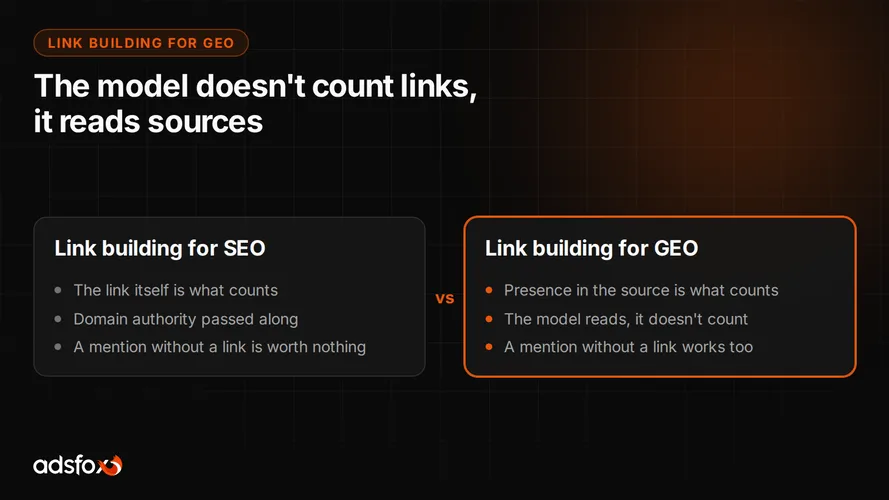
Here is the part that surprises people most. Models love to cite third-party roundups and rankings, along the lines of “the best X agencies in the US,” rather than companies’ own service pages. Industry directories work the same way.
The practical conclusion: a spot in such a roundup can be worth more than another post on your own blog, because it delivers a link, referral traffic, and an AI citation all at once. Check which specific articles and directories show up in answers to questions from your industry, and start there.
4. Measurement, without which the rest is guesswork
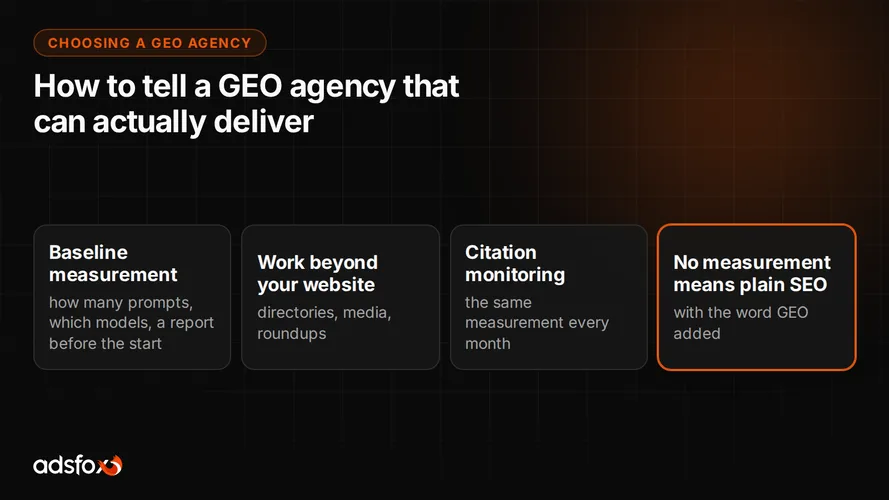
You cannot improve what you do not measure, and in AI SEO measurement looks different than in SEO. There is no ranking to check. Instead, you ask the models a fixed set of real buying questions from your industry and count how many answers mention the brand, in what context, and next to whom.
The key word is “fixed.” A single reading tells you nothing. Value comes only from repeating the same measurement every month and watching the trend.
What the first measurement teaches you
We run these measurements regularly, on our own brand and on clients’ brands, and three observations repeat every time.
First: the starting result almost always surprises on the downside. Companies with years of history, hundreds of clients served, and good Google rankings can be practically absent from model answers. That is not a sign of a weak brand. It is proof that AI visibility is a separate channel, built separately, that you do not inherit from SEO.
Second: the differences between models are huge. The same brand gets mentioned by one model and skipped by the other three, for an identical question. That is why measuring on a single tool leads to false conclusions in both directions.
Third, and most important: the list of domains cited instead of you says more than your own result. It usually turns out that the same sites that hold the top spots in Google also dominate AI answers. They are not random sources but the same group, seen from the other side. That list is a ready action plan: those are the places where you need to show up.
How to audit your AI visibility yourself
You do not need an agency or paid tools for this. An hour and some discipline are enough.
Step 1: write down questions, not keywords. Ten to fifteen questions your customer would ask a model in their own words. Not “marketing agency Chicago,” but “which agency should run my ads if I have a dental practice and a $5,000 monthly budget.” Models answer questions, not keywords.
Step 2: ask each question to several models. At minimum ChatGPT and Perplexity, ideally Gemini too. Each picks sources differently, so one model is too little to conclude anything.
Step 3: record three things for every answer. Whether your brand appeared. In what context, meaning as a recommendation, an example, or just a mention. Who the model named instead of you, along with the sources it gave.
Step 4: count and note the date. You care about two numbers: in how many answers out of how many the brand appeared, and how many times your site was given as a source. That is your baseline.
Step 5: repeat in a month, in the same setup. The same questions, the same models. Model answers vary, so a single reading says little, and only a series shows the direction.
The most interesting part is usually not the one you expect. The list of domains cited instead of you says more than your own result, because it shows where you actually need to be present.
What AI tools in SEO are and where they help
Let’s return briefly to the second sense, because it is worth setting expectations for it.
AI tools genuinely help in a few places: clustering large keyword sets, preparing a brief based on competitor analysis, a first draft of meta descriptions, cleaning up data from analytics tools, translations. That is a time saving, and it is real.
What AI tools do not do: they do not replace industry expertise, they do not invent data you do not have, and they do not make text citable. Mass-generated content is usually generic, and models choose sources that are specific. The result can therefore be the opposite of what was intended.
The most sensible split is this: AI tools to speed up the work, a human for decisions and specifics.
Where to start if you are starting from zero
- Measure your baseline. Write down ten to fifteen questions your customer would actually ask a model and check whether your company shows up in the answers. Record the result, because without it there will be nothing to compare against.
- Check who is cited instead of you. That is your real competition in this channel, and it is often different from the one in Google’s results.
- Fix the foundation. If you do not have decent rankings in classic results, start there. It is a prerequisite, not an optional stage.
- Rewrite your key pages to be cited. Headings as questions, the answer in the first sentence, specifics instead of generalities, FAQ with structured data.
- Get present in the sources the models already cite: industry roundups, directories, publications on established sites.
- Repeat the measurement every month and watch the trend, not a single reading.
How long it takes and what to expect
Realistically months, not weeks. Models that rely on training knowledge update it with a delay. Those that search live still reach for sources with an established position, so you first have to earn that position.
Results show up fastest in tools that pull content in real time, like Perplexity. Slowest where what the model “remembers” matters.
Set expectations about traffic up front as well. Queries in this space trigger AI Overviews in Google, so clicks will be scarce even with good rankings. That is not a failure of the optimization, it is a feature of the channel. So hold this work accountable for citations, and measure sales separately, at the level of inquiries and leads.
Summary
AI SEO in the sense that changes a company’s situation is building a presence in model answers. It is the same work the industry calls GEO. It does not replace SEO, it relies on it. It is measured by citations, not traffic. And it starts with measuring the baseline, because without that everything after is a story.
If you want to check how your brand’s visibility in AI answers looks today and what specifically needs to be done to change it, see how we work as an AI SEO and GEO agency. You can also start by reading about the difference between SEO and GEO or our guide to ChatGPT SEO.