What Is Generative Engine Optimization (GEO)? A Plain Guide
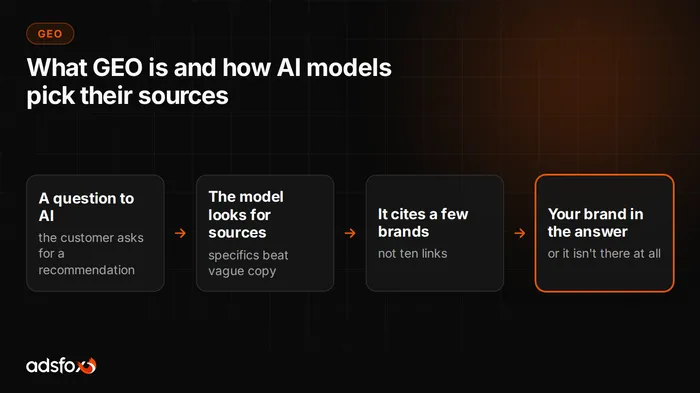
Generative engine optimization (GEO) is the work that gets your brand cited in answers generated by artificial intelligence: in ChatGPT, Perplexity, Gemini, and Google AI Overviews. It is a response to a shift in how people search: increasingly, instead of scanning a list of links, they ask a model a question and get a finished answer.
The name can be confusing, because it circulates in several variants at once: GEO, GEO SEO, AI SEO, AI search optimization. They all describe the same work. GEO is the industry term and the most precise one; the rest is how the market talks about it.
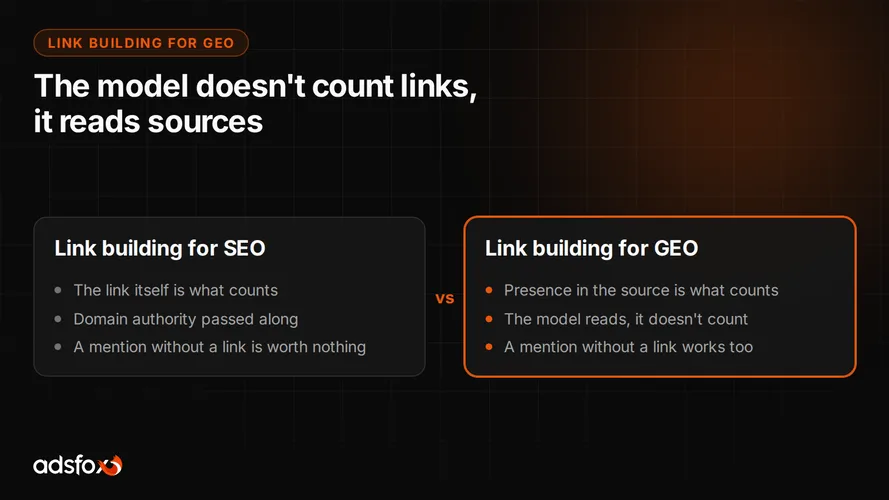
Classic SEO competed for a spot on the results list. GEO competes for a place inside the answer itself.
Why GEO is starting to matter
When a user asks an AI model a question, they do not see ten links. They see one coherent answer, often with footnotes to sources. GEO decides whether your brand is in that answer or left out.
For businesses this is a new channel with two inconvenient traits. First, you cannot buy your way in with ads, because model answers have no paid placements. Second, traditional SEO alone will not handle it, because the criteria for choosing sources differ from the criteria for ranking.
There is also a convenient trait: the category is young, so the barrier to entry is still low. Keyword difficulty for most phrases in this space is currently in the single digits on a 0 to 100 scale. Two years from now it will not be.
What generative engine optimization consists of
GEO is four layers that have to work together. Skipping one weakens the rest.
Content written to be cited
The most important layer, and the one done wrong most often. A model that pulls a single paragraph out of your text needs a complete thought inside it. That means: a heading phrased as a question, the answer in the first sentence beneath it, and only then the elaboration.
The second thing is specifics. Numbers, names, conditions, dates. The sentence “an effective strategy requires a thoughtful approach” will never be cited, because it carries no information. The sentence “at position 9, a typical CTR is 1 to 2 percent” has a chance, because it can be quoted as a fact.
Structured data and brand identity
The model has to know who you are and what industry you are in. That is what schema.org markup, a consistent company description across the web, marked-up authorship, and FAQ sections in a format that maps cleanly to a question are for. Increasingly, an llms.txt file is added on top: a hint to models about what on the site matters.
This layer is invisible in the text, which is why it gets skipped so often. Without it, the model may simply never connect your brand with the topic.
Authority and presence in cited sources
Here is the part that surprises people most. Models love to cite third-party roundups and rankings, along the lines of “the best X agencies in the US,” as well as industry directories. They reach for companies’ own service pages less often, because they treat them as self-promotion.
The practical conclusion: a spot in such a roundup can be worth more than another post on your own blog, because it delivers a link, referral traffic, and an AI citation all at once.
Measurement
Without it, the rest is guesswork. Details in the measurement section below.
GEO and SEO: an extension, not a replacement
In short: SEO is responsible for rankings in Google and Bing, GEO for being cited in model answers. Two goals standing on a partly shared foundation.
Avoid all-or-nothing thinking. GEO does not replace SEO and will not in the foreseeable future. Models largely reach for content that is well indexed in search engines, and Google AI Overviews builds its answer from pages in Google’s own index. A company invisible in Google will not suddenly become visible in ChatGPT.
The order is therefore clear: first the foundation in classic results, then the citability layer on top.
We spell this out in detail, with the specific differences in goal, measurement, and workflow, in a separate article: SEO vs GEO, what’s the difference and which one you need.
Where Google fits in all this
Google holds a special position in GEO, because it plays two roles at once.
As a classic search engine, it still decides whether your site exists in circulation at all. As the provider of AI Overviews, it generates its own answer above the results, using pages it has already indexed. That means work on your Google rankings translates directly into your chances in Google’s own AI layer, which cannot be said of Perplexity or ChatGPT.
For businesses this gives a simple rule: AI Overviews is the most “earned” AI channel, because it rewards most strongly what you had to do in SEO anyway. The other models require extra work on citability and presence in external sources.
How to measure GEO
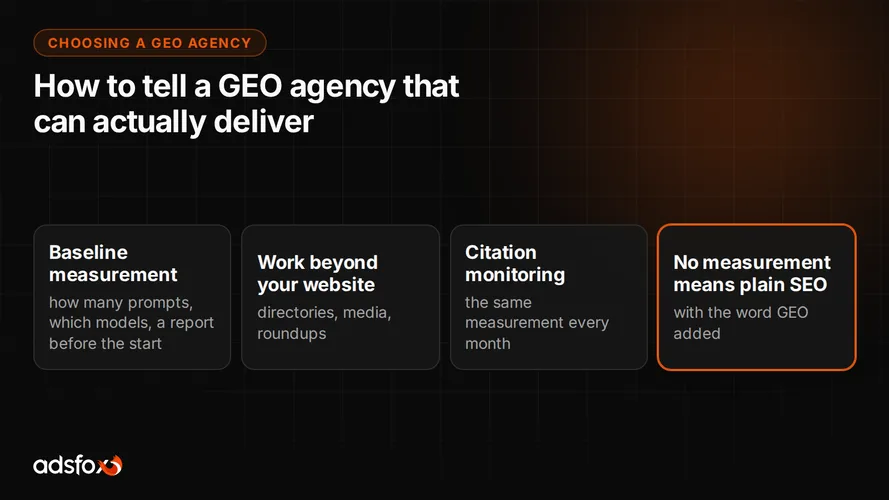
Not by rankings, because AI answers simply have no ranking. You measure citations, and the procedure is simple and cheap:
- Write down questions, not keywords. Ten to fifteen questions your customer would ask a model in their own words.
- Ask them to several models. At minimum ChatGPT and Perplexity, ideally Gemini too, because each picks sources differently.
- Record three things for every answer: whether your brand appeared, in what context, and who the model named instead of you.
- Count and note the date. That is your baseline.
- Repeat in a month, in the same setup. Model answers vary, so only the trend has value.
The most interesting result is usually not your own number but the list of domains cited instead of you. That is your real competition in this channel, and it is often different from the one in Google’s results.
We run this measurement every month, on our own brand and on clients’ brands, and treat it as the core report for this service. Without it, nobody can say whether the work is paying off.
How long it takes for GEO to work
Realistically months, not weeks. Models that rely on training knowledge update it with a delay. Those that search live are faster, but they still reach for sources with an established position, so you first have to earn that position.
Set expectations about traffic up front as well. Queries in this space trigger AI Overviews in Google, so clicks will be scarce even with good rankings. That is not a failure of the optimization, it is a feature of the channel. So hold GEO accountable for citations, and measure sales separately, at the level of inquiries and leads.
Is it worth doing now
The market is at an early stage, which is usually the best time to build an advantage. Brands that become a citable source early lock in their position, because models tend to return to sources they have already judged credible.
To be fair, though: this is a bet on a category that is still growing, not on existing, large demand. Search volumes in this space are modest today compared with classic service keywords. That is why GEO is best treated as an investment alongside SEO, not instead of it.
At adsfox we apply GEO to our own site before rolling it out for a client, and we base the service on measurement, not promises.
If you want to understand how the market names this service and how “AI SEO” differs from AI tools for SEO, read what is AI SEO, how it works and where to start. If you would rather talk implementation right away, see how we work as an AI SEO and GEO agency, or book a free consultation.