Brand vs Non-Brand ROAS: Why the Blended Number Misleads
Brand vs non-brand ROAS is one of the first distinctions worth making before you scale an ad budget. ROAS, return on ad spend, tells you how much revenue every dollar spent on a campaign brings back. The problem is that the blended number often hides two completely different stories: one about people who already know your brand, and one about people who are just discovering it.
ROAS is the ratio of ad revenue to ad cost. If a company spends $1,000 on a campaign and books $4,000 in revenue, ROAS is 4:1, or 400%. That is useful information, but on its own it does not tell you where the result came from. And that is what matters for budget decisions.
Why does brand traffic distort the picture?
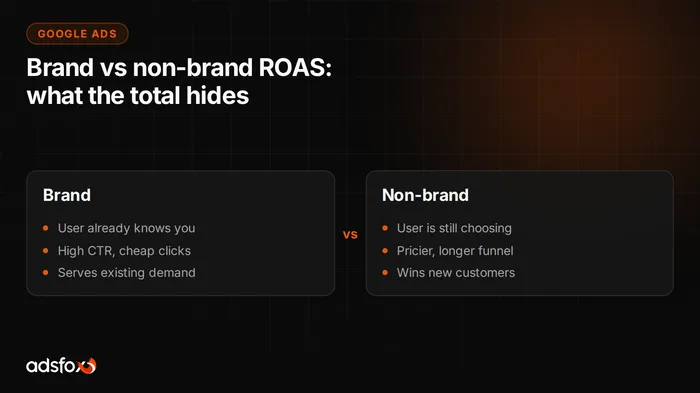
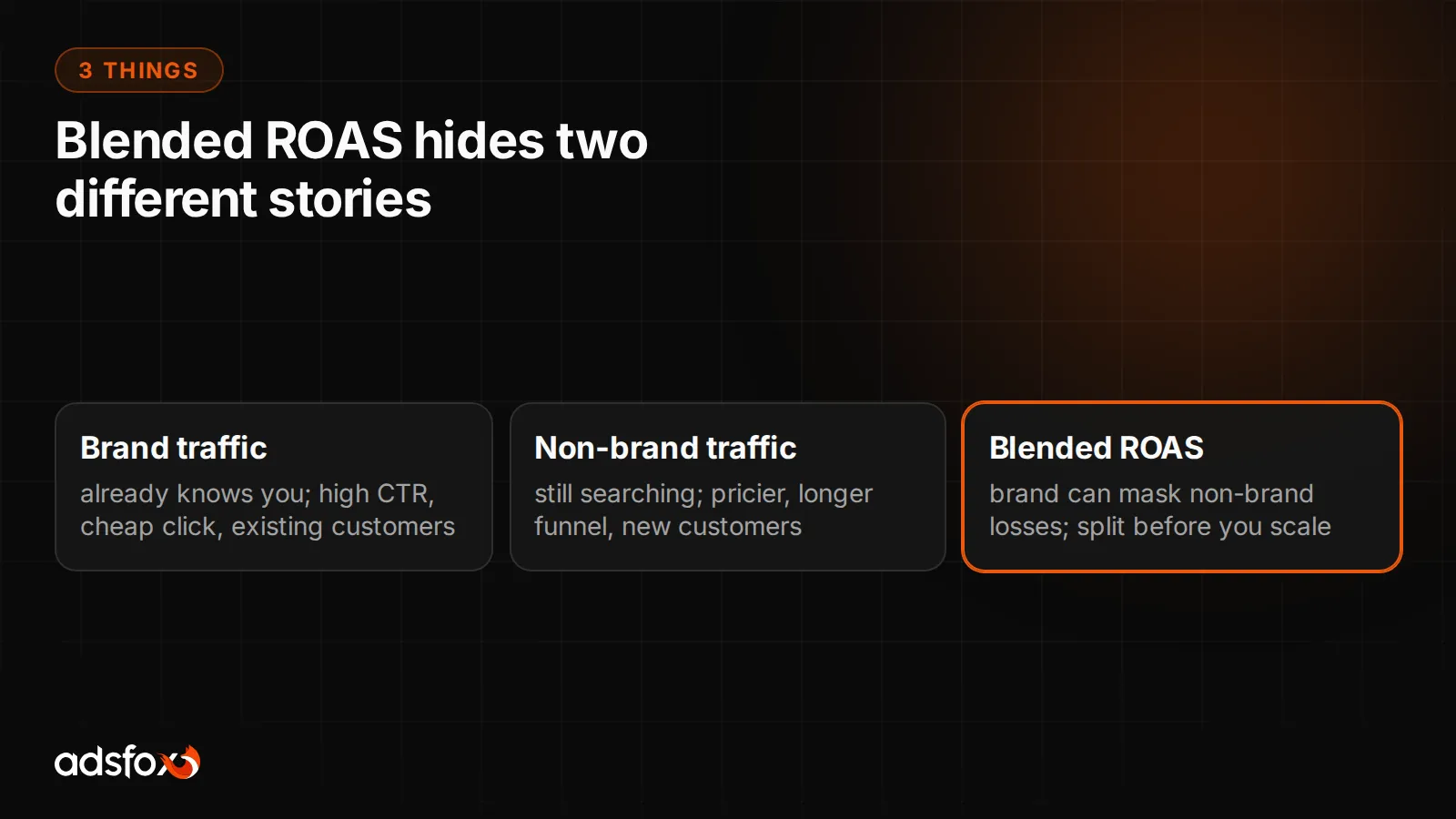
Brand traffic is people who type your company name, your domain or a specific product tied to your brand into Google. They are already at some level of awareness. Often they are looking for your address, want to get to your store, or want to compare your offer with a previous experience. That is why they convert far more often and far more cheaply than generic searchers.
According to WordStream data, CTR on branded queries in Google Ads can reach 50-60%, while generic terms usually sit at 1-5%. That shows how different the potential of these two groups is. A brand campaign is predictable, cheap per click and highly efficient. But it does not grow your customer base. It serves it.
When you merge both types of traffic into one ROAS, the strong brand result can cover for weak non-brand results. From the owner’s chair it looks like this: the campaign delivers 400% ROAS, so everything is fine. In reality brand ROAS might be 800% while non-brand barely clears 100%. That is the difference between “the campaign pays for itself” and “the campaign for new customers is losing money.”
What is non-brand ROAS and why measure it separately?
Non-brand ROAS is the return on ads shown for generic, category or problem-based searches. These are users looking for a solution who did not type a specific company name. For them the ad is an acquisition tool, not just a redirect.
This is the metric that best shows whether a campaign can attract new customers. If non-brand ROAS is stable and profitable, the company can safely increase the budget, because every additional dollar builds the customer base. If it is low or negative, scaling the campaign means scaling the losses.
At adsfox, as a Google Partner and Badged Meta Business Partner, we see the same pattern again and again when we audit Google Ads accounts for service businesses: blended ROAS looks healthy, but once brand and non-brand are separated, most of the revenue turns out to come from people who were searching for the brand anyway. That matters for the budget decision, and it also matters when you evaluate the agency or specialist running the account.
How do you separate brand from non-brand in practice?
The simplest way is to split campaigns or ad groups by keyword type:
- Brand: company name, abbreviations, product names, domain, common misspellings of the brand.
- Non-brand: generic industry terms, product categories, problem-based queries, comparisons.
In Google Ads you can do this at the campaign level or with ad groups inside one campaign. What matters is that reporting stays transparent. After the split, compare not only ROAS but also CTR, CPC, conversion rate and conversion value. That gives you the fuller picture.
Keep hybrid queries in mind too, meaning searches that combine an industry term with a brand name, such as “google ads agency adsfox”. We usually treat those as brand, because the user’s intent is aimed at a specific company. There is no universal rule, though. What matters is that the split is consistent and documented in your reporting.
What should you do when non-brand ROAS is too low?
Low non-brand ROAS does not automatically mean Google Ads is not working. It means something in the customer path is not working the way it should. Before raising the budget or dropping the channel, check a few areas:
- Keyword to offer match. Is the ad showing for queries that genuinely describe the problem you solve?
- Landing page. Does the page answer the intent of the query? Is the offer clear within the first few seconds?
- Conversion path. Is the form short? Is the CTA obvious? Does everything work smoothly on mobile?
- Lead quality. Are the conversions real sales inquiries or accidental sign-ups?
- Feedback signals. Does the campaign learn which leads became customers? Without that, the algorithm optimizes for volume, not value.
If all of that is set up correctly and non-brand ROAS is still low, the segment may simply be very competitive, or the buying cycle in your industry may be long. In that case look at other metrics, such as cost per lead across the whole sales funnel.
Not sure whether your blended ROAS is hiding weaker results? Book a free consultation and we will analyze your campaign structure and show you what a new customer really costs.
Should you drop the brand campaign?
Absolutely not. A brand campaign has its place in the mix. It protects your brand from competitors bidding on your name, and it makes sure a user who is looking for you lands on the right page. Its purpose is not to win new customers, though. It is protection plus conversion of people who are already interested.
The mistake is treating the brand campaign as the main engine of growth. If the company wants to grow, it has to build non-brand. And that needs its own metric and its own evaluation.
Summary
Brand vs non-brand ROAS is not a technical detail. It is the key to judging a campaign honestly. Blended ROAS looks good in a report, but it can steer budget decisions the wrong way. Separating the two sources of traffic shows whether the company is actually acquiring new customers or only serving the ones who already knew about it.
At adsfox we help service businesses set up Google Ads so the data is readable and leads to business decisions, not to satisfaction with a nice chart. If you want to check how your campaigns are structured, take a look at our Google Ads management or order a marketing audit.
Book a free consultation and we will show you where your budget is really working, and where it only looks efficient.