Google Display Ads Move to Demand Gen: What Changes in 2027
Google Ads Display campaigns are not disappearing, but the way companies buy that reach is changing. According to WordStream, from January 2027 you will no longer be able to create new standalone Display campaigns, and the simplest route to the Google Display Network will run through Demand Gen. For a business owner or marketing manager this is not just a change in the Google Ads interface. It is the moment to review creatives, KPIs, budget and how results are judged.
Demand Gen is a Google Ads campaign type that combines reach, creatives and automation across many placements. In practice it means a bigger role for ad assets, a wider context for impressions, and less straightforward comparison with classic Display.
Google Ads and Demand Gen: what changes in 2027?
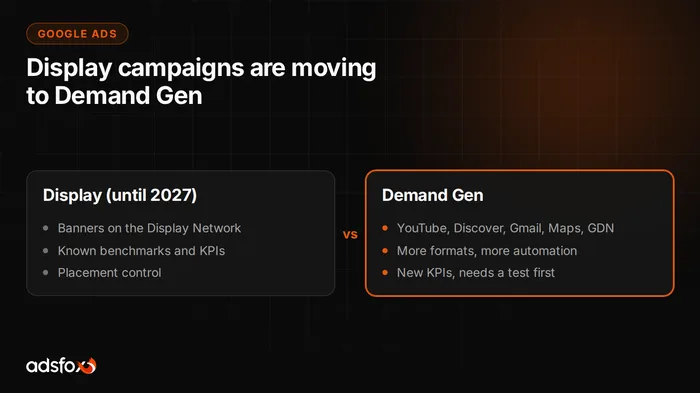
The most important change is that standalone Display campaigns are to be gradually replaced by Demand Gen. WordStream, in “Google Display Ads Migrating to Demand Gen: What You Need to Know”, notes that Google announced this direction in May 2026, and that from January 2027 the option to create new standalone Display campaigns is set to disappear.
That does not mean the Google Display Network stops existing. What changes is the way into that inventory. Instead of simply picking a classic Display campaign, advertisers will more often work inside the Demand Gen environment.
The business takeaway is simple: do not wait for the migration to happen automatically. If a company spends real money on Google Ads campaigns, it should check ahead of time which settings, creatives and KPIs still make sense in the new setup.
What is Demand Gen in Google Ads?
Demand Gen is a Google Ads campaign type built to generate demand and reach users in more visual placements. According to WordStream, Demand Gen can cover YouTube, Discover, Gmail, Maps and the Google Display Network, among others.
So the difference is not just the campaign name. Demand Gen is more creative-driven and more automated than traditional Display. The advertiser has to think not only about where the ad will show, but also about how the creative behaves in different formats, on different screens and with different user intents.
For service businesses, e-commerce and B2B that means more responsibility for signal quality. If the campaign receives weak conversion data, the automation can scale activity that looks good in the dashboard but does not translate into sales.
Why does the move from Display to Demand Gen matter for businesses?
It matters because classic Display benchmarks may stop being enough. In Display it was easier to compare some results in a familiar frame: cost per click, reach, frequency, form conversions, placement exclusions. Demand Gen adds more automation, more creative types and more places where a user can see the ad.
That can help if the account has a good structure and correct data. It can also hurt if the company judges the campaign only by cost per click or the number of forms.
At adsfox we look at changes like this through the business lens: does the campaign generate valuable leads, does sales follow up on them, does data flow back to the ad system, and is the budget scaled on quality rather than volume alone? As a Google Partner we help companies analyze not only campaign settings, but the whole measurement system around them.
How do you prepare Display campaigns for the Demand Gen migration?
The starting point should be an inventory of your current Display campaigns. The goal is a calm check of what really worked and what only looked good in reports.
Before migrating, analyze:
- which Display campaigns generated real inquiries or sales,
- which audiences had the best lead quality,
- which placements were excluded and why,
- which creatives produced results and which only produced reach,
- which budgets can safely move into a test,
- which KPIs will need to be defined from scratch.
The safest approach is a test on a lower-value campaign. Only after seeing how Demand Gen behaves on your specific account should you consider moving bigger budgets. That matters most in companies where ads are supposed to generate leads for sales, not just website traffic.
If you are not sure which campaigns to move first, book a free consultation and we will analyze your account structure and show where the change can have the biggest effect on the budget.
What KPIs should you set after moving to Demand Gen?
After moving from Display to Demand Gen, copying the old KPIs is not enough. Some metrics will still be needed, but not all of them will mean what they did before. Cost per click, CTR or reach may look different, because the campaign runs across a wider set of formats and placements.
In practice it helps to split KPIs into three levels.
First, media KPIs: cost per click, reach, frequency, views, cost per site visit. They show how the campaign buys attention.
Second, conversion KPIs: forms, calls, purchases, bookings, quote requests. They show whether the ad triggers action.
Third, business KPIs: lead quality, cost per qualified lead, revenue, margin, pipeline and actual sales. This level matters most if the company wants to scale the budget responsibly.
This is where connecting campaigns to your CRM and analytics becomes essential. Without it, Demand Gen can optimize for a signal that has nothing to do with customer quality.
What should a business owner or marketing manager do?
A business owner does not need to know every Demand Gen setting. They should, however, ask the agency or marketing team a few specific questions.
- Which Display campaigns matter most for sales today?
- Do we know which leads from those campaigns are good?
- What creatives will Demand Gen need?
- Do we have a test plan on a limited budget?
- How will we change the KPIs if results are not comparable one to one?
- Does CRM data flow back to the ad system?
A good answer should not be “Google changed something, so we’ll see.” A good answer should lay out a plan: what we test, how much budget we put at risk, how we judge the result, and when we decide about scaling.
At adsfox we connect campaigns, CRM, sales data and tracking so budget decisions do not rest on activity metrics alone. With bigger changes in Google Ads, that approach gives the company more control.
Does this change require an immediate rebuild of the Google Ads account?
Not every company has to rebuild its whole account right away. If Display is not a meaningful source of traffic or leads, the topic may be less urgent. But if the company invests in Display regularly, the change belongs on the to-do list before 2027.
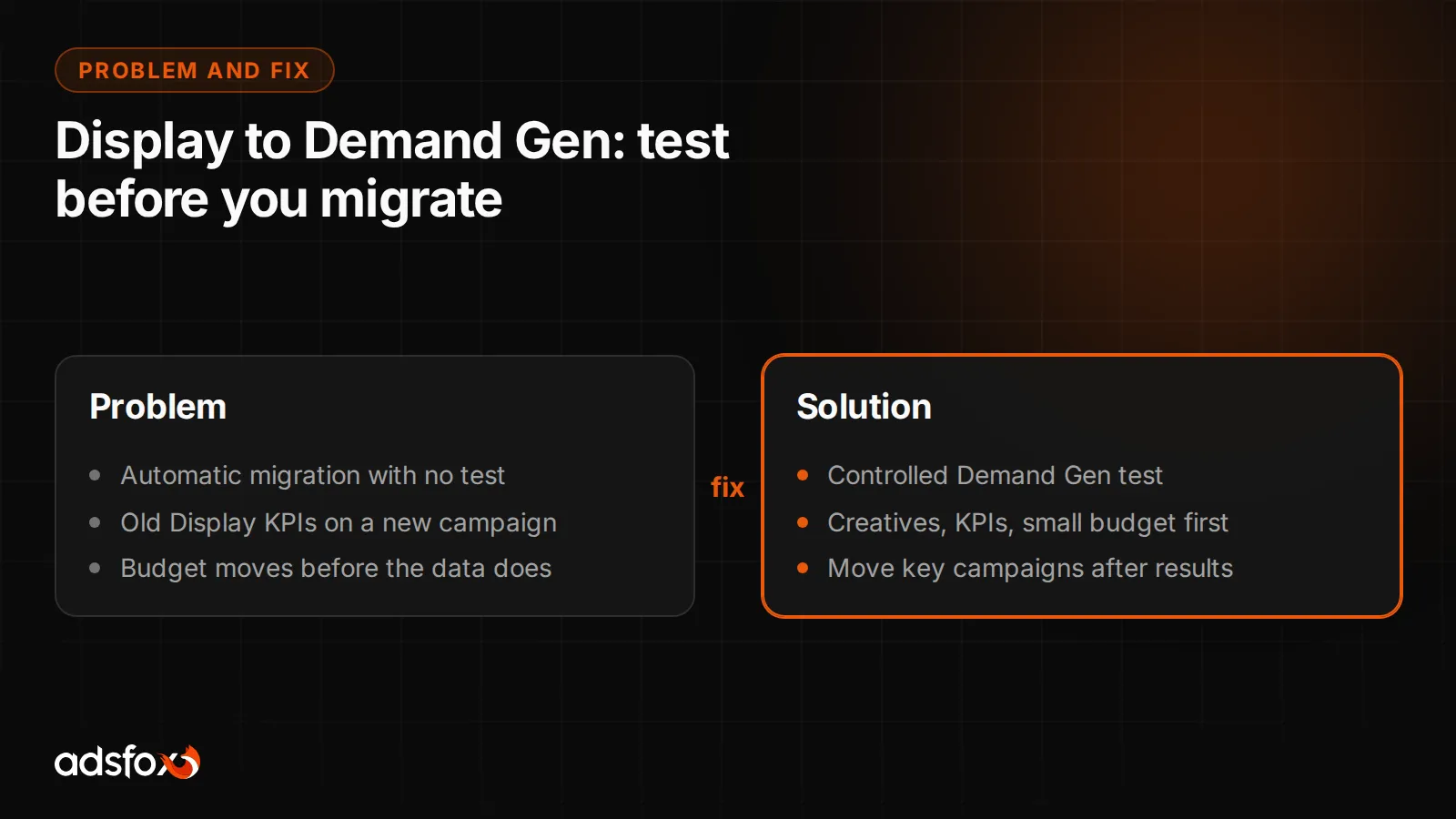
The riskiest scenario is an automatic migration with no prior test. The company may then see different results, different placements and different campaign behavior, while still judging them by the old rules.
The better scenario is a controlled transition. First a data review, then a Demand Gen test, then a check of lead quality, and only at the end, budget scaling. That order limits risk and avoids the conclusion “the campaign doesn’t work” when the real problem is wrong KPIs or weak tracking.
Summary: Google Ads campaigns need a test before scaling
Google Ads Display campaigns are moving toward Demand Gen, but for the business the key question is whether the company controls what it measures and how it judges results. The migration itself does not have to be a problem. The problem can be a lack of preparation, no new KPIs and no data on lead quality.
Before 2027, review your current Display campaigns, prepare creatives for Demand Gen, define a new way of judging results, and test the change on a smaller budget. Only then scale.
If you want to check whether your Google Ads account is ready for the Display to Demand Gen change, book a free consultation and we will analyze the campaigns, data and tracking before your budget starts working in the new model.