Google Ads Frequency and ROI: How Often Should Ads Show?
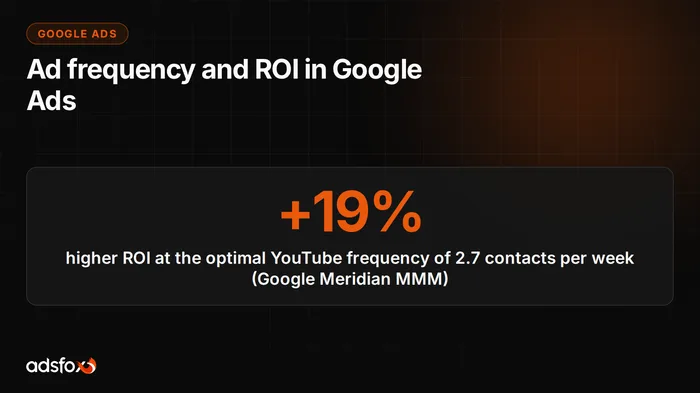
Google Ads and YouTube Ads campaigns should be judged not only by clicks, cost per lead and reach, but also by how often people are exposed to the ad and how those exposures affect ROI. Google showed in its Meridian MMM study that an optimal frequency of 2.7 exposures per week for YouTube was linked to 19% higher ROI. For a company investing in advertising that means one thing: reach alone is not enough if you do not know whether the message shows up the right number of times and whether those exposures help sales.
Ad frequency is the number of times a person is exposed to an ad message in a given period. It affects brand recall, the buying decision and the efficiency of media spend. In practice it is one of those parameters that gets underrated, because it is easier to look at clicks, forms and cost per conversion. The problem is that the ad dashboard shows only part of the picture.
Why does frequency in Google Ads campaigns matter for ROI?
Frequency matters because an ad rarely works after a single exposure. A person may see the message, compare offers, go back to search, visit the site later, or leave their contact details only after several days. If the campaign has too few exposures, it may never build recognition or a decision. If it has too many, it starts repeating the message to people who already know it or are not interested.
Start with the data: Google Meridian MMM showed that an optimal frequency of 2.7 exposures per week for YouTube was linked to 19% higher ROI (source: Google Ads & Commerce Blog, “Optimize your reach and frequency across campaigns with video campaign groups”). That is not an instruction for every company to set the same cap. It is a signal that frequency can be a real lever for results, not just a reporting metric.
For service businesses and B2B it is especially important to judge frequency together with lead quality. A campaign can look good in the dashboard, but if it produces contacts that go nowhere in sales, ROI will still be weak.
Do more impressions always mean a better campaign result?
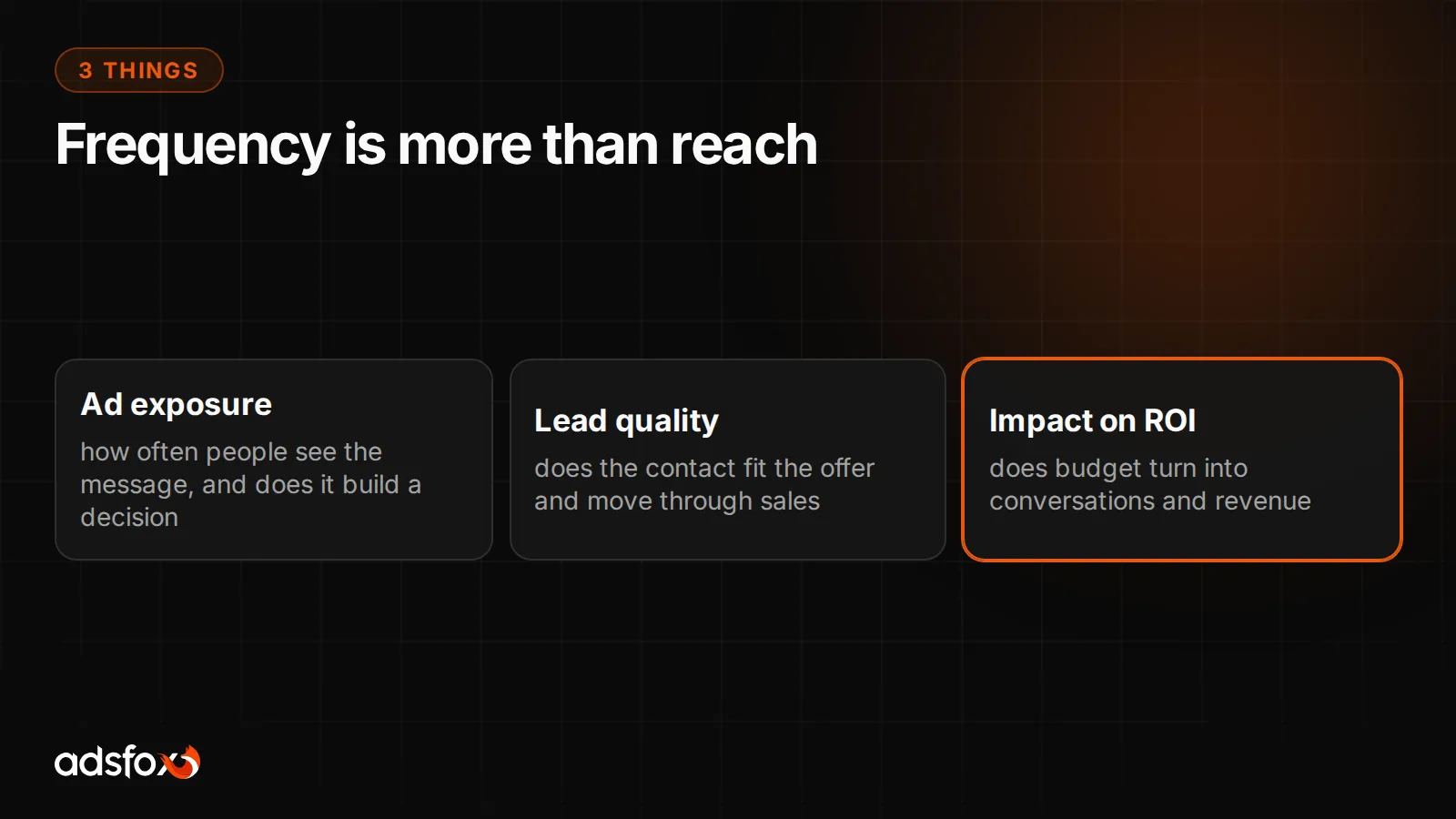
More impressions do not automatically mean a better result. Reach and frequency are necessary, but only combined with sales data do they show whether the budget is really working. The ad simply being present in the audience’s mind is not the goal. The goal is an effect on the decision, the inquiry, the sales conversation and revenue.
In practice, watch for three situations:
- frequency too low: people see the ad too rarely to remember the offer,
- frequency too high: the campaign starts burning budget on people who do not respond,
- no CRM data: the company sees leads but does not know which contacts are valuable.
That is why optimizing Google Ads campaigns for clicks or form submissions alone can lead to wrong conclusions. If the algorithm only learns that a form was submitted, but not whether the lead was any good, it may scale similar contacts. And that does not always mean better business.
How do you measure campaign performance without looking only at clicks?
Measure performance by combining media data, analytics and your CRM. The ad platform answers the question of what a contact cost and where it came from. The CRM answers what happened next: did the lead pick up the phone, did they fit the offer, did they move into a sales conversation and did they generate revenue?
The starting point should be a simple data map:
- campaign and ad group,
- cost per click and cost per lead,
- source and medium,
- lead status in the CRM,
- sales value or potential customer value,
- feedback sent back to the ad platform.
Only this setup lets you judge whether frequency helps sales or only adds exposures. If a campaign has high reach but does not deliver good leads, the problem may be in the message, the audience, the landing page, the sales process or the tracking itself.
If you want to check whether your campaigns are being judged on the right data, see how Google Ads management at adsfox works. In our campaign work we combine performance marketing, analytics and sales data instead of looking only at dashboard numbers.
What is changing in Google’s approach to reach and frequency?
Google is building tools to coordinate reach and frequency across video campaigns. For an advertiser that means more control over how often a message appears in front of the same person across different campaigns. It matters especially when a company runs several activities at once: awareness campaigns, remarketing, product campaigns and lead generation.
If each campaign is analyzed on its own, it is easy to miss ad fatigue, or frequency that is too low across the whole ecosystem. The user does not distinguish between the parts of your account structure. They just see a brand and a message. That is why reporting should answer how many real contacts with the brand a person had, and whether those contacts turned into results.
That is also why a good agency should not stop at setting the budget and the creatives. With Google and YouTube campaigns, structure, tracking, data interpretation and checking that the system learns from the right signals all matter. adsfox is a Google Partner, so on topics like this we look not only at platform features, but above all at their effect on the client’s business decisions.
How does adsfox approach ROI in ad campaigns?
adsfox looks at ROI through the whole customer acquisition process: ad, website, form, CRM, sales and feedback to the ad platform. That matters because a campaign can generate plenty of activity and still not help the company grow. The difference between “lots of leads” and “leads that buy” often decides whether the budget is profitable.
In practice we analyze, among other things:
- whether the campaign has the right goals set,
- whether tracking collects the data that matters to sales,
- whether the CRM shows lead status and value,
- whether lead quality data flows back to the ad systems,
- whether the report shows business impact, not just dashboard activity.
On the tracking side, what happens in the technology matters too. For more advanced setups it is worth considering server-side tracking, which helps organize conversion signals and limit data loss. It is not a technical curiosity. It is an element that can affect how well the campaign optimizes.
When should you check frequency and data quality in your campaigns?
Check frequency and data quality especially when campaigns look good in the dashboard but sales are not growing in step with the budget. It is a common situation in companies that see cost per lead but do not see the full path from ad to buying decision.
Before raising the budget, check:
- whether the ad is reaching the same group too often,
- whether the message loses effectiveness after a few exposures,
- whether leads from the campaign move forward in the CRM,
- whether sales reps mark the quality and status of contacts,
- whether CRM data is used to optimize the campaign,
- whether the report shows ROI, not just cost per conversion.
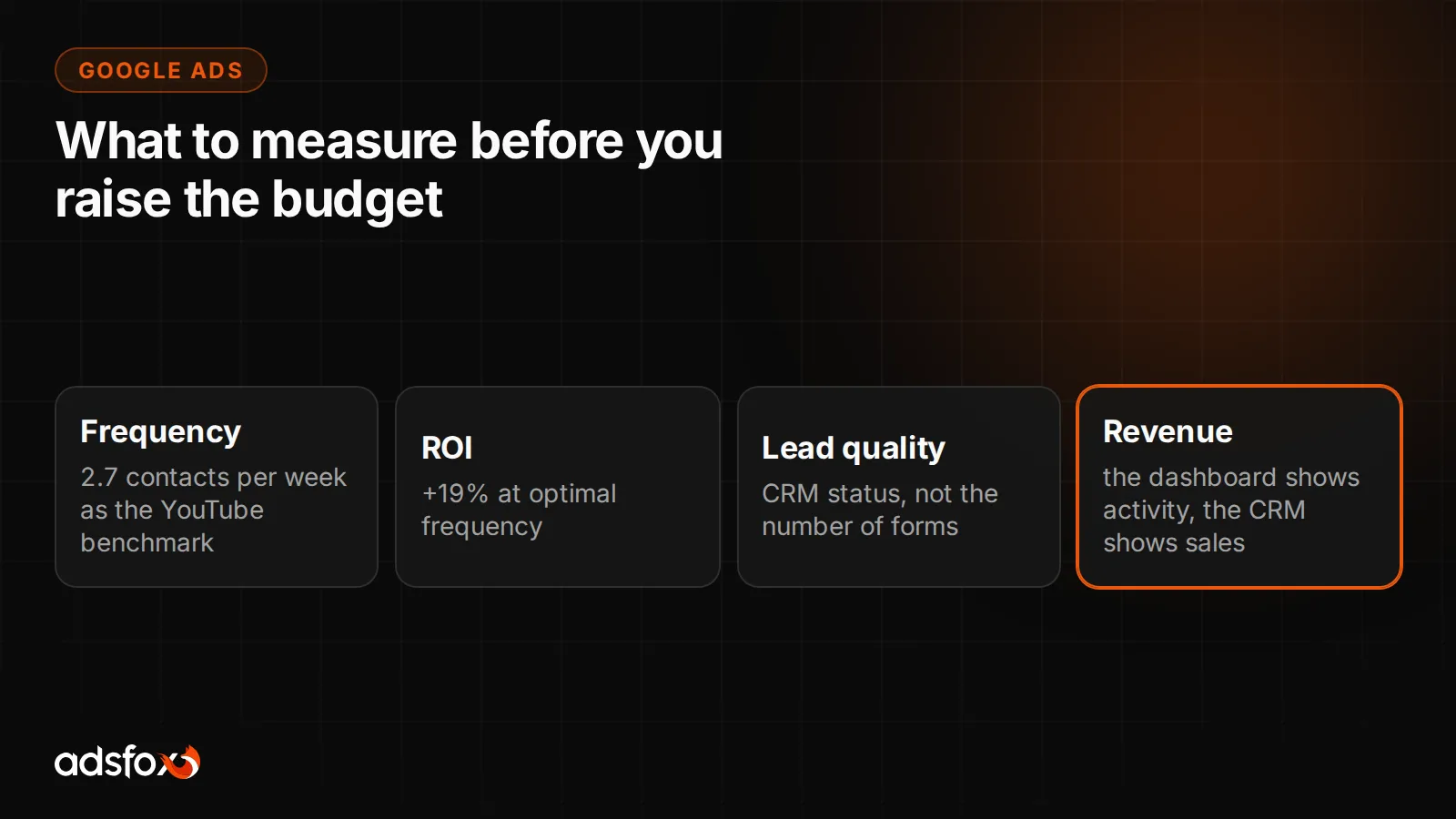
If those questions have no answers, a bigger budget may only make the problem bigger. More reach without good data does not give you control. It gives you more activity that is hard to interpret.
Summary: Google Ads campaigns need data, not just reach
Google Ads and YouTube Ads campaigns can perform better when frequency is analyzed together with ROI, lead quality and CRM data. The 19% figure from Google’s study is not a simple promise of a result. It is a reminder that advertising works as a process, not as a single click.
For a company the practical conclusion is this: it is not enough to ask what a lead cost. You have to ask whether the campaign reaches people at the right frequency, whether it builds a buying decision, and whether the data shows a real effect on sales.
Book a free consultation and we will check whether your campaigns are optimized for the right signals and whether your campaign data helps you make business decisions.