Google Ads When Organic Traffic Drops: When It Helps
Google Ads campaigns can help a company when organic traffic drops, but they should not be treated as a bandage for every SEO problem. If a business is losing clicks from organic results, paid search can deliver part of those queries faster than content or SEO, but only when the budget targets the right intent, the landing page turns traffic into inquiries, and tracking shows the real quality of leads or sales.
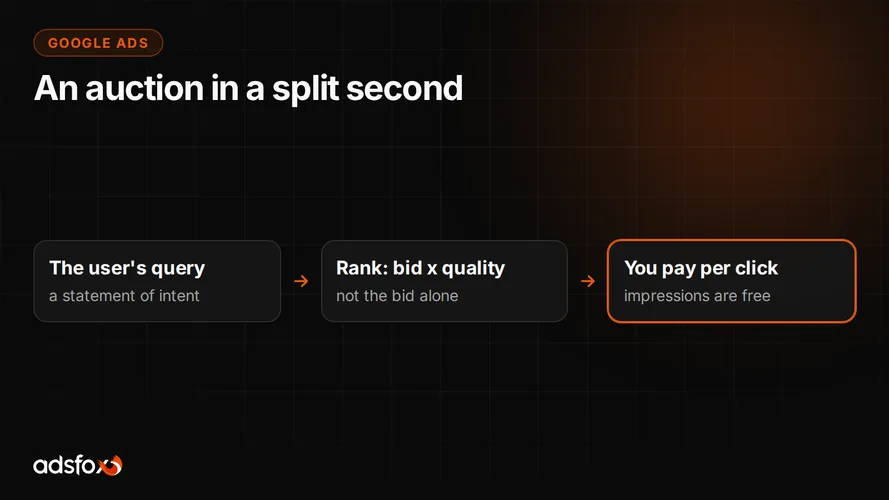
Paid search is advertising in search results that lets a company buy visibility for specific user queries. In Google Ads that means the ability to show up quickly where the customer is already looking for a solution, but also the risk of paying for traffic that has too little business value.
Why is organic traffic getting less predictable?
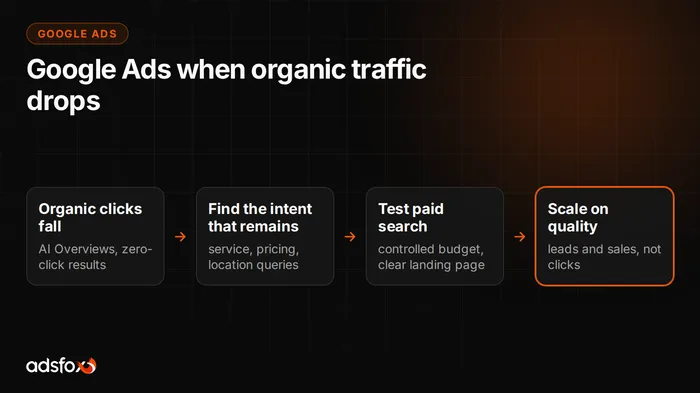
Organic traffic is less predictable because search results increasingly answer the user without a click to any website. Search Engine Journal, covering the Tinuiti Q2 2026 benchmark, points out that pressure on organic clicks has grown over the last 18 months, driven among other things by AI Overviews and zero-click experiences.
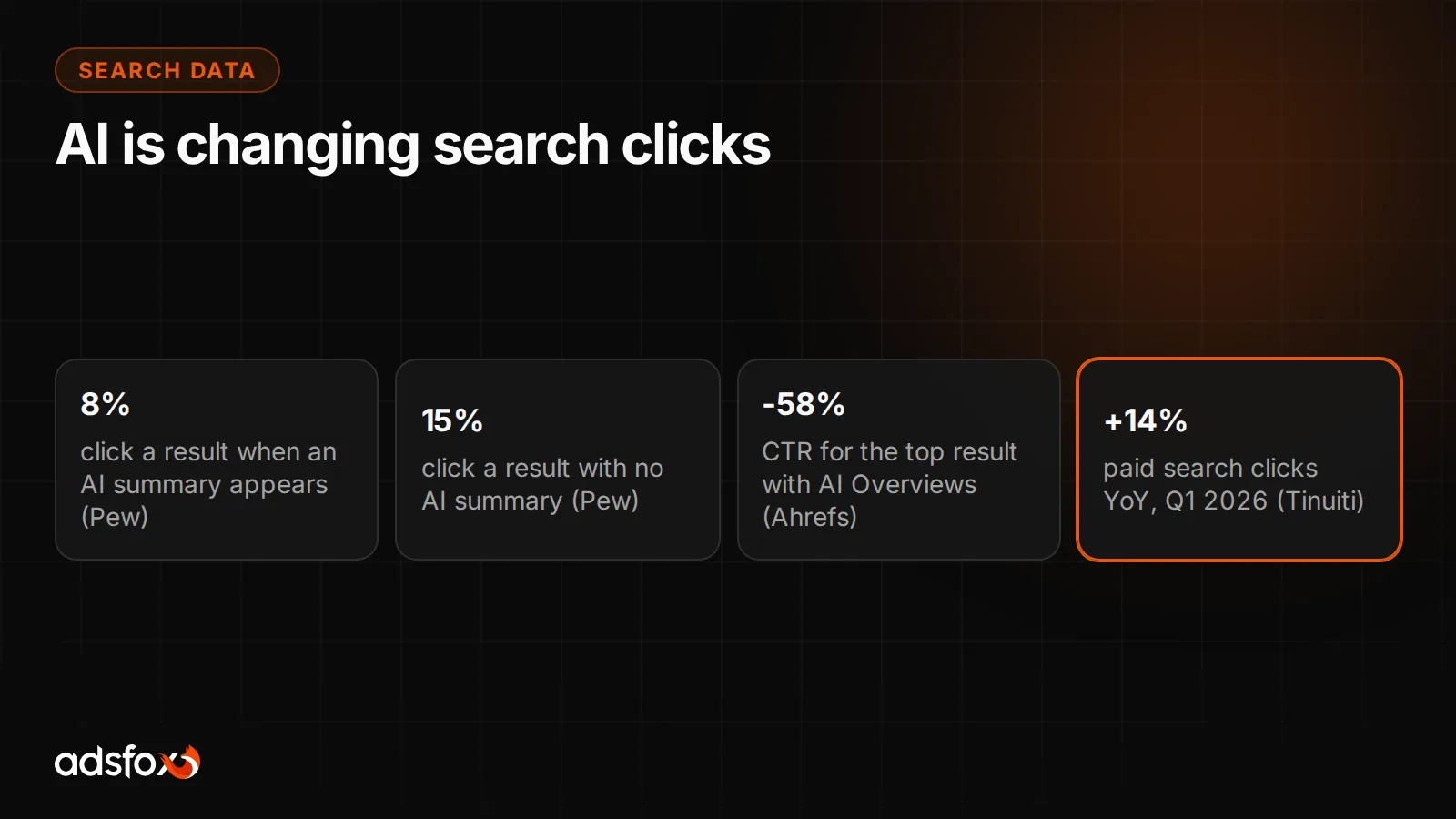
The data shows the scale of the shift. Pew Research Center found that users clicked a traditional search result in 8% of visits when an AI summary appeared, versus 15% of visits without one. Ahrefs, meanwhile, estimated that AI Overviews correlated with a 58% lower CTR for the page in position one in data from December 2025.
For a business owner the takeaway is simple: a drop in organic visits does not have to mean demand disappeared. It may mean that part of the answer stays inside the search engine, part of the decision starts earlier, and part of the audience no longer follows the same path it did a year ago.
Can Google Ads take over the traffic lost from SEO?
Google Ads can take over some of the traffic lost from SEO, but not all demand can simply be bought back with ads. Search Engine Journal notes that paid search growth in recent quarters ran parallel to the decline in organic clicks, but the data alone does not prove a simple transfer: the user did not click the organic result, so they clicked the ad instead.
That is an important distinction. If a user got their answer directly in the search results and ended the session, a paid ad will not always recover that contact. But if the user still intends to buy, compare offers or contact a company, Google Ads can help you reach that moment faster.
So the question is not “should we raise the budget now that SEO is down?” The better question is “which queries still carry business intent, and can we turn them into a lead or a sale?” Only then does paid search become a tool of control rather than a panic reaction.
What does the Tinuiti data say about paid search in 2026?
The Tinuiti Q2 2026 benchmark, as reported by Search Engine Journal, shows that paid search is still growing, but the pace has started to normalize. According to the article, Google paid search clicks rose 14% year over year in Q1 2026, and in Q2 spending on Google paid search grew by almost 14% year over year. At the same time, Q2 was already being compared with a stronger base from the previous year.
That means companies entered 2026 with a bigger paid search presence than before. Some marketers may have assumed that since organic keeps losing clicks, paid search would keep accelerating. Q2 paints a more sober picture: growth is still there, but it should not be treated as a goal in itself.
For companies with 10 to 200 employees, the result on their own account matters more than a broad market benchmark. If cost per click rises slowly but query quality drops, the campaign is not better. If there are more clicks but sales do not keep up, the report may look good while the business result stays weak.
When does Google Ads help with an organic traffic drop?
Google Ads helps with an organic traffic drop when the company knows which queries carry real sales value. The safest place to start is high-intent terms: searches for a service, a comparison, pricing, a location, availability or a specific customer problem.
In practice, check:
- which pages lost the most valuable organic traffic,
- whether those pages produced inquiries, forms, calls or sales,
- which keywords still show buying intent,
- whether the landing page answers the user’s question faster than competitors do,
- whether the campaign measures a valuable contact, not just a click,
- whether the budget is split between defending current demand and acquiring new customers.
At adsfox, as a Google Partner, we look at these situations not only through campaign settings but through the whole system: query, ad, landing page, form, CRM, sales and report. Only that chain shows whether Google Ads campaigns are actually helping the company recover results or just buying more traffic.
When does paid search only burn the budget?
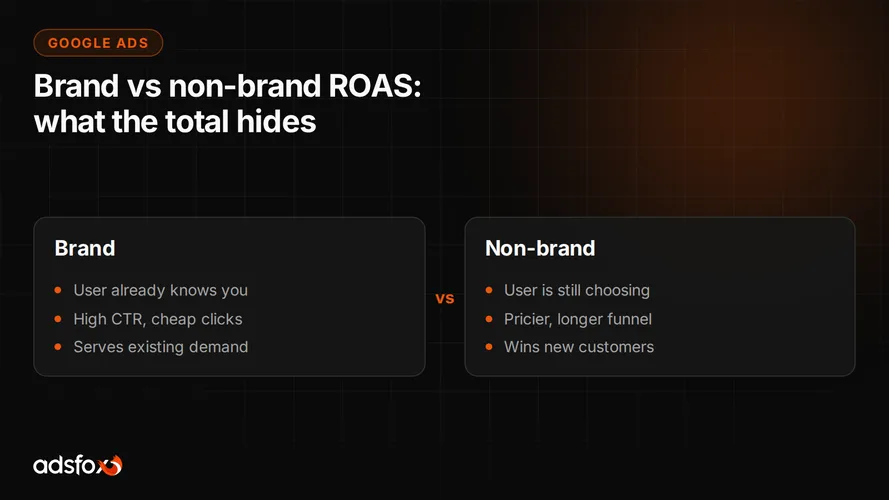
Paid search burns the budget when a company tries to use ads to fix a problem that sits outside the campaign. That usually happens when the site does not answer the user’s intent, the offer is unclear, the form is too long, nobody picks up the phone, and the report shows only clicks and a conversion count.
The typical warning sign looks like this: paid traffic grows, cost per click is acceptable, the number of forms does not look bad, but sales say the inquiries are weak. Raising the budget at that point only enlarges the problem. The company pays more for the same kind of contacts instead of fixing the conditions the campaign has to work in.
Watch out for overly broad match types and informational keywords too. An SEO decline often hits educational queries. Not all of them are worth buying back in Google Ads. Some users are too far from a decision, some are looking for a definition, and some have no intention of contacting a company.
If you are not sure whether the problem is in the campaign, the site or the tracking, book a free consultation and we will check where the budget is really working and where it only adds traffic.
How do you check whether a bigger Google Ads budget makes sense?
A bigger Google Ads budget makes sense only when current traffic shows quality signals. Before scaling, run a short audit of the account and the user journey instead of moving money straight from SEO to PPC.
The key questions for a business owner or marketing manager:
- Which campaigns generate contacts that the sales team considers valuable?
- Do we know which keywords the best inquiries come from?
- Does the landing page have a clear message, trust signals and a simple path to contact?
- Do we track calls, forms, purchases and the next stages of the sale?
- Does the report show cost per valuable lead or sale, not just cost per click?
- Does the test budget have a risk limit and a clear condition for scaling?
This approach separates an investment from a nervous reaction. A drop in organic traffic can be a good reason to strengthen Google Ads, but only if the company knows how to judge the effect.
What should be in the action plan?
The action plan should combine SEO, Google Ads and analytics, because the user does not see those channels separately. The customer sees a problem, an offer, a price, reviews, timing, the company’s credibility and the convenience of getting in touch. If one link in the path is broken, ad budget alone will not fix it.
A practical plan can look like this:
- check which organic pages lost traffic and conversions,
- pick the keywords with the highest business intent,
- prepare or improve the landing page for those queries,
- launch Google Ads campaigns with a controlled test budget,
- measure not just forms, but contact quality and sales,
- after 2 to 4 weeks decide what to scale, what to fix and what to switch off.
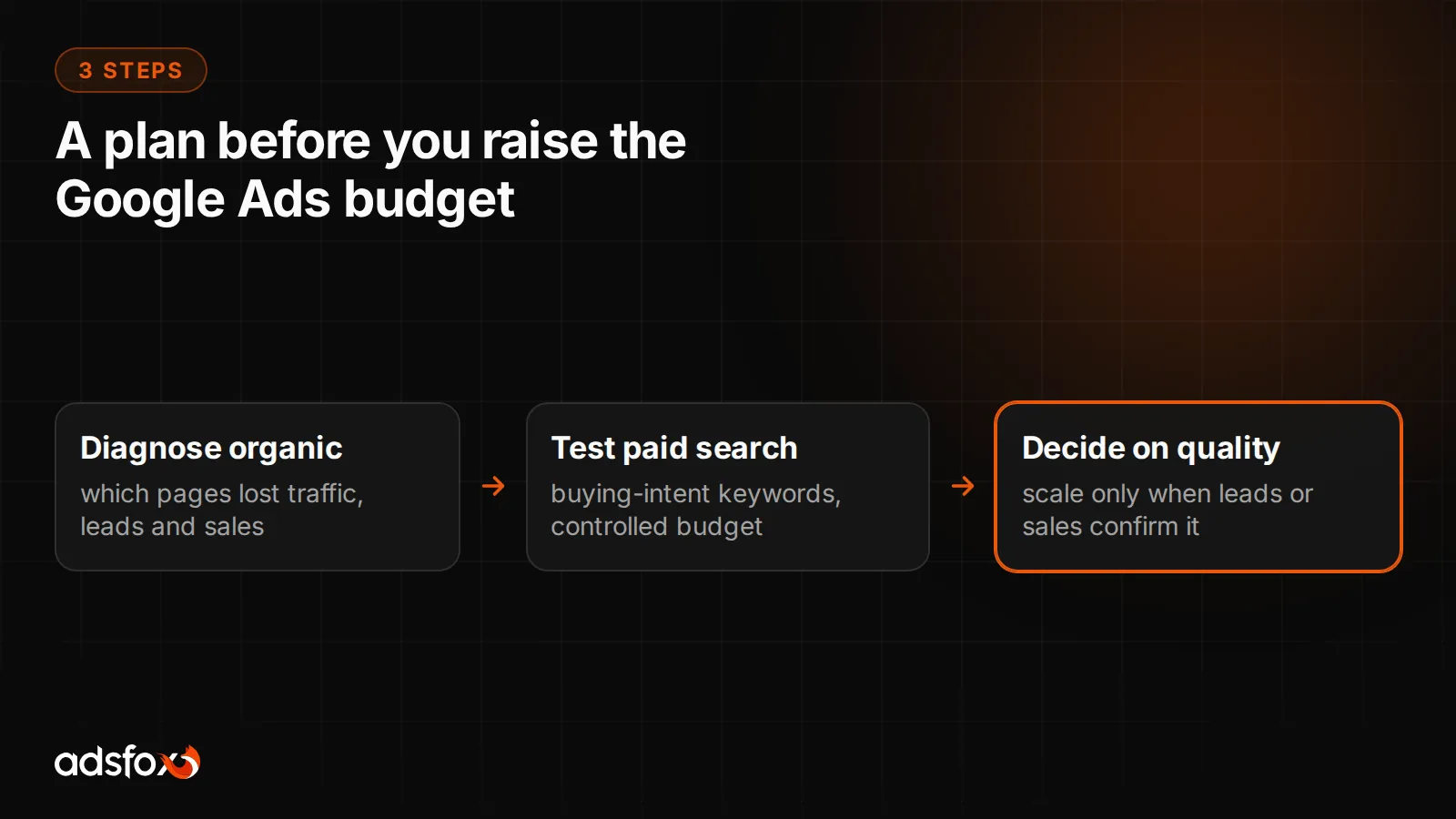
In this setup Google Ads does not replace strategy. It is a tool for a fast test, for recovering part of your visibility and for collecting data. If the test shows quality, the budget can grow. If the test exposes a weak customer path, fix the site, the offer or the tracking first.
Summary: paid search does not replace strategy
Google Ads can help a company get through a period of declining organic traffic, but it should not be the automatic answer to every SEO problem. Paid search works best when the company understands user intent, has a good landing page, measures contact quality and knows what cost per customer is acceptable.
Market data shows organic clicks are under pressure and paid search keeps growing. For an individual company something else matters more: does a bigger budget actually deliver sales, or does it only buy visibility in a harder search environment?
If you want to check whether Google Ads can safely offset a drop in organic traffic for your business, book a free consultation and we will analyze the campaigns, the landing page and the tracking before you raise the budget.
Data sources: Search Engine Journal, “Paid Search Absorbed Organic’s Collapse - Then Q2 Slowed Down”, August 4, 2026; Tinuiti Q2 2026 Digital Ads Benchmark Report; Pew Research Center; Ahrefs.