How Much Does Google Ads Cost? Budget and Billing Explained
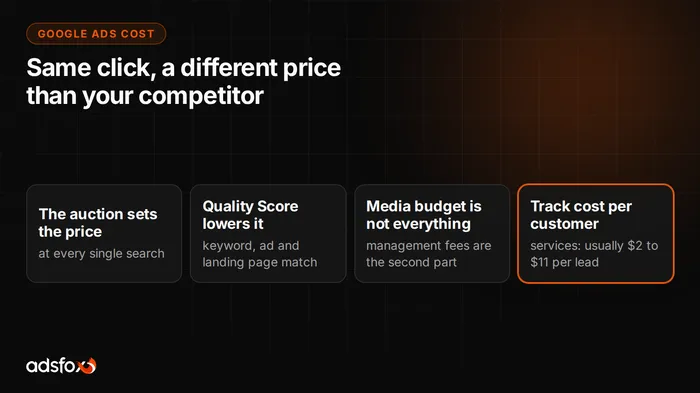
Google has no price list for ads. You do not buy a campaign for a fixed amount: you set a daily budget, and the price of each click is set by an auction that runs at every search. That is why the question of how much Google Ads costs only makes sense once you ask about cost per customer. In the campaigns we have run, cost per lead for service businesses usually landed between about $2 and about $11, depending on the industry.
Below we break it down: what you pay Google, what you pay an agency, what really drives the price up, and how to calculate a starting budget.
Billing models: what you pay Google for
In Google Ads you are billed in one of several models, and the choice depends on the campaign type:
- CPC, cost per click. The basic model on the Search Network. You pay when someone clicks the ad, not when it is shown.
- CPM, cost per thousand impressions. Typical for the Display Network and video campaigns built for reach.
- CPA, cost per action. Billing tied to a specific action, such as a form submission or a purchase. It requires correctly implemented conversion tracking.
Most of the time you work in the CPC model, and that is what most questions about price come down to.
Cost per click: why there is no single rate
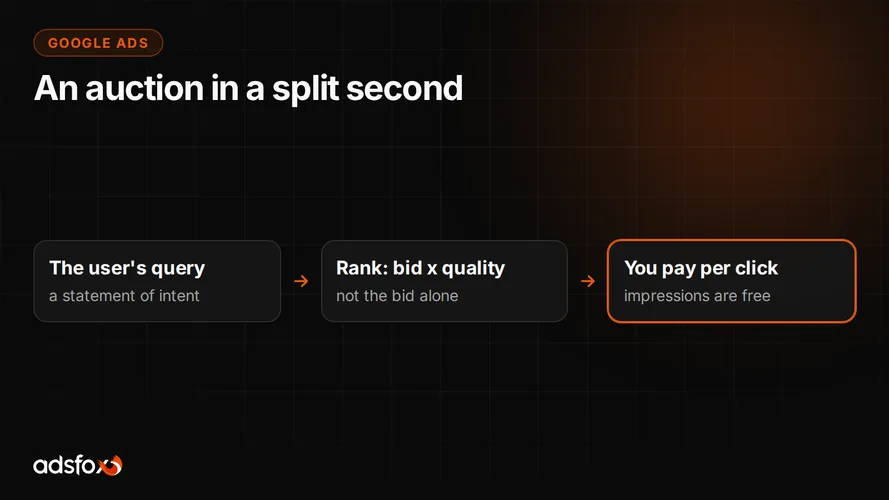
Every time someone types a query into Google, the system runs an auction among the advertisers who want to show up for it. Who wins and how much they pay is decided not by the bid alone, but by the bid combined with Quality Score.
Quality Score is a rating of three things: how well the keyword matches the ad, the expected click-through rate, and the quality of the landing page the user arrives on. The better these fit together, the less you pay for the same position.
That has a practical consequence that is easy to forget: cost per click is not purely a market price. It is partly the result of your own work. Two companies in the same industry bidding on the same keyword can pay noticeably different rates. The one with the better-matched ad and a sensible landing page pays less.
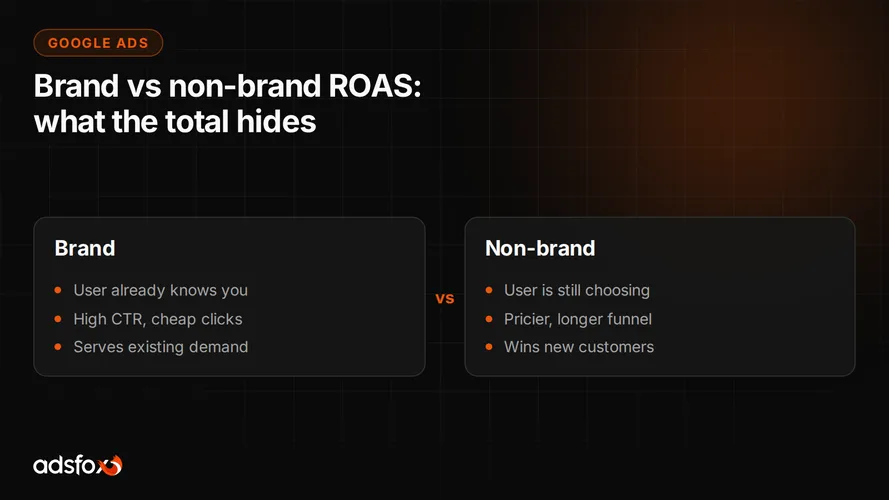
So the honest answer to “how much does a click cost” is: it depends on your industry, the competition for that specific query, and how well the campaign is built. WordStream’s cross-industry benchmarks have put the average Google search CPC in the $4 to $5 range in recent years, but that average mixes markets that cannot be compared. Legal, insurance, home services and finance keywords routinely cost several times more, with some legal terms passing $50 per click, while local service queries in smaller markets can cost a fraction of that.
What else affects the cost
Keyword competition. Queries with clear buying intent are more expensive because more companies bid on them. “Personal injury lawyer Chicago” costs something very different from an informational query.
Campaign type. A text ad on the Search Network is billed differently from a Google Shopping campaign or a Display campaign. Comparing their costs head to head makes little sense, because they reach the customer at different stages.
Location and reach. A nationwide campaign competes with far more advertisers than a campaign targeting a single metro area.
Seasonality. In peak shopping periods more companies bid on the same queries, so rates go up.
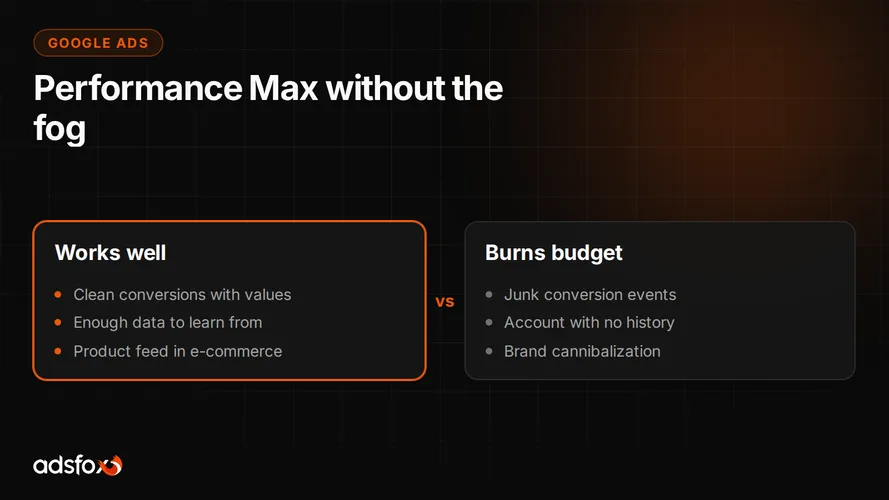
Conversion tracking quality. If part of your conversions never reaches Google, the campaign optimizes on incomplete data and the cost per result goes up even though nothing changed on your side. Server-side tracking helps here by limiting the data loss caused by browser blocking.
How much does agency management cost
This is the second, separate cost component, and many comparisons fail to separate it from the media budget. On the market you will see three approaches:
- Flat monthly fee. Predictable, independent of the ad budget.
- Percentage of ad spend. Popular, but understand its flaw: the fee grows when you spend more, not when you get a better result on the same budget.
- Mixed model, combining a base fee with a performance-based component.
The question worth asking every agency: what happens to your fee if we reach the same result on a smaller budget? The answer tells you more about the working relationship than the price list does.
Why cost per click alone tells you nothing
The best illustration is one of our campaigns for a local service business. With the budget increased by 0.68 percent, practically unchanged, the number of valuable actions grew by 206 percent and the cost per action dropped by 67 percent.
The market did not change and neither did the rates. What changed was what the campaign was optimized for and what data it received. We describe the details in the Google Ads case study for a local service business.
That is why “how much does a click cost” is a less useful question than “how much does it cost to win a customer.” Reference points for different industries, from about $2 in local services to $8 to $11 in more competitive niches, are collected in our benchmark from 20 campaigns, with a link to the source case study next to every number.
How to calculate an ad budget
Work backwards, not from the amount you “would not mind spending”:
- Calculate customer value. Average order value or contract value times the probability of closing.
- Set the maximum cost per customer at which the math still works.
- Check how many customers you need per month to hit the plan.
- Multiply and add a margin for the test period. The first weeks are for collecting data, not for judging the campaign.
There is one more condition, more important than the amount itself: the budget has to let the campaign collect enough conversions for the system to learn from. A budget that is too small does not simply produce proportionally smaller results. It produces unpredictable results, because the algorithm keeps guessing.
Google Ads vs SEO: which to choose
This question comes back at every budget planning session, so let’s settle it. Google Ads and SEO work on different timelines:
- Google Ads brings traffic from day one, lets you quickly test which queries sell, and stops when the budget stops.
- SEO works slower, but the effect stays and lowers your cost per customer over time.
For most service businesses both make sense: campaigns cover current sales, and SEO builds a cheaper source of inquiries for the future. The same goes for Facebook and Instagram advertising, which catches the customer earlier, before they start searching.
Google Ads management pricing: what an agency charges
At adsfox, campaign management for a single channel starts at $490 per month. With more channels the price per channel is noticeably lower, because part of the work (tracking, analytics, learning your offer) is done once for the whole account. The price also depends on how much creative work we take on (whether we prepare the ads or you supply them) and on the size of the ad budget, because we take responsibility for spending it, and the more money involved, the more risk sits on our side. The full rules are on our Google Ads pricing page, and the reasoning behind them in the post on campaign management pricing.
Summary
How much Google Ads costs depends on the competition for your keywords, the campaign type and your Quality Score, not on a price list, because there is none. On top of the media budget comes the management fee, which is best structured so it rewards results rather than spending. The most important number is cost per customer set against what that customer is worth, and that is the one to track instead of an average cost per click.
If you want to check how much you are really paying and where that cost can come down, that is what we do in our Google Ads management.
Book a free consultation and we will review your account and calculate cost per customer for your industry.