What Is Performance Max and When Does It Make Sense

Performance Max is a Google Ads campaign type where you supply the assets, the goals and a spending limit, and the platform chooses placements across all Google channels at once: Search, the Display Network, YouTube, Gmail, Maps and Discover. It sounds like the dream of a machine that does everything by itself. Sometimes it is, on one condition that decides everything: the campaign learns only from the conversion signals you give it. Good signals produce good results; bad signals produce an expensive-looking disaster.
This post explains the mechanics without the marketing fog and answers the question we hear most often: turn it on or not?
How does Performance Max work?
A classic Search campaign gives you control: you pick the keywords, the bids, the placements. Performance Max flips the arrangement. You supply:
- conversion goals (purchase, lead) and their values,
- assets: headlines, descriptions, images, video, from which the system assembles the ads,
- audience signals as a hint, not a restriction,
- a spending limit and a target return.
The platform decides who sees the ad, where and in what form, so as to maximize the defined conversions within the set limit. It is not “set it and forget it.” It is “set the inputs very carefully, because you do not control the middle.”
When does Performance Max work well?
From our experience on client accounts: the campaign performs best when three conditions are met at the same time.
- Conversion tracking is correct and complete. The system optimizes for what it sees. If it sees only some of the purchases, or counts a visit to the contact page as a success, it learns nonsense. That is why before launch we check the events, not the creatives.
- There are enough conversions. Automation needs data. An account with a handful of conversions a month will not feed the algorithm, and the results will be a lottery.
- There is a product feed (e-commerce). Performance Max with Merchant Center connected is the natural successor to Shopping campaigns, and this is where it is strongest. Online stores are its home turf.
For service businesses it can be a good complement to a Search campaign, provided there are hard conversions (form, phone call) and honest checks on their quality. How to raise signal quality with CRM data is covered in our post on connecting your CRM to ad campaigns.
When does Performance Max fail?
Three recurring scenarios we see in audits.
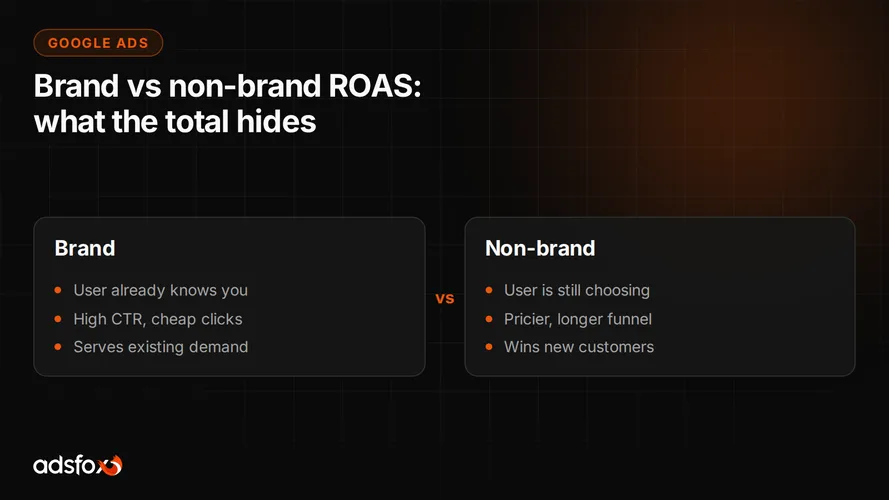
Brand cannibalization. The campaign happily serves on queries containing your brand and takes credit for conversions that would have happened without it. The report looks great; the lift is an illusion. The fix: brand exclusions and looking at the lift for the whole account, not the result of the campaign alone.
Junk conversions. If the goal is “click on phone number” counted together with misclicks, or a form with no quality check, the campaign will deliver exactly that: cheap events with no money behind them. The automation cannot tell a lead from spam until you show it the difference.
Too little data, too much faith. Switching on Performance Max in an account with no conversion history, a small budget and the hope that “the AI will figure it out” ends in a learning phase that never ends.
Performance Max vs Search campaigns
This is not an either-or choice. The standard, working setup looks like this: the Search campaign handles the clear-intent keywords you want to control, and Performance Max picks up reach wherever it finds conversions on its own. The first gives control and clarity, the second gives scale.
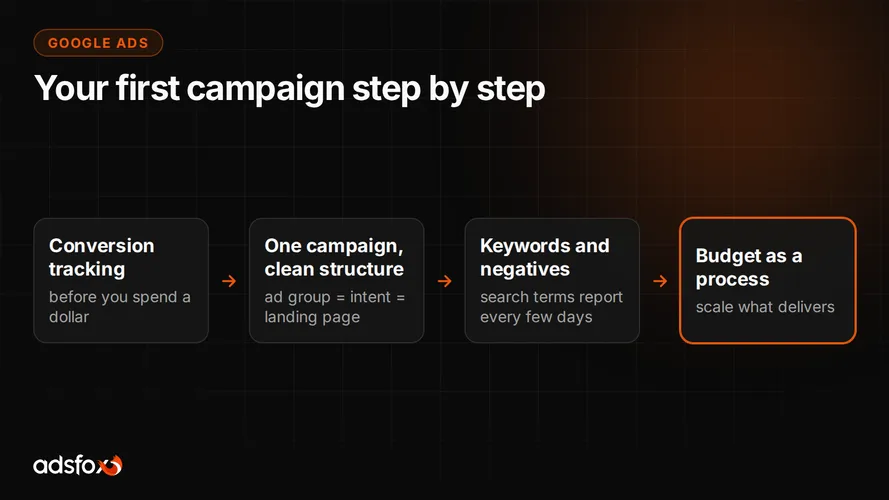
If you are just starting with Google Ads, the order is unambiguous: first a solid Search campaign with clean tracking, which we describe step by step, then, optionally, Performance Max as an extension. Launching the automation as the first campaign in an account is like driving without a license in a car with no steering wheel.
How do you judge Performance Max results?
Not by cost per click and not by the campaign’s own result, but by its effect on the whole account:
- Total conversion lift, after subtracting what the campaign took from other campaigns (especially brand).
- Cost per acquisition and profitability at the account level, compared with the period before launch.
- Lead quality, if you sell through forms: the number of qualified leads, not all of them. In one of our accounts, switching the optimization to quality raised the share of qualified leads from 21.1% to 45.7%.
Cost reference points for different industries are in our benchmark of 20 campaigns across 11 industries, and the broader picture of Google Ads costs in the post on how much Google Ads costs.
Turn it on or not?
A short checklist instead of fortune-telling: your conversions are tracked correctly, there is a meaningful number of them per month, you can separate brand traffic, and you will judge the lift for the whole account. Four times yes: worth testing. Any no: fill in the missing piece first, because Performance Max will amplify what you have, mistakes included.
We have run Google Ads campaigns since 2018 for more than 350 clients across more than 20 industries, and we set up Performance Max with exactly this discipline: signals first, automation second. See how our Google Ads management works and book a free consultation. We will check whether your account is ready before the automation gets a budget.