Are LinkedIn Ads Worth It? Who They Make Sense For
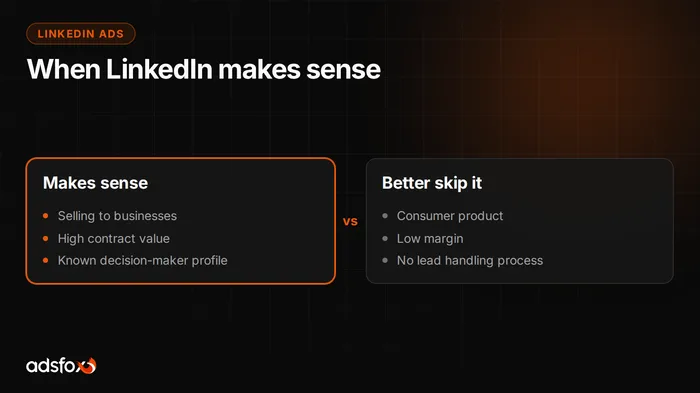
LinkedIn ads are worth it when one acquired customer is worth enough that you can afford a few dozen clicks on the way to them, and the decision maker can be described by job title, industry and company size. They are not worth it for a cheap consumer product, for a mass-market audience, or when the budget barely covers one channel. It is the most expensive channel in social media and there is no point hiding it: its entire advantage is that you pay to reach the right person, not a large number of people.
Below you will find the criteria we use for this decision, and the situations in which we advise against LinkedIn Ads instead of selling them.
What are LinkedIn ads and how do they differ from other channels?
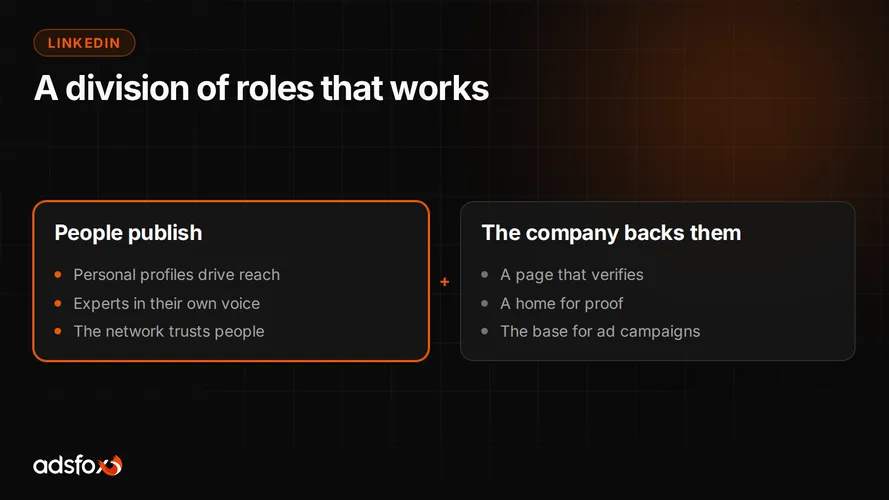
LinkedIn ads are paid campaigns targeted by professional data that users provide about themselves and keep up to date, because their careers depend on it. You choose job title, seniority, industry, company size, years of experience, skills, and even specific organizations from a list.
The difference from Meta Ads or Google Ads is fundamental. On Google you reach a person who is searching for something right now. On Meta, a person with a certain profile of behaviors and interests. On LinkedIn, a person who is responsible for a specific budget at their company, whether or not they happen to be searching.
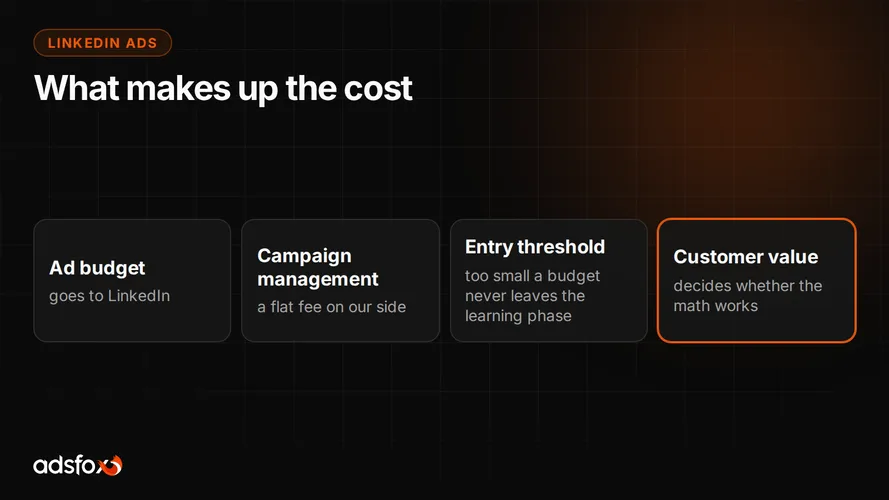
You pay for that precision in the cost per click. So the decision to enter this channel is not a marketing decision but arithmetic: how much a customer is worth and how many clicks you need to win one. Without that math, even a well-built campaign will only be an expensive test.
When do LinkedIn ads make sense?
In short: when you sell high-ticket, to companies, and a specific role in the organization makes the decision. From our experience, these cases look promising:
- Subscription services and implementations: business software, systems, integrations, outsourced services. The customer stays for months or years, so you can afford to pay more to acquire them.
- Sales to large organizations: when your market is a few hundred companies from a list and you want to show the message only to people from those organizations.
- Professional services with high engagement value: consulting, law firms, audits, design, financial services.
- Recruiting specialists: when you are looking for people with a specific profession and experience, not candidates in general.
- Training, executive education and professional courses: the audience is selected by profession, so profile data works.
The common denominator: high value of a single customer and an audience that can be described professionally. If your customers differ mainly by age, location or interests, you will reach them cheaper elsewhere.
How to calculate whether LinkedIn Ads add up for your company?
Before you spend the first dollar, go through four numbers from your own company. Not from the internet, your own.
| What to calculate | Where to get it | Why it matters |
|---|---|---|
| Margin from one customer | financial data, not just revenue | sets the upper limit of what you can pay per customer |
| Share of inquiries that become customers | CRM or sales history | tells you how many leads have to come in per contract |
| Customer lifetime | contracts, repeat orders | with subscriptions it raises the break-even threshold |
| Size of the real target audience | number of companies and people in the role | too narrow an audience burns out in a few weeks |
The math is one sentence: the margin from one customer has to cover the cost of all the clicks and leads needed to win them, plus campaign management, and still leave a profit. If you do not know your share of inquiries that turn into sales, start there, because without that number you judge every channel by feel. We describe how to connect that data in our post on CRM and ad campaigns.
Who do LinkedIn Ads not make sense for?
We ask this question as often as the previous one, because advising against a channel is often cheaper than testing it. LinkedIn Ads are usually not a good choice when:
- You sell cheap and at volume: a $20 product will not carry the cost of a click, even with a great campaign.
- The audience is consumer: beauty, restaurants, fitness, retail. Those customers are cheaper to acquire on Meta or Google.
- The budget only covers one channel: splitting it between two platforms usually means neither collects enough data to prove anything.
- There is nothing to fill the campaign with: without material that adds something (a report, a comparison, a recording, a specific case), all that is left is a form, and that works poorly on LinkedIn.
- The company does not measure lead quality: if you do not know which leads turn into contracts, an expensive channel will only expose that gap faster.
If you recognize three of these points, the decision is essentially made, and the answer is not “yes.” Fix the gap first, because a new channel will not fix it for you.
What does a sensible B2B LinkedIn Ads campaign look like?
A B2B LinkedIn Ads campaign rarely works as “a form from the first contact.” A structure where you first give something valuable and only then ask for contact works better: a report, a data set, a webinar recording or a specific implementation story.
For collecting data you use the Lead Gen Form format, where fields are prefilled from the profile, so the viewer does not retype the company name and job title. What happens next is the key part: the lead has to go straight to the CRM, and a sales rep has to reach out the same day. At this cost per click, a contact sitting in an export for a week is money thrown away.
The third element is the feedback signal. You mark in the CRM which submissions the sales rep qualified, and send that information back to the ad system, so the campaign learns from quality rather than form count. That is exactly how we structure LinkedIn Ads campaigns for clients.
Is it better to start with another channel instead of LinkedIn?
Often yes, and we say so plainly. If your customers search for a solution on their own, Google Ads should come first, because there you capture existing demand instead of building it. If the audience is wider and the product can be shown, you will validate the message faster on Meta.
We have data for this from our own campaigns in other channels. At a medical aesthetics clinic, the share of qualified leads rose from 21.1 percent to 45.7 percent, and cost per contact dropped from about $8.50 to about $7. The mechanism that did it, sending lead quality information back to the ad system, is exactly the one you need on LinkedIn.
We deliberately do not quote a cost-per-lead range for LinkedIn here: we do not have a comparable data sample for this platform. Our actual results from 20 campaigns across 11 industries, including a cost per lead of $8 to $11 for a law firm, are collected in our CPL and ROAS benchmark. Reference points for the channel that is usually worth starting with are on our Google Ads management page.
How to judge whether a LinkedIn Ads test succeeded?
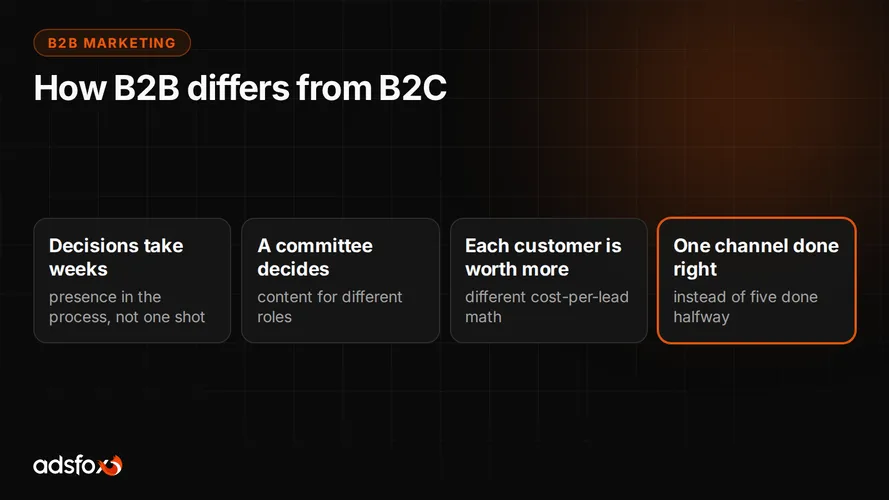
Judge the test by the same measures as any other channel, only with a longer horizon, because the B2B decision cycle is longer than in consumer sales. Impressions and reactions are not a business result.
Check above all:
- cost per lead qualified by sales, not per contact in general,
- whether inquiries come from the job titles and companies you care about,
- how many entered a sales conversation and at what stage they stalled,
- what the same period looks like in your main channel,
- whether the audience burned out faster than you managed to collect data.
If after a few weeks the cost of a valuable contact is clearly higher than in your main channel and there is no downward trend, the honest conclusion is to close the test or push it back in time. That is a result too, and it is better to accept it after a quarter than after a year.
How to make this decision for your company?
Answer three questions: how much you earn on one customer, whether your buyer can be described by job title and industry, and whether you know which inquiries turn into sales. Three “yes” answers mean a LinkedIn Ads test is justified. Even one “no” means you need to deal with that gap first.
At adsfox we have been working since 2018, have served more than 350 clients across 20+ industries, and are a Badged Meta Business Partner and a Google Partner. That gives us a point of comparison in this conversation: we know when a more expensive channel actually adds contracts, and when it only scatters a budget that would work better elsewhere.
Book a free consultation. We will go through your customer value, sales process and current measurement, then tell you plainly whether LinkedIn ads are a channel for you now, later, or not at all.