B2B Marketing Strategy: How It Differs From B2C, Where to Start
B2B marketing is marketing aimed at companies, and it differs from consumer marketing in three ways that everything else follows from: the decision takes longer, several people make it at once, and a single customer is worth many times more. Anyone who tries to do B2B with the methods of a shoe store burns budget on impulses that barely exist in B2B. This article lays out the basics: how it differs, which channels work, and where to start when the budget is not unlimited.
How does B2B marketing differ from B2C in practice?
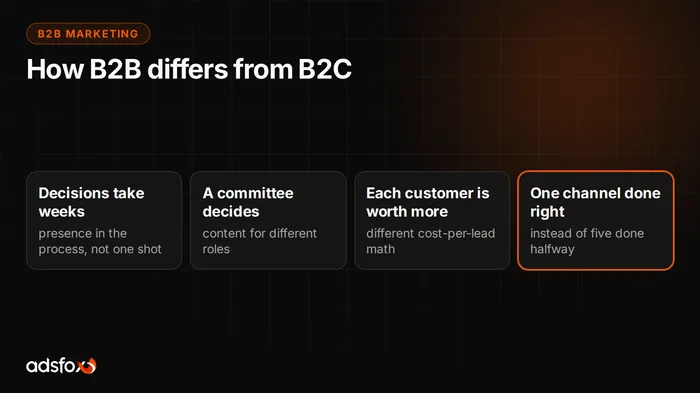
The decision takes weeks and months, not minutes. A company does not buy an accounting system, an implementation or a vehicle fleet on the strength of one ad. Before the decision is made, someone reads, compares, asks industry peers and comes back to the topic several times. Conclusion: a single contact with an ad almost never sells; presence throughout the process does.
A committee decides, not a person. The user wants convenience, the CFO looks at cost, the board looks at risk. A message that convinces one can leave another cold. Conclusion: content has to answer the questions of different roles, not one persona.
The customer is worth more, so you can afford to pay more to acquire them. A multi-year contract changes the math: a cost per lead that would be absurd in B2C can be a great deal in B2B. Conclusion: do not compare your costs with e-commerce; calculate customer lifetime value.
Which channels work in B2B?
The ones where the customer looks for answers on their own or builds trust in a vendor.
- Search. Decision makers search like everyone else: “software for X,” “company that does Y.” Organic visibility, built through SEO, and fast entry through Google Ads complement each other: the first works over months, the second from tomorrow.
- Expert content. Posts, guides and case studies that answer questions from the buying process. In B2B, content is not an add-on to marketing but its core, because the customer educates themselves before talking to sales.
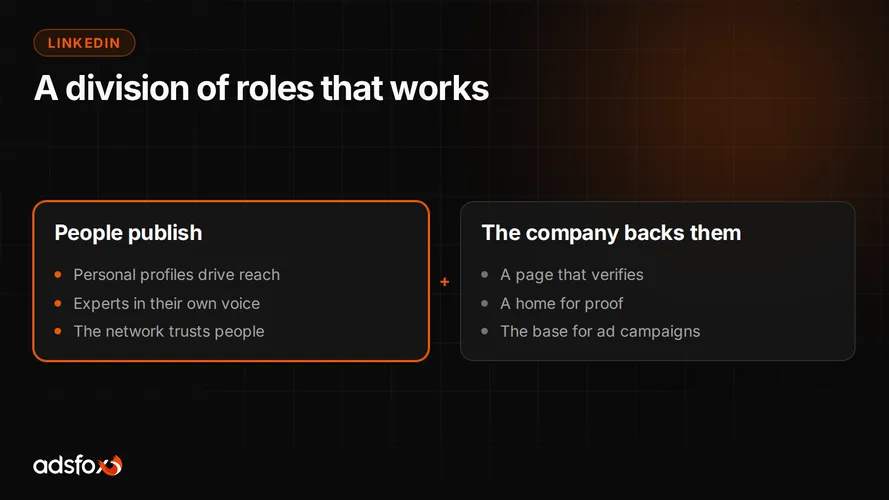
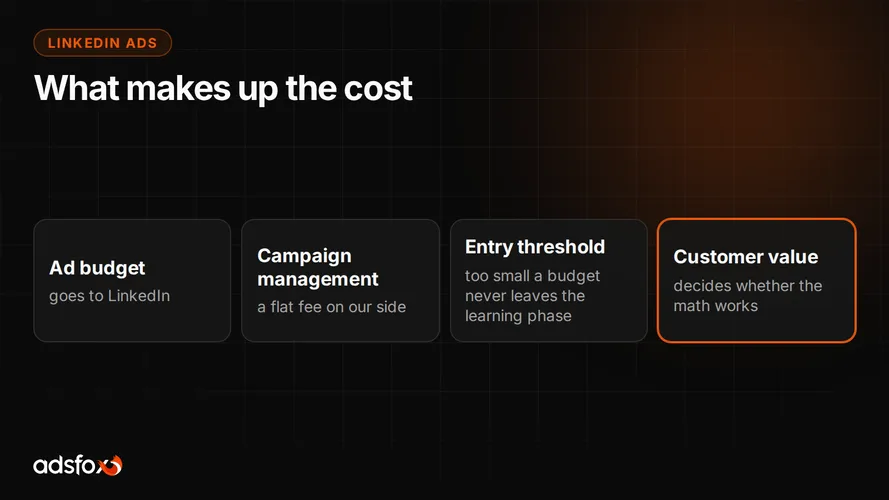
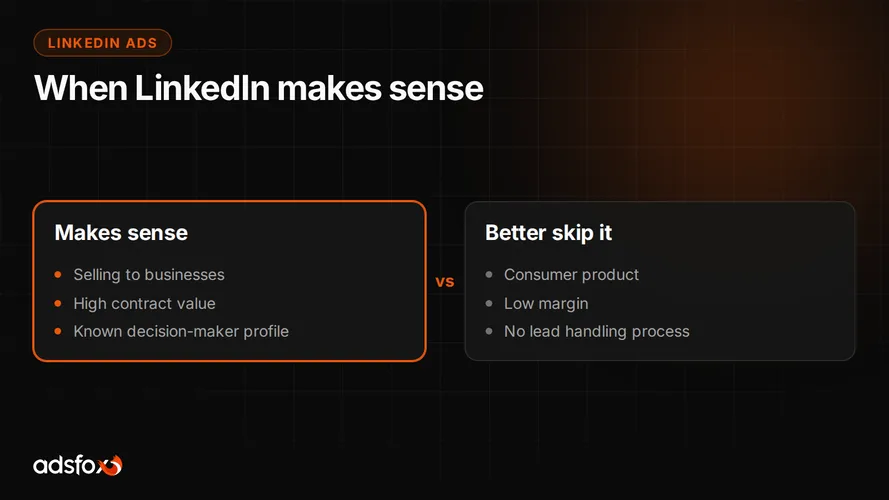
- LinkedIn. The only place where you target a message by job title, industry and company size. It works on two tracks: the company page and experts’ personal profiles build organic reach, while paid campaigns reach defined roles. We ran the numbers on when paid LinkedIn adds up and when it does not in are LinkedIn ads worth it.
- Referrals and proof. In B2B, references carry the most weight, because the risk of a wrong choice is high. Case studies with numbers and named testimonials are ammunition worth collecting systematically.
- AI answers. More and more often a decision maker asks a language model “which company for X do you recommend.” Showing up in those answers is separate work, which we describe under our AI SEO (GEO) service.
Channels that usually fail as a foundation in B2B: broad consumer reach and purely impulse formats. They can support, but they will not carry the whole thing.
Where to start when the budget is limited?
By narrowing, not expanding. The sequence that works for our clients:
- Define the decision maker and their questions. Who signs, who uses, who blocks? What questions do they ask at each stage? That list of questions is a ready-made content plan.
- Pick one main channel and do it properly. Usually: content plus search (when customers look for solutions) or LinkedIn (when the customer is a specific role you have to find). One channel with measurement beats five channels done halfway.
- Set up lead measurement from day one. In B2B leads vary in quality, so count not forms but leads qualified by a sales rep. We described how to connect this with campaigns in our post on CRM and campaigns.
- Add more channels once the first is saturated. The signal is rising cost per lead as you add budget, not boredom.
The most common B2B marketing mistakes
Talking about yourself instead of the customer’s problem. A website full of “we are the leader” loses to a website that answers the questions the customer actually types into a search engine.
Expecting a sale after the first contact. In B2B a campaign more often opens a conversation (material, webinar, consultation) than closes a deal. Measuring it by online-store standards ends in switching off activities that were just starting to work.
No patience for content. The effects of content and SEO compound over months. Companies that hold on build an asset; those that quit after a quarter pay for the warm-up without the game.
Scattering. A bit of trade shows, a bit of posts, a bit of ads, none of it measured. The sum: budget spent, conclusions none.
What does this look like with us?
We run B2B marketing from the side that can be measured: content and visibility where the customer searches, campaigns where you can reach precisely, and lead quality measurement connected to the CRM. Since 2018 we have walked this path with more than 350 clients across 20+ industries, so we know where B2B companies lose the most: almost always on measurement and scattering.
If you want to arrange your B2B marketing into a sensible sequence instead of a list of random activities, book a free consultation. We will go through your sales process and point to the channel that is actually worth starting with, and the one that is not, even if it is a service you would not buy from us.