How Much Do LinkedIn Ads Cost? Pricing, Models and Budget
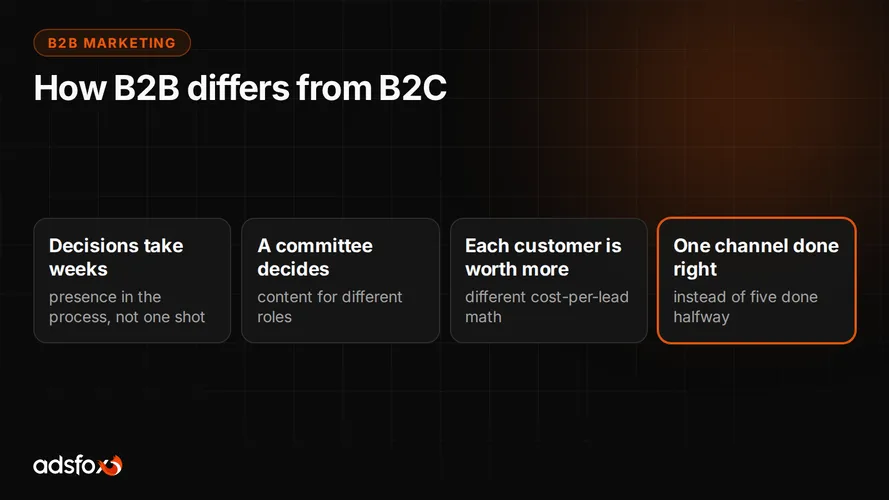
LinkedIn has no price list. You set a daily or lifetime budget, and the platform spends it in an auction across impressions to people you selected by job title, company or industry. So the question “how much do LinkedIn ads cost” only makes sense once you ask about cost per lead and cost per customer. A click on LinkedIn usually costs noticeably more than on any other social platform, and that is normal, because you are not buying reach, you are buying access to specific decision makers.
Below we break that bill into parts: what you pay for, why the click is so expensive, what starting budget makes sense, and when this channel simply does not add up.
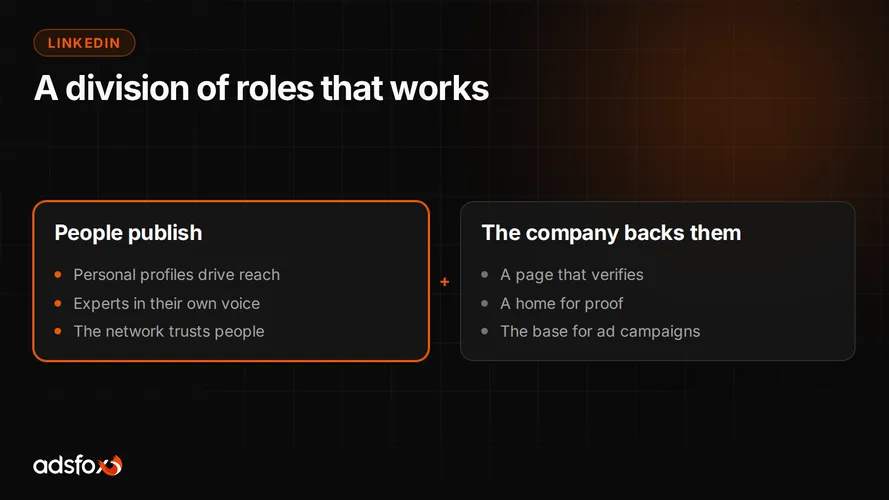
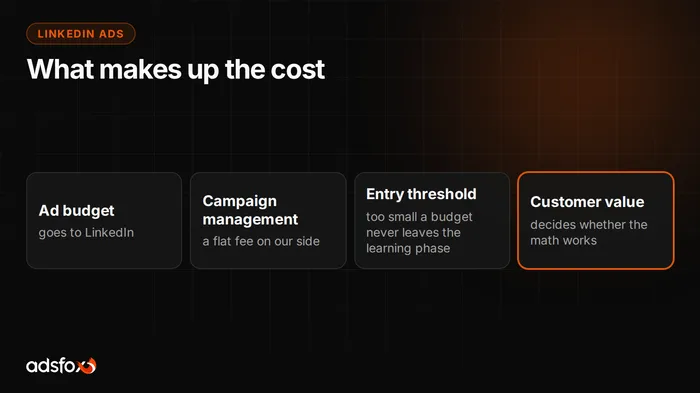
What makes up the cost of a LinkedIn campaign?
The bill has three layers, and most companies only look at the first one.
Media spend. The budget that goes through the auction. You set it per day or for the life of the campaign, and LinkedIn bids with it on your behalf.
Production cost. Images, video, copy, a landing page or a lead form. In B2B there is also the content you trade for contact details: a report, a calculator, a recording.
Management and measurement. Running the campaign, testing, correct conversion tracking, and handing leads to sales. Without this layer you usually cannot tell whether the campaign made money, because in B2B a lot of time passes between the click and the signed contract.
Advertisers usually compare only media spend, while the other two layers make the difference in results. A campaign with good material and working measurement produces a different outcome on the same budget than a campaign without them.
What exactly do you pay for in LinkedIn Ads?
LinkedIn bills under several models, and the choice depends on the campaign objective:
- CPC, cost per click. You pay when someone clicks the ad. The standard for driving traffic and collecting leads.
- CPM, cost per thousand impressions. You pay for reach. Makes sense when building awareness in a narrow professional group, or when the ad has a high click-through rate.
- Cost per send. In conversation formats you pay for delivering a message to the recipient’s inbox, whether or not they open it.
- Lead Gen Forms. Not a separate billing model, but they strongly change cost per result, because fields are prefilled from the profile and the user never leaves LinkedIn.
The final price is decided by the auction, not a rate card. The winner is not the ad that bids the most, but the one with the best combination of bid, predicted user response and material quality. The practical conclusion is the same as in other channels: an ad people actually click costs less for the same result.
Why is a LinkedIn click the most expensive in social media?
Several things add up at once.
You are buying work data, not interest data. Job title, company size, industry and seniority are information you will not find at this quality anywhere else. You pay for that precision in the auction.
A narrow audience means a small pool of impressions. If you target CFOs at manufacturing companies with more than a hundred employees, the number of possible impressions per day is limited. Less supply at the same demand means a higher price.
Less ad inventory per user. People open LinkedIn less often and for shorter sessions than Facebook or TikTok. Fewer feed views means fewer slots to sell.
Competition for the same people. Companies with high-value offers, often selling software or advisory services, bid for decision makers’ attention. Their break-even point is high, so they raise the bar for everyone.
A high cost per click is therefore not a flaw of the platform. It is the price of skipping the people who would never have bought anyway.
What starting budget makes sense for LinkedIn Ads?
LinkedIn enforces a minimum daily budget per campaign, and you will see the current amount in Campaign Manager when you set one up. That is only a technical threshold, not an answer to the question of a sensible budget.
The sensible minimum is set by the number of conversions, not the amount. A campaign optimized for leads goes through a learning phase: the system needs a certain number of events to recognize who responds to your offer. With too small a budget that number is never reached, so the campaign keeps guessing. The result is weak not because you spend little, but because the algorithm has nothing to learn from.
On LinkedIn this problem is sharper than elsewhere, because at a high cost per click, the budget needed for a few dozen conversions a month is simply bigger. The practical order looks like this:
- Calculate customer value. Average contract value times the probability of closing.
- Set a cost-per-lead ceiling at which the sale still makes sense.
- Check how many leads per month you need to hit the plan.
- Multiply and add a test period. The first weeks are for collecting data, not judging the campaign.
If the result of that calculation lands below the threshold at which the campaign can learn anything, it is better to postpone LinkedIn and start with a channel with a lower cost of entry.
How does cost per lead on LinkedIn compare with other channels?
The honest answer: we do not have our own verified cost-per-lead data for LinkedIn, so we will not quote a number here pretending to be a benchmark. What we do have are results from campaigns in other channels, and they show the scale of differences between industries well.
In our CPL and ROAS benchmark from 20 campaigns across 11 industries, cost per lead for service businesses ranged from about $2 in beauty to $8 to $11 for a law firm. The difference comes mostly from niche competitiveness and customer value. The same mechanism works on LinkedIn, only the starting point is higher.
That gives a practical rule for comparing channels: do not set cost per lead from LinkedIn against cost per lead from Google Ads or Facebook without checking how many of those contacts end in a sales conversation. A pricier lead that reaches a proposal half the time can be cheaper per customer than a cheap contact nobody picks up.
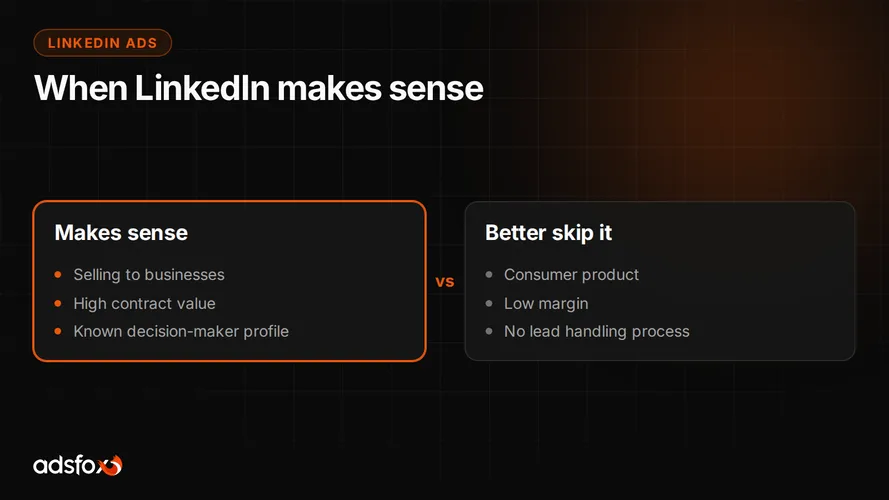
When do LinkedIn ads pay off, and when not?
The math works when one customer is worth enough to cover the cost of reaching a few dozen wrong people along the way.
LinkedIn usually works when you sell B2B, contract value is in the thousands of dollars or more, a specific role at the company makes the decision, and the sales cycle is long and multi-stage.
LinkedIn usually does not work when you sell to consumers, the value of a single transaction is low, the purchase is impulsive, or your customers look for a service only at the moment of urgent need. In that last case it makes more sense to start with search and only later test LinkedIn as a supporting channel. It also will not work as the only channel on a very small budget, because it will not leave the learning phase.
The condition in both cases is measurement. In B2B so much time passes between click and contract that without connecting campaigns to your CRM you cannot see which contacts actually turned into sales. A company that does not measure usually switches off a campaign that was making money, or keeps feeding one that only brings random inquiries.
How to check whether you are overpaying for LinkedIn ads?
Four things to verify in your own account:
- Is the campaign collecting enough conversions to leave the learning phase? If not, the problem is the budget or too narrow an audience, not the bid.
- Is the audience narrowed twice over? Stacking job title, industry, company size and seniority can shrink the pool to a level where every impression costs a fortune.
- Do leads reach sales, and what happens to them? The number of contacts without information about their quality says nothing about profitability.
- Do you have more than one creative in rotation? In narrow audiences an ad wears out faster, because the same people see it many times.
If you would like to go through this point by point on your account, that is what we do as part of our LinkedIn Ads management. We have been doing this since 2018 and have served more than 350 clients across 20+ industries, so the account structure alone usually shows whether the problem is the bid, the audience or the measurement.
What an agency charges for management: a specific number
At adsfox, campaign management for one channel starts from $490/month. With more channels the per-channel price is noticeably lower, because part of the work (measurement, analytics, learning your offer) is done once for the whole account. The price also depends on how much creative work we take on (whether we produce the creatives or you supply them) and on the size of the ad budget, because we take responsibility for spending it, and the bigger the money, the bigger the risk on our side. The full rules are laid out in our campaign management pricing.
What to remember about LinkedIn ad costs
There is no price list. You pay in an auction for access to specific decision makers, and that is why a click costs more here than on any other social platform. The math works with high customer value and B2B sales, and falls apart with low-ticket transactions and a budget too small for the campaign to learn. Instead of asking about the price of a click, calculate how much you can pay for a customer and check whether leads from this channel actually turn into proposals.
Book a free consultation. We will go through your campaigns, calculate the real cost per lead and tell you plainly whether LinkedIn is the right channel in your case.