Advertising Campaign Plan: Steps, Example and Template
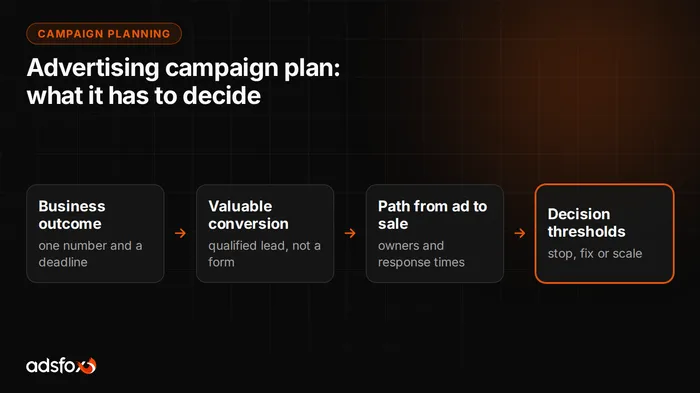
An advertising campaign plan is a document that connects a business goal with the offer, the audience, the channels, the budget, the measurement and the rules for making decisions. A good plan does not start with the question “Meta Ads or Google Ads?” It starts by settling what result should show up in sales, how we will recognize a valuable conversion, and what the business will do with the lead it acquires.
A breakdown of channels and formats is only a media plan. A full campaign plan has to state how the business will recognize a valuable lead, who will take over the contact, and how the sales result will feed back into evaluating the ads.
What is an advertising campaign plan?
An advertising campaign plan is an operational description of a specific promotional effort that sets out the goal, the audience, the offer, the message, the channels, the budget, the schedule, the metrics and the people responsible for execution. Its job is not to predict every result but to establish what we are testing, how we measure the effect, and when we make a decision.
In practice the plan should be specific enough that marketing, sales and leadership read it the same way. If marketing counts a form as a success, sales looks at booked calls, and leadership looks at revenue, the campaign has three different goals before it even starts.
A CoSchedule survey found that marketers who document their strategy were 414% more likely to report success, and those who plan proactively were 331% more likely to report success than the other respondents (source: CoSchedule, Trend Report on Marketing Strategy). That is a correlation, not a guarantee of results, but it illustrates the practical value of a plan well: the team has a shared reference point before spending starts.
Why should a campaign plan not start with picking a channel?
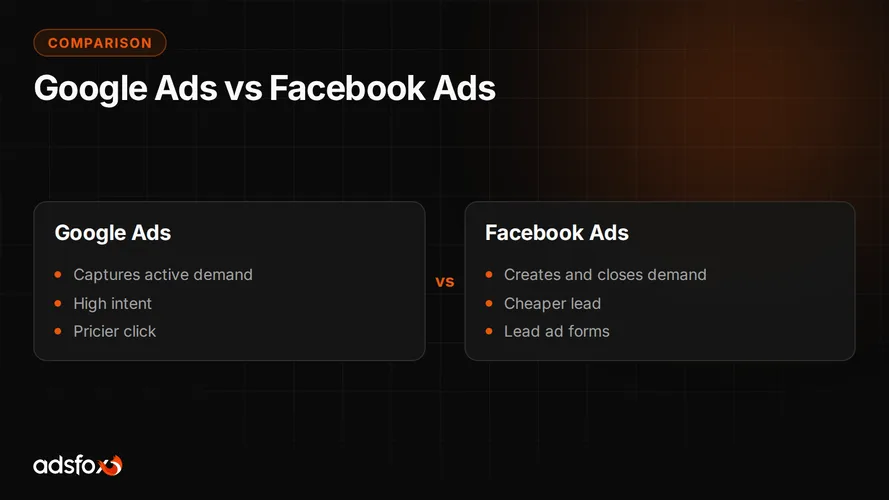
A channel is a distribution tool, not a strategy. Google Ads can capture existing demand, Meta Ads can build interest and reach the right groups, and retargeting can remind people about the offer. But no channel on its own decides whether the offer is attractive, whether the lead fits the business, and whether sales can handle it.
At adsfox we follow a rule that rarely shows up in ready-made templates: the campaign plan should start with what happens after the ad. So the starting point is answering these questions:
- what sale or valuable opportunity is supposed to come out of it,
- how we will recognize a good lead,
- how quickly the business will contact them,
- where the result of the conversation will be recorded,
- which data will come back to the team running the campaign.
Without this, the algorithm can efficiently increase the number of the easiest forms while the business needs fewer, better-matched customers. A document like that is a media plan, but not a full plan for winning sales.
What does data from adsfox campaigns show?
In one anonymized adsfox project for a beauty business, we compared two two-month periods of a Meta Ads campaign. Spend was about $3,220 in the first period and about $3,031 in the second (a European campaign, amounts converted to US dollars). Despite the lower budget, the number of qualified leads rose from 80 to 195, and the number of unqualified leads fell from 299 to 232.
The share of valuable contacts rose from 21.1% to 45.7%, while the average cost per form fell from about $8.50 to about $7.10. The most important change was not the lower CPL itself, though. It was connecting the campaign to lead classification in adsfox and passing lead quality information back to Meta. Full data and methodology are in our Meta Ads case study for medical aesthetics.
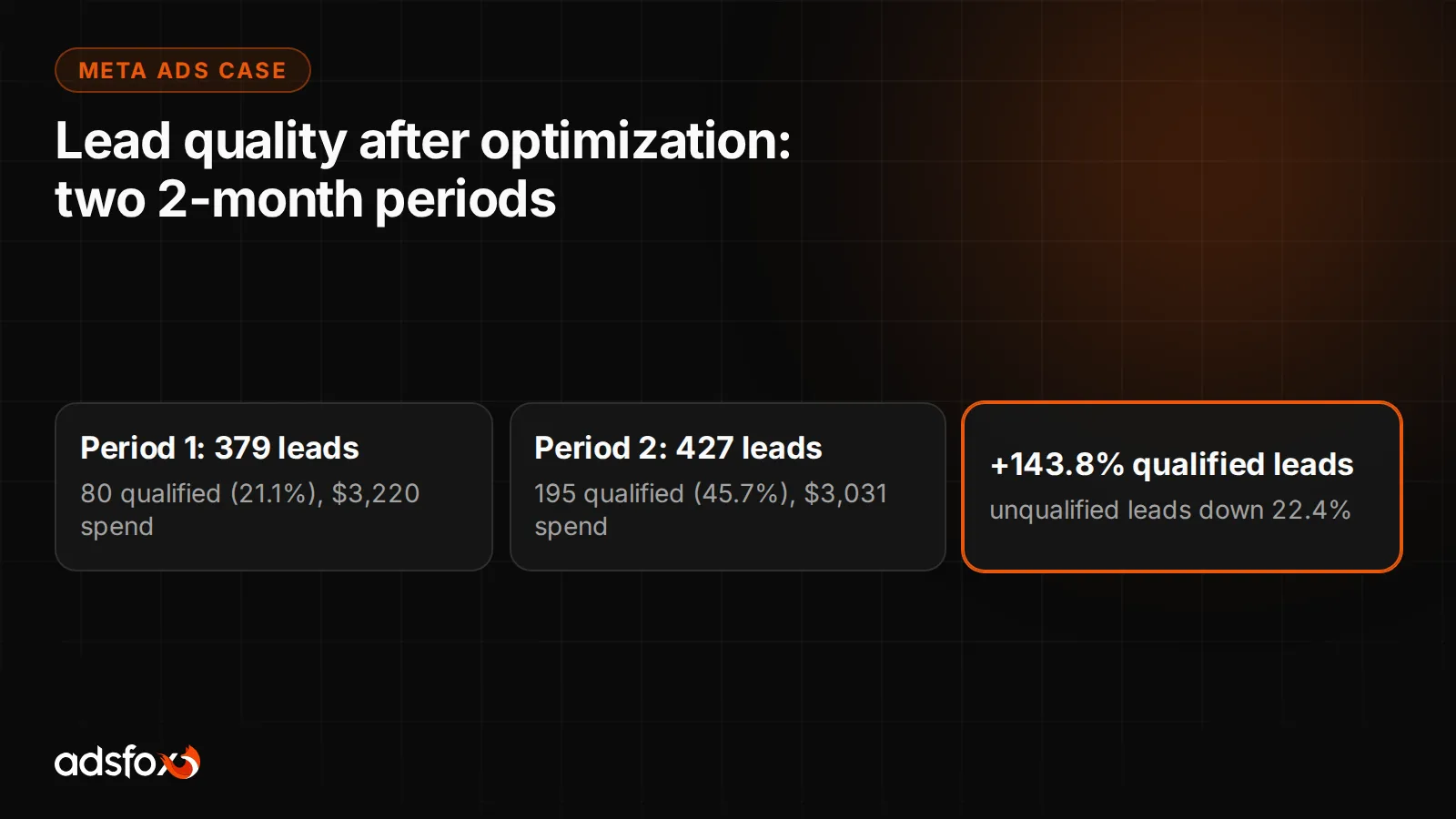
Takeaway for the campaign plan: if the document had covered only the number of forms and their cost, the biggest business change would have stayed invisible. That is why, before launch, it is worth defining a qualified lead, naming where its status is recorded, and settling who passes feedback to the campaign team and when.
How do you prepare an advertising campaign plan step by step?
An effective campaign plan can be built in eight steps. Each step should end with a decision you can write down in one or two sentences.
1. Define the business outcome
The goal “increase sales” is too vague. You have to settle what result, over what period, and for which part of the offer. It might be the number of new customers, the number of valuable sales opportunities, revenue from a specific service, or sales in a specific region.
Write down the starting point right away. Without it, after the campaign you will not know whether the result actually improved. If the business has no reliable history, the plan should call the first stage a pilot and use it to collect a benchmark for the next decisions.
2. Decide what counts as a valuable conversion
A click, a video view and a form submission can help with diagnosis, but they are rarely the final business result. In a lead generation campaign it is worth distinguishing at least: a new contact, a lead that meets the criteria, a booked call, a proposal, and a sale.
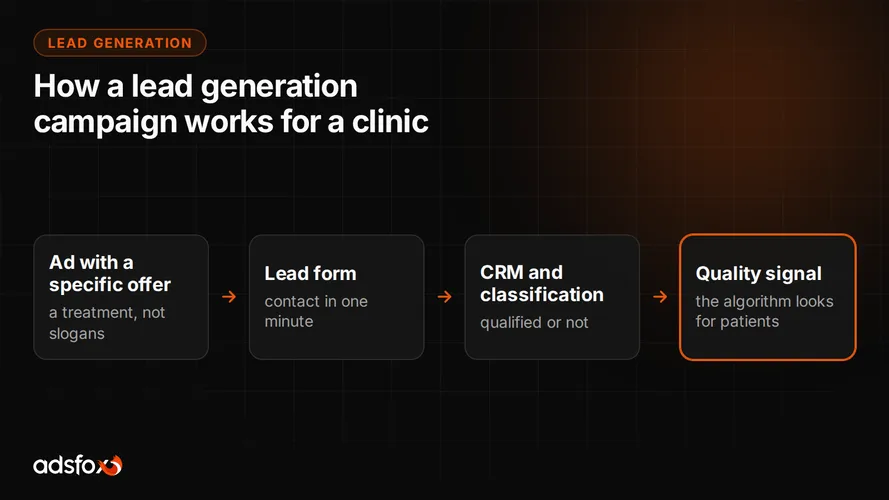
This definition has to be shared by marketing and sales. If the ad platform only receives information about the form, it will look for people inclined to fill out a form. If CRM data lets you flag valuable leads and sales, optimization can run on a better signal.
3. Describe the audience through the buying situation
Demographics alone are usually not enough. The plan should describe what triggers the need, what the customer has already tried, what worries them, who takes part in the decision, and what they need to see to move forward.
For a manager choosing an agency, what matters may be not only company size and industry but also the moment of change: rising acquisition costs, no data on lead quality, inconsistent reports, or the need to connect marketing with sales. A buying situation like that suggests both the message and the place to reach them.
4. Write down the offer and one main promise
A campaign should not promote the whole business at once. Pick a specific service, product or next step. Then write down one promise that answers the audience’s problem and is backed by the offer.
A good promise is not a slogan. It should explain what change will happen and why the customer can trust it. The proof can be a process, a demo, reviews, real client results, partner status, a work sample, or clear terms of engagement.
5. Map the path from ad to sale
The plan should show what happens after the click. The simplest path covers the ad, the page or form, inquiry confirmation, first contact, qualification, the conversation, the proposal and the sales outcome.
At each handoff, name the owner and the maximum response time. That way a drop in results is not automatically blamed on the campaign. The business can check whether the problem appeared in the message, on the page, in lead quality, in response time, or in closing the sale.
6. Assign roles to channels
Channels are chosen for the job. One can capture existing demand, another can build a need, a third can win back people who did not decide at first contact.
Listing platform names in the plan is not enough. You have to explain the role of each, the audience, the type of message, and the expected stage of the path. For a campaign spanning several platforms, also settle whether you judge results separately or by combined impact on sales.
7. Set the budget and a testing reserve
The budget should follow from the goal, customer value, historical conversion rates and an acceptable cost per acquisition. Where data is missing, adopt hypotheses, label them clearly, and state what it costs to verify them.
Do not split a limited budget across too many channels, audiences and creatives. Every variant needs data. It is better to test a few important hypotheses at the right scale than to launch dozens of ad sets, none of which collects enough material for a decision.
8. Write down the decision thresholds
The campaign plan should state what the team will do with a good, a weak and an ambiguous result. Thresholds can concern the cost of a valuable lead, the number of booked calls, the share of qualified leads, the cost of a sale, or the return on the campaign.
The minimum amount of data before an evaluation matters too. Turning an ad off after a few clicks or scaling after a single sale usually leads to decisions based on chance. The review date should follow from data volume and the length of the sales process.
A ready advertising campaign plan template
You can copy the template below into a working document. Its value is that it connects media to the rest of the process instead of ending with a list of ads.
| Plan element | Question to answer | Decision it should produce |
|---|---|---|
| Business goal | What result should appear, and by when? | one main number and a deadline |
| Starting point | What is the current result, and from what period? | a benchmark for comparison |
| Offer | What exactly are we promoting? | one offer or next step |
| Audience | In what situation does the need arise? | segment and buying moment |
| Promise | Why should the customer respond? | one main message |
| Proof | What backs up the promise? | case study, review, process or demo |
| Path | What happens from click to sale? | stages and owners |
| Main conversion | Which event means real value? | definition of success |
| Measurement | Where do we record source, quality and outcome? | ad platform, analytics and CRM |
| Channels | What role does each channel play? | capture demand, build demand or retarget |
| Budget | What does the test cost, and what cost is acceptable? | media budget and reserve |
| Creative | Which messaging hypotheses are we testing? | list of variants and formats |
| Schedule | When are the launch, reviews and decisions? | dates and minimum data |
| Decision thresholds | When do we stop, fix or scale? | clear operating rules |
If the team cannot fill in the rows on valuable conversion, path and measurement, it should not be deciding the budget split yet. That is a sign the business is trying to buy traffic before settling how it will recognize its value.
What does an example advertising campaign plan look like?
The example below is hypothetical. It shows a way of thinking, not a benchmark for every business.
A service business wants to increase the number of new contracts in one quarter. It sets a media budget of $30,000 and a test cost per lead of $250. The plan assumes 120 leads, of which 40% should meet the agreed criteria. Then 25% of the valuable leads should move to a conversation, and 25% of conversations should end in a sale. As a model that gives 48 valuable leads, 12 conversations and 3 sales.
The plan does not treat these numbers as a promise. They are a hypothesis to be verified against the company’s data. But they tell the team what to look for:
- if there are fewer leads than assumed, check traffic, offer and creative,
- if there are many leads but few meet the criteria, improve the promise and the qualification,
- if valuable leads do not move to a conversation, look at response time and the way of contact,
- if conversations do not end in sales, check the offer, the argument and the follow-up,
- if sales happen but the campaigns cannot see them, fix the measurement and data flow.
A model like this is more useful than a target CPL alone, because it shows at which stage to change course and who should do it.
How do you set the budget and the scaling criteria?
The budget should not be the only number in the plan. Next to the media amount, write down the cost of the test, the acceptable cost of a valuable lead or customer, and the conditions for scaling.
When setting the budget, account for:
- customer value and margin,
- historical cost per click, per lead and per sale,
- the share of leads meeting the criteria,
- the sales conversion rate,
- the delay between contact and revenue,
- the cost of preparing the page, the creative, the measurement and the handling.
Scaling makes sense when higher spend does not degrade the quality of acquired customers beyond an acceptable level. So the decision threshold should refer to sales or opportunity quality, not just the number of forms. If a business wants to run several channels as one system, PPC management should cover not only media buying but also consistent measurement and evaluation of the business result.
How do you measure the plan’s execution?
Measurement should mirror the structure of the plan. The ad platform shows delivery and attributed conversions, analytics shows on-site behavior, and the CRM shows contact quality and sales outcomes. Only combining these layers lets you judge the whole process.
The minimum set depends on the business model, but in a lead generation campaign it is worth tracking:
- spend and number of contacts,
- cost of a valuable lead,
- share of leads meeting the criteria,
- time to first response,
- number of booked calls or proposals,
- cost per customer acquired,
- revenue or sales value attributed to the source.
Tracking is not a technical add-on at the end of the plan. If the business does not record the source, quality and outcome of a lead, the team can end up optimizing the campaign for an event that produces no revenue. So the plan should include a measurement test before launch and an owner responsible for the data once the ads are running.
Who should own the plan and the schedule?
One person can own the document, but a campaign plan needs agreement between marketing, sales and the decision-maker on the business side. Each team brings different data: marketing knows the cost and audience behavior, sales judges quality and objections, and leadership defines the economic sense of the result.
A practical schedule covers:
- the preparation stage: goal, offer, measurement, materials and a technical test,
- a controlled launch: checking delivery, events and lead handling,
- a first diagnosis: assessing whether data is flowing in and whether the campaign reaches the right people,
- a quality review: data from the CRM and sales conversations,
- a decision: stop, adjust, keep testing or scale.
adsfox is a marketing agency for service businesses that connects campaigns, data and the sales process. When planning, we do not separate the cost of advertising from what happens to the lead after the inquiry, because that stage is what shows the real value of the campaign.
What mistakes most often break an advertising campaign plan?
The most common mistake is a document full of activities but with no decision rules. The team knows what to launch but not how to recognize success or when to change direction.
Watch out especially for:
- a goal written as reach, traffic or “more leads” with no definition of quality,
- picking a channel before understanding the buying situation,
- promoting several offers with one message,
- no owner for the stage after the form,
- measuring the form as the final sale,
- splitting a small budget across too many tests,
- changing many elements at once,
- judging the result before collecting the necessary data,
- no feedback from the CRM,
- scaling cheap leads without checking whether they buy.
A plan does not remove uncertainty. What it should do is make sure that once data shows up, the business can make a better decision instead of reacting with a random change to the budget or the creative.
An advertising campaign plan should lead to decisions
A good advertising campaign plan connects the business goal, the audience, the offer, the channels, the budget, the measurement and sales into one system. What matters most is not how many pages the document has, but whether it answers three questions: what should happen, how will we know, and what will we do with a given result.
Before launching a campaign, check in particular the definition of a valuable conversion, the path after the lead comes in, and the decision thresholds. These are what separate a plan for spending a budget from a plan for improving sales.
Book a free marketing consultation: we will analyze your goal, measurement and sales process before the budget starts working in a campaign.
Sources
- CoSchedule, Marketing Strategy Trend Report: data on reported success among marketers who document and plan their strategy.
- Google Ads, About campaign goals in Google Ads: the official description of the role of a campaign goal in ad setup.