AI Recommendations and Effective Online Advertising
Effective online advertising is no longer just about winning the click on Google, Meta or TikTok. More and more often, a customer first asks an AI tool, gets a recommendation, narrows the shortlist, and only then lands on your website, your ad or your contact form. For a business owner this means one thing: if you only measure the last click, you may be missing part of the impact marketing has on sales.
AI recommendations are suggestions generated by AI tools that help a user pick a product, a service or a company based on the content, reviews and data available online. In practice, part of the decision process moves out of the classic search engine and into a conversation with AI.
According to EMARKETER (July 1, 2026), nearly 1 in 5 consumers already buy after an AI recommendation without using a traditional search engine first. That is not a tech curiosity. It is a signal that the buying journey is becoming less linear, and reports based only on clicks may show an incomplete picture.
Why effective online advertising has to account for AI
Because the customer does not always start with an ad. Sometimes they start with a question: “which company is the best fit,” “which option should I choose,” “what will work in my situation.” If the answer comes from AI, the first round of selection happens before there is a session in Google Analytics, an ad click or an organic visit.
For a company with 10, 50 or 150 employees, this changes how you evaluate marketing. It is not enough to ask which campaign had the highest CTR. You have to ask whether your marketing builds signals that AI and customers can understand: a clear offer, credibility, reviews, expert content, specific advantages and consistent data about the company.
Our verdict at adsfox: this topic matters to you if you invest in ads, SEO or content and want to know what actually drives sales. A missing line in a report does not always mean missing impact. Sometimes it only means that your measurement system has not caught up with how customers behave.
What changes in the customer’s buying journey
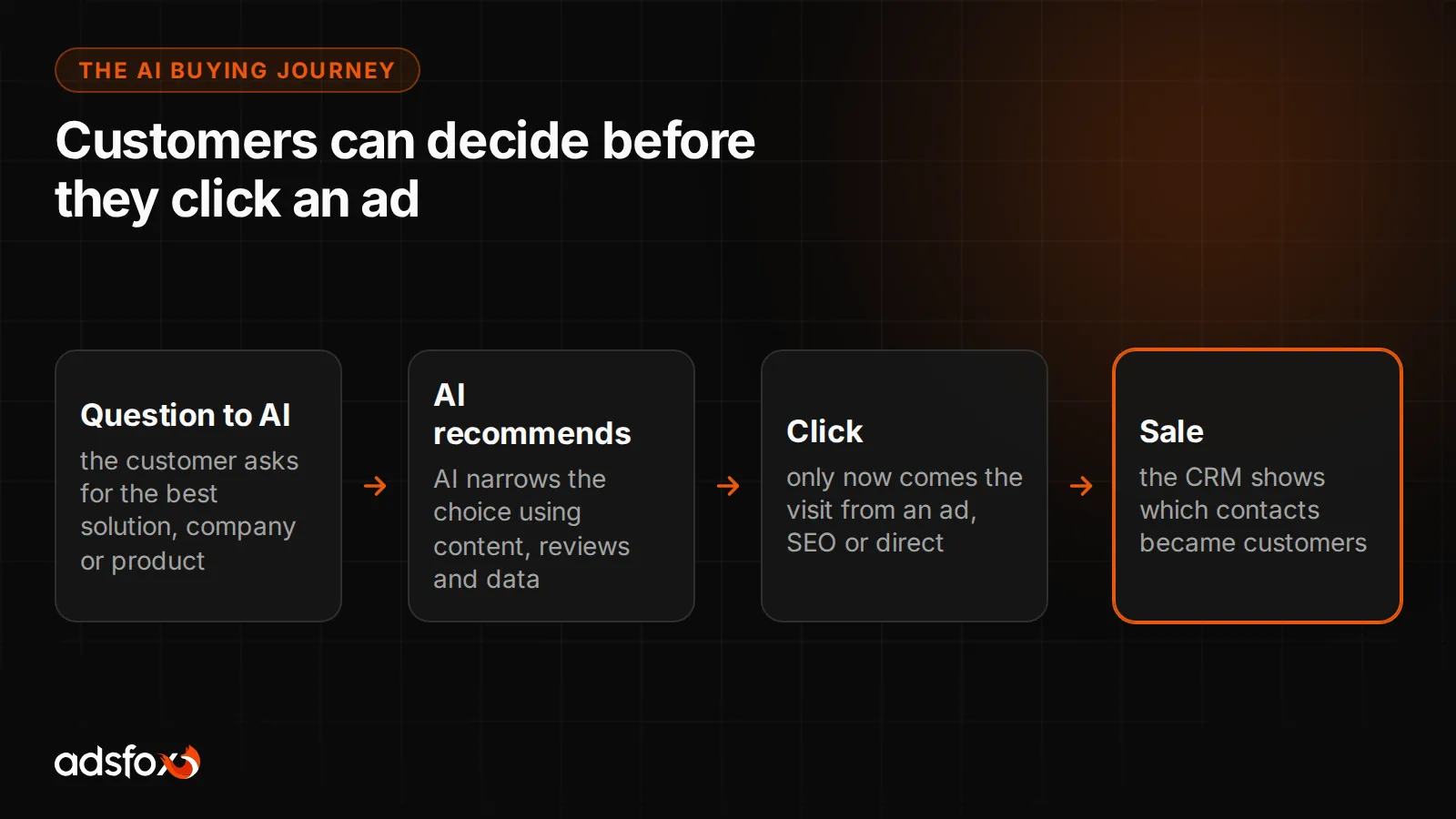
In the classic model, a business owner looked at a fairly simple sequence: ad, click, website, form, contact, sale. That model still exists, but it increasingly gets an earlier layer: an AI recommendation, a comparison of options, a sharper definition of the need, and only then a visit to a specific website.
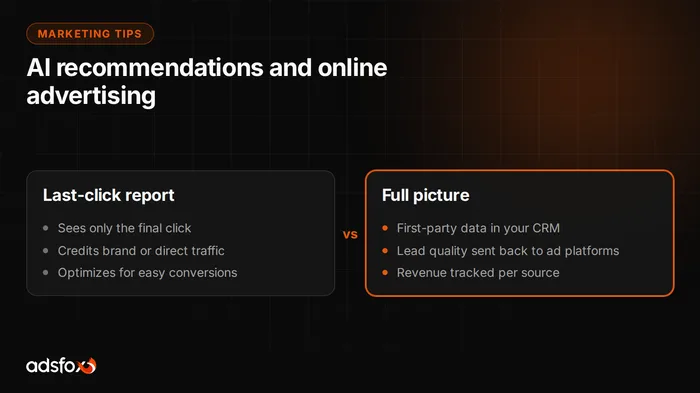
This creates a reporting problem. If a customer asked AI for recommended options, then typed your company name into Google and went straight to your site, the analytics tool may attribute the result to branded or direct traffic. The owner sees the sale but not the full path that led to it.
That is why effective online advertising depends more and more on the quality of first-party data. This is the data your company collects itself: inquiries, sales conversations, lead sources, CRM statuses, deal value, reasons for lost deals and your team’s response time. Without it, you can easily reach the wrong conclusion: “AI does not affect our marketing,” even though it affects buying decisions before the click.
Why Google Analytics alone may not be enough
Google Analytics shows a lot, but it will not show everything. If the path starts in a conversation with AI, in a messaging app, in a referral, on a comparison site or in the customer’s private research, a standard report may only catch the final fragment of the process. It is a bit like judging a salesperson only by the last email before the contract was signed.
In practice, a company can run into three problems. First, it does not know which content and arguments build trust before the contact. Second, it does not see which leads are the most valuable on the sales side. Third, the ad platforms get an incomplete signal, so they optimize campaigns for easy conversions rather than for customers who actually buy.
This is exactly where a CRM, server-side tracking and the Conversions API matter. When campaigns are connected to sales data, the company can analyze not only the number of form submissions but also the value of the leads it acquired and which activities actually lead to revenue.
If you want to check whether your measurement stops at the last click, see how server-side tracking works and why it is becoming the foundation for marketing decisions.
How should a business prepare its marketing for AI recommendations?
The first step is to clean up your offer and content. AI does not “invent” a company’s credibility out of nothing. It uses what it finds online: your website, service descriptions, reviews, articles, structured data, comparisons and the consistency of your message. If a company has a vague offer, scattered information and weak content, it is harder for it to become a natural recommendation.
The second step is better measurement. You have to connect marketing with sales instead of treating them as two separate worlds. Ads can deliver inquiries, but only the CRM shows which inquiries turned into a customer, an order, a booking or real revenue. Without that information, it is easy to scale campaigns that look good in the ad dashboard but do not make money for the business.
The third step is feeding data back to the ad platforms. If Meta, Google or TikTok only see “form submitted,” they learn to get more form submissions. If they see which leads are valuable, they can allocate budget better. That is the difference between marketing focused on volume and marketing focused on results.
What should a business owner check?
Start with a simple audit of questions. Do you know where your best customers really come from? Does your CRM show the status of every lead and the deal value? Are your campaigns optimized for a real outcome or just for the number of inquiries? Does your website content clearly show why a customer should pick your company? Does data from forms and sales flow back into the ad systems?
If the answer to most of these questions is “I don’t know,” the problem is not just AI. The problem is the lack of a complete data system. AI only accelerates a trend that was already visible: ads without good measurement optimize for signals that are too shallow.
At adsfox we look at marketing more broadly than through the ad dashboard alone. We connect performance marketing, CRM, analytics, automation and AI so that companies see not only the number of leads but also their quality and their impact on sales. As a Meta Business Partner and Google Partner we work inside the ad accounts, but we base decisions on business data, not on clicks alone.
Not sure whether your campaigns are optimized for the right signals? Book a free consultation. We will review your measurement, CRM and campaigns and show you where you are losing data and budget.
How to improve online ad performance in the age of AI
The most important shift is moving from “how many clicks did we get?” to “which activities lead to customers?” Clicks still matter, but they are only one stage. In the era of AI recommendations, the advantage goes to companies that can connect visibility, credibility, data and the sales process.
In practice, that means five actions. Clean up your offer so it is clear to customers and to AI systems. Create content that answers the real questions buyers ask. Collect first-party data in a CRM. Send valuable events to the ad platforms through server-side tracking and the Conversions API. Analyze campaigns through revenue, lead quality and customer acquisition cost, not just cost per click.
This is the direction effective marketing is heading. The point is not to chase every AI novelty. The point is to have a system that can measure marketing’s impact even when the customer’s path stops being simple.
Summary
AI recommendations do not mean the end of PPC, SEO or analytics. They mean that effective online advertising requires a tighter connection between data, content and sales. If nearly 1 in 5 consumers already buy after an AI recommendation, a business owner should not only ask “where did the click come from.” They should ask: “does my marketing give customers and algorithms a strong enough signal to choose us?”
Companies that keep looking only at the last click may undervalue part of the work that builds sales. Companies that connect ads, CRM, server-side tracking and sales data will make better decisions and see faster which activities actually make money.
Book a free consultation if you want to check whether your marketing campaigns are optimized for the right signals, not just for the visible clicks and form submissions.