Amusement Park Marketing: More Tickets and Online Bookings
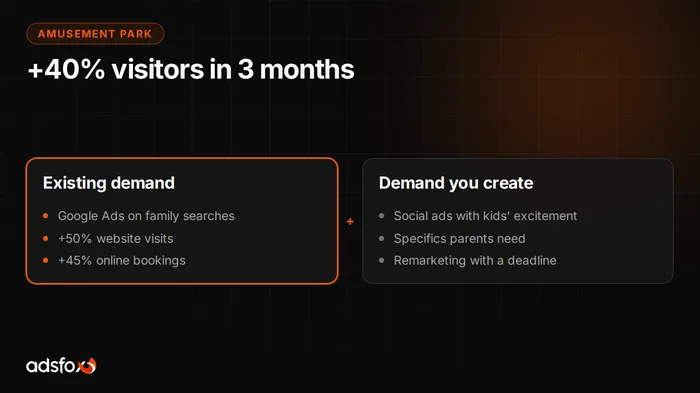
Amusement park marketing sells one thing: the idea of a great day out. Sometimes that idea already exists in a parent’s head as they type “amusement park for kids” into a search engine, and all you have to do is capture it. Sometimes you have to plant it first. In our case study, working on both fronts produced a 40% increase in visitors and a 35% increase in ticket revenue in three months, with online bookings up 45%. This post shows how those numbers came about.
The source is our amusement park advertising case study.
Two engines of attendance: existing demand and created demand
In family entertainment, demand has two natures, and each needs a different tool.
Existing demand is families who are already planning an outing and comparing options. In our project, Google Ads campaigns on searches like “amusement park for kids” and “family attractions” captured it. The result of this part: website visits up 50% and online bookings up 45%. This is the cheapest attendance you can buy, because the intent is already there; you only have to win the moment of choice.
Created demand is families who are not thinking about a trip yet. This is where social media works: showing the attractions, the kids’ excitement, seasonal events. This part works more slowly, but it expands the market instead of just dividing the existing one.
The sum of both engines after three months: attendance up 40% and ticket revenue up 35%.
Why is online booking the axis of the whole system?
A park without online ticket sales advertises blind: it does not know which campaign brought the family to the gate. Online booking changes everything. It is a measurable event that can be attributed to a campaign, a creative, and a search term. In our project, the 45% increase in bookings was the hard proof that the campaigns were working, before attendance was even counted.
The practical tracking minimum for an attraction: a ticket purchase event with a value, a booking-started event, and phone calls. On that basis, the budget is split between campaigns by cost per ticket sold, not by impressions.
Seasonality: how to plan campaigns for a park
The business lives by the season, the weather, and the school calendar, so campaigns are planned in that rhythm:
- Before the season, you build the base: website traffic, followers, a remarketing audience. Clicks are cheapest then.
- During the season, capturing demand and closing bookings dominates; bids go up, but intent is hottest.
- Off season, special events (birthdays, groups, holidays) smooth out revenue.
Data from each season lowers the startup cost of the next: the system already knows the audience, and remarketing has someone to return to. That is why we evaluate these projects by season, not by week; we calculated the full results of this case study after three months.
What does attendance from ads cost: how to calculate it
- Cost per ticket sold per campaign, calculated from online bookings with a value.
- Ticket revenue against ad spend, over the horizon of a season; for us, +35% revenue in a three-month evaluation window.
- Family value beyond a single ticket: food, souvenirs, return visits. The ticket is often the beginning of the bill, not the whole of it.
We collected benchmarks from other industries in our benchmark of 20 campaigns in 11 industries; campaign management at adsfox starts from $490 a month per channel.
What works in creatives for family attractions?
A child’s excitement sells better than a list of attractions: a shot of pure joy on a slide does more than a rundown of rides. Add the specifics a parent needs to decide: hours, prices, directions, what the ticket includes, what happens in bad weather. In remarketing, closing with a deadline works: weekend availability, a seasonal event, the benefit of booking online.
Video has a natural advantage here, and it belongs in Meta campaigns; for younger parents, it is also worth testing on TikTok. The search side of the system is run by Google Ads campaigns.
Where to start at your venue
- Launch online ticket sales or bookings with a tracked purchase.
- Set up demand capture in search; for us, it produced +50% visits and +45% bookings.
- Add social with emotion and specifics for parents.
- Evaluate by season and carry data from one season to the next.
Want to plan a system like this for your venue? Book a free consultation: we will go through your season, ticket prices, and capacity, and map out campaigns for attendance you can actually handle.